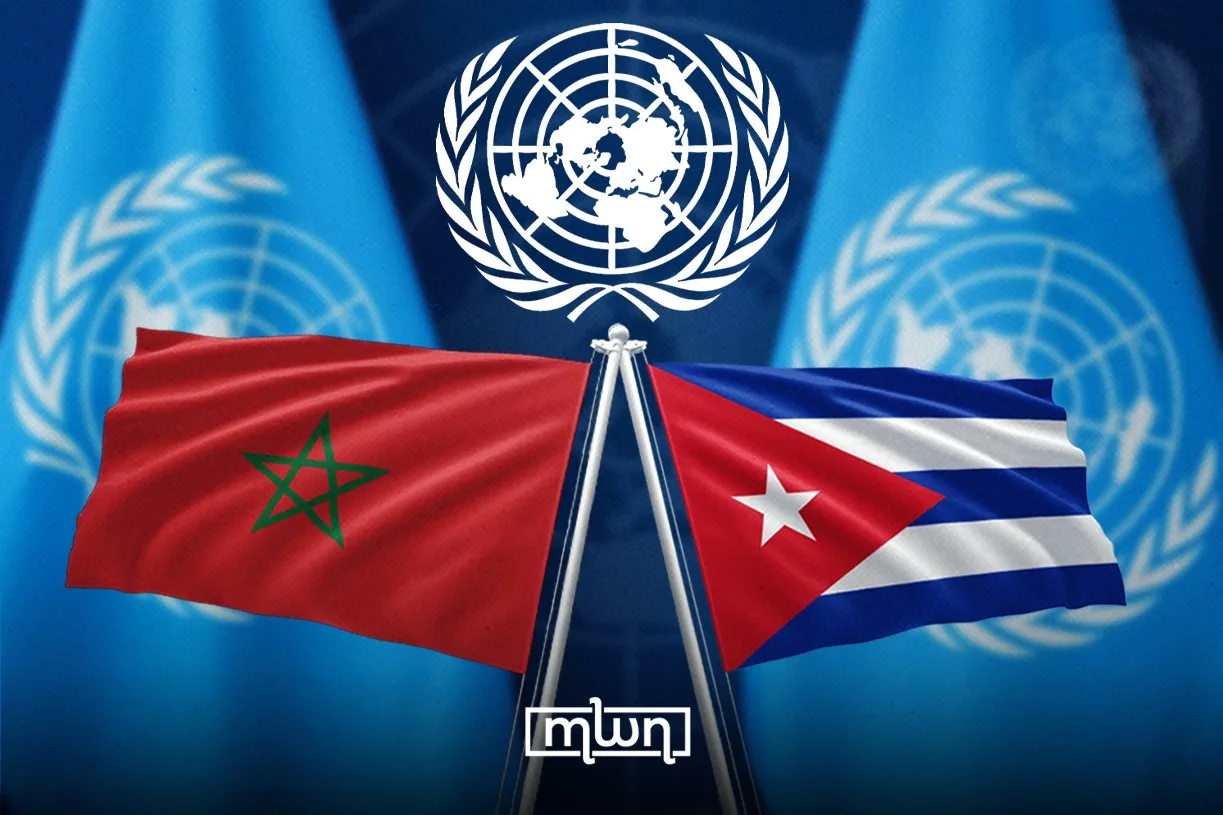
Rabat – Morocco has voted against reopening a UN General Assembly debate on lifting the US economic embargo on Cuba.
Eight other countries voted against the debate, including the US, Argentina, Costa Rica, North Macedonia, Paraguay, the Czech Republic, Ukraine, and Israel.
The vote also recorded 30 abstentions, while 136 countries voted in favor.
The US objected to reopening the debate, emphasizing, according to the UN, that “the matter had already been concluded on October 25, 2025.” It argued that another discussion “would not contribute to humanitarian assistance, human rights, or support for the Cuban people.”
Cuba sees the decades-long US embargo as a “multidimensional unconventional war.”
Cuban Foreign Minister Bruno Eduardo Rodríguez Parrilla said the embargo includes an energy blockade and alleged military threats, arguing that such measures are intended to create a humanitarian crisis and destabilize Cuba.
While the US emphasized that the sanctions only target the Cuban government, Parrilla claimed that the embargo caused a record $80 billion in economic damage in one year.
The US, however, argued that t Cuba’s government has effectively imposed the real embargo on its own people.
“People speak a lot today about an embargo. And indeed there is one. It is the embargo that the Cuban regime has relentlessly imposed on its own people, decade after decade,” the US representative said.
The US describes the embargo as a “comprehensive economic measure,” proclaimed by former President John F. Kennedy in February 1962.
The embargo covers trade between the US and Cuba in response to Cuban government policies and actions, with the Cuban Missile Crisis accelerating tensions.
Why Morocco voted against
Cuba and Morocco have maintained turbulent ties for years, with recent reports stating that the two countries are seeking to expand political dialogue after years of frozen relations.
Cuba has supported the Polisario Front, a separatist group challenging Morocco’s territorial integrity with the backing of Algeria’s regime.
In 1980, Morocco severed ties with Cuba after the country recognized the self-styled SADR.
While ties have steadily improved since the two countries formally restored diplomatic relations in April 2017, Cuba historically continues to maintain a hostile political position on the Western Sahara dispute, opposing Morocco’s territorial integrity.
Cuba’s delegate clearly conveyed the country’s support for the Polisario during the UN Fourth Committee (C-24) in June.
“We advocate for a just, lasting, and mutually acceptable political solution that will lead to the self-determination of the people of Western Sahara,” Cuba’s delegate said.
The spokesperson also rejected “any unilateral decisions – including the proposal for ‘autonomy without sovereignty.’”
The delegate also expressed Cuba’s solidarity with the “Sahrawi people,” reaffirming Havana’s support despite its own struggles under the United States’ longstanding economic blockade.
This comes amid Morocco’s growing diplomatic momentum, as 130 countries now view the Autonomy Plan as the only or the most serious and credible pathway to ending the dispute over Western Sahara. The UN has also backed that momentum through Resolution 2797, which describes the autonomy initiative as a genuine political solution to the dispute.