


































































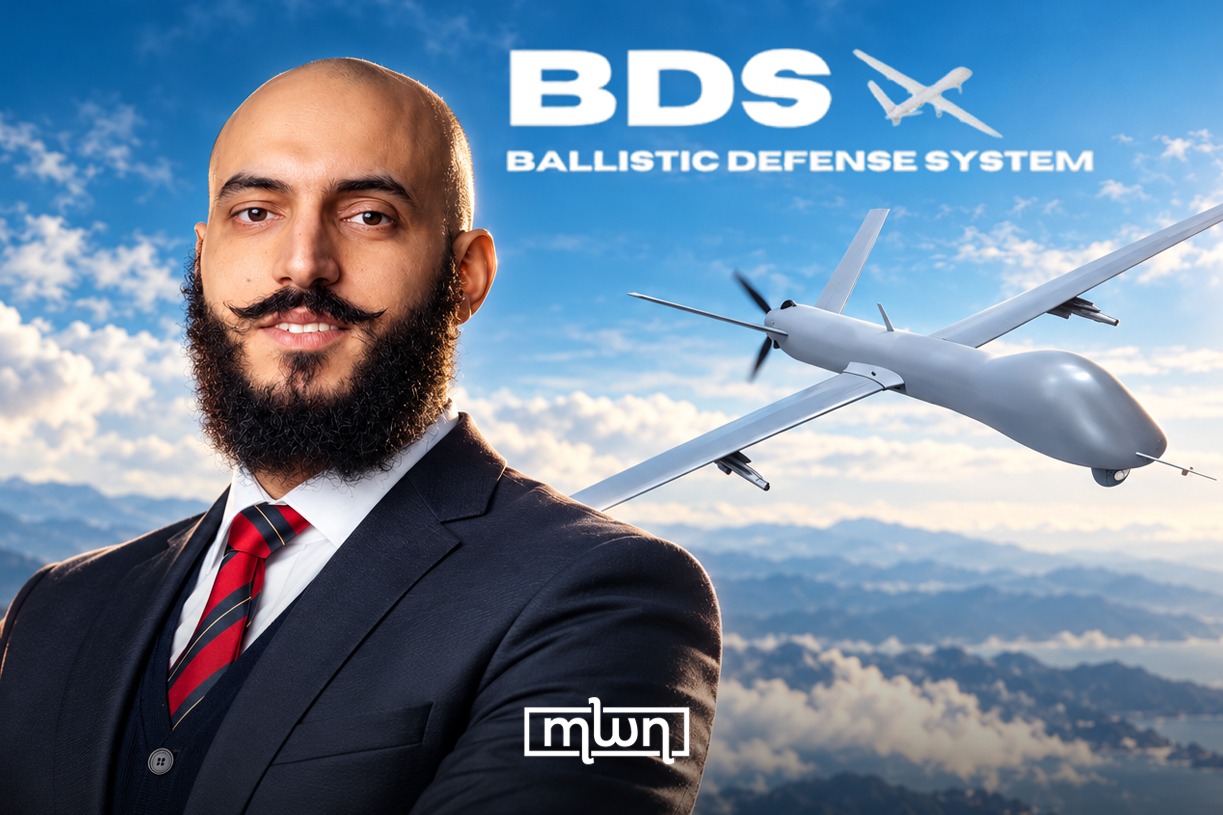
Marrakech – Moroccan defense startup Ballistic Defense System (BDS) has completed the first version of an autonomous drone prototype that navigates without GPS. Co-founder and Managing Director Fahd Laamoumi announced the milestone on LinkedIn on Monday, sharing a demonstration video as part of the announcement.
In the video, the drone reportedly recognized and guided itself toward a decoy representing an HQ-9 air-defense launcher. The test combined autonomous detection and recognition with GPS-free guidance. It formed part of a wider campaign over different terrain and lighting conditions, including night flights with a thermal camera.
Founded in Rabat in December 2023, BDS develops autonomous flying robots rather than remote-controlled drones. Laamoumi previously worked as an aerospace engineer at NASA’s Ames Research Center, as a consultant at McKinsey & Company, and as a field engineer with Schlumberger in Saudi Arabia. He holds an aerospace propulsion engineering degree from France’s ISAE-SUPAERO.
The project addresses a specific weakness in modern military systems: dependence on satellite signals. These signals are now routinely jammed or spoofed, leaving most drones and guided systems unable to navigate.
The BDS drone works around this problem by reading the terrain beneath it. Onboard cameras and standard sensors observe the ground, and the system compares that data with a free worldwide digital elevation map to compute its position in real time. All processing runs onboard, on a computer the size of a hand.
Once the drone reaches its objective area, a second AI agent searches for the target. A third agent then takes over for the final, high-precision approach.
The video presentation of the project describes the system as a kamikaze drone that performs six stages on its own: take-off, GPS-free flight, target search, detection and identification, approach trajectory calculation, and a final dive to strike within one meter. The same presentation states the company’s mission as designing high-tech weapons at low cost.
Five Moroccan engineers worked on the project for three years using their own funds. According to the announcement, the prototype itself took under 18 months and less than MAD 11.5 million ($1.15 million) to develop. The company states the drone is designed for production at scale, at a fraction of the cost of comparable systems.
From test drone to operational airframe
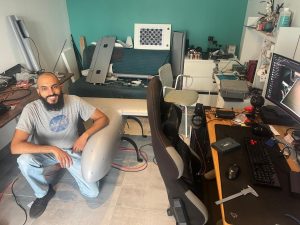
So far, the navigation system has been validated on a 17 kg test drone. The team has flown about 800 km over land and water, by day and by night, with every calculation running onboard. The flights shown in the video took place in Chimay, Belgium, in the last week of August.
The 2,000 km range cited in the announcement, however, is a design specification. It has not yet been demonstrated in a single flight.
Laamoumi told Morocco World News (MWN) that “the hardest part is behind us,” since the onboard system is finalized. “What remains is mostly aeronautical engineering, which is well understood, even if it takes time and resources,” he explained.
The next step is an operational airframe of about 250 kg, designed for a 2,000 km range and a 50 kg payload. Its design work is largely complete, and manufacturing comes next.
But runway access remains the main bottleneck. An aircraft of that size requires a proper take-off and landing strip, and BDS is still awaiting a response from the Royal Armed Forces (FAR).
After that, the company plans progressive flight testing, payload and communications integration, and environmental qualification in heat, dust and wind. A live demonstration in a GPS-jammed environment and an evaluation by the end user would follow before pilot production. “With the right funding and access to test infrastructure, we believe the operational version can be demonstrated in 2027,” Laamoumi stated.
He also welcomed independent verification. “In defense, claims mean nothing without proof,” he told MWN. His preferred route is evaluation by the FAR or a test center they designate. BDS is also open to a confidential technical review with full access to flight data, followed by a public summary stripped of sensitive details. He described the approach as “transparency on results, discretion on methods.”
On human control, Laamoumi’s principle is that “autonomy serves human decisions; it does not replace them.” A human operator within the military chain of command authorizes every mission, including target type, area, and time window. If the system cannot confirm the designated target with sufficient confidence, “it must not engage.”
The drone also carries a radio or satellite data link. While the link is active, an operator can retake control, redirect the drone, or abort the mission. If the link is jammed, the drone completes its mission within parameters set before launch. Accountability, Laamoumi noted, rests with the authorizing military authority under international humanitarian law.
“We believe that responsible autonomy is not only an ethical requirement. It is also what makes a system trustworthy and usable for a professional army,” he summed up.
Sovereignty beyond technology transfer
BDS has held two working meetings with the National Defense Administration and one with the FAR. It has requested access to a military runway and proposed a live demonstration. The Ministry of Industry has supported the company through the Innovation Support Fund, and Minister Ryad Mezzour has received the team three times.
Laamoumi acknowledged the steps Morocco has taken under King Mohammed VI’s vision for a national defense industry, including Law 10-20. Yet he argued the law was built for a foreign company opening a production unit for a product whose design is already frozen. It does not cover a Moroccan company developing its own prototype from scratch.
BDS experienced this directly. Its application to the National Armament Commission for a manufacturing authorization was not approved because the design is still evolving. “No product in history has been created in a single iteration,” Laamoumi told MWN.
As a result, defense R&D has no clear legal status in Morocco. “Without a clear framework, the administration naturally hesitates, and projects cannot move forward,” he explained.
Laamoumi also questioned reliance on foreign production. Hosting a foreign production unit beats importing finished weapons, he noted, but Morocco still pays for R&D carried out abroad, and the intellectual property stays abroad. Foreign firms transfer knowledge that is “useful but not critical,” so “genuine sovereignty cannot rely on technology transfer alone.”
He proposed four measures: a legal status for defense R&D and prototyping to complement Law 10-20; a single entry point linking the armed forces with startups, modeled on the US Defense Innovation Unit, the UK’s DASA and France’s Agence de l’innovation de défense; designated flight test zones with clear safety rules; and procurement tools suited to startups, such as small R&D contracts, evaluation contracts and pilot orders.
The absence of a testing framework explains why BDS currently flies in Europe. “Without flight testing, there is no innovation in aeronautics,” Laamoumi stated.
He believes that Morocco’s next step is to build a much tighter bridge between the armed forces and domestic defense innovators. Countries with advanced defense industries have institutionalized that relationship, he argued, noting that promising technology cannot mature into deployable capability without access to real flight-testing environments.
For BDS, sovereignty does not mean “making every screw in Morocco. No country in the world does that, not even the largest powers.” It means controlling the algorithms, software, AI models, data, and system integration, all developed in-house with zero outsourcing. It also means avoiding dependence on any single foreign supplier.
To that end, BDS deliberately uses commercial, off-the-shelf civilian components that are interchangeable and available from multiple sources. The company buys them directly from manufacturers, which also keeps costs low, and fully inspects every batch before integration. A country, Laamoumi argued, is sovereign over a system when it can “design it, produce it, repair it, and upgrade it without asking permission from anyone.”
Over time, BDS plans to bring electronics, communication links, mission payloads, and composite airframe structures in-house. It also aims to produce propulsion, including small engines and turbojets, which rank among the world’s most export-controlled components.
The ambition is to establish a fully integrated, end-to-end Moroccan industrial base, covering development, assembly, production, maintenance, and customer support, while building local expertise through the training of engineers and technical staff, with the planned facility backed by a funding round and an initial contract.
BDS says it works with retired FAR veterans and privately funds its R&D to deliver ready-to-use products. Asked whether the company sees itself as a supplier to the FAR or a future exporter, Laamoumi replied, “Both, in that order.” Its first priority remains the Moroccan military.
In the long term, he argued, a defense company can only stay at the cutting edge if it reaches sufficient scale. “Exports finance R&D, lower unit costs and keep teams at the highest level,” he explained. Any sales to partner countries would remain “within the framework and with the approval of the Moroccan authorities.” In his view, “a successful export champion also strengthens the sovereignty of its home country.”
Laamoumi sees a real opportunity for Morocco over the coming decade. The drone revolution has lowered the barriers to entry, since software, artificial intelligence and affordable production now matter most, he noted. “These are areas where talent counts more than legacy.”
The BDS CEO pointed to four Moroccan assets: qualified engineers, many trained at some of the world’s top universities; an aerospace manufacturing ecosystem already proven with major international groups; political stability, strategic direction from the highest level of the State and a legal framework for the defense industry; and a geographic position linking Europe, Africa and the Middle East.
“Realistically, Morocco will not compete with the United States or China on every front, and it does not need to,” he acknowledged.
Instead, he sees the North African country competing in specific niches: affordable autonomous systems, GPS-free navigation, drones adapted to demanding environments, and maintenance and support for partners in Africa and beyond.
“Artificial intelligence is changing warfare as profoundly as gunpowder once did,” he stated. “Countries that seize this moment will count in the decades ahead. Morocco has the talent to be one of them, and we intend to contribute to that, one flight at a time.”
Read also: Report: Morocco Eyes Defense Autonomy Through Local Production