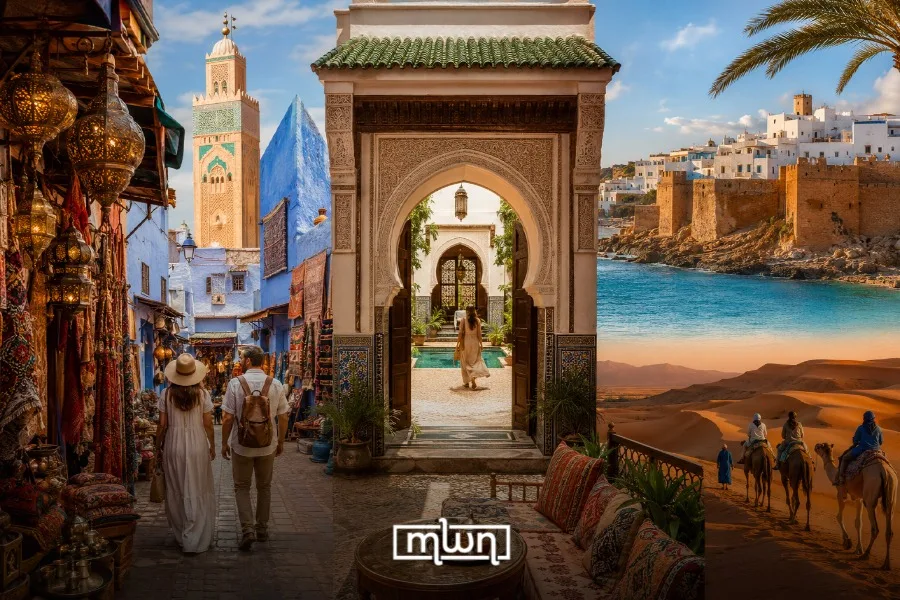
Like many, I travel to learn about more of the world, challenge myself, and understand alternative ways of life that have developed in specific contexts. I spend money in local economies to stay in a new place, eat local food, explore the natural environment, and visit communities with distinct traditions and worldviews. Part of this exchange engages with the illusion that I can observe a place without shaping it, or that my decision to pay for one more “authentic” experience over another can prevent cultural erasure. The relationship between tourism and cultural preservation, however, is rarely straightforward.
Tensions between cultural preservation and commercialization
Discussions can focus on whether tourism makes culture more commercialized, but it also raises the question of who decides how culture is shared, or where sharing culture should fall in community priorities. Cultural traditions are not static artifacts that should be preserved for visitors, and yet they attract streams of income that can support the health and growth of development-engaged communities.
The cultural preservation effort often manifests in distinct heritage sites, which attract international attention and investment, but also involve a tension between preservation and commercialization. One site I’ve been able to visit is the ksar of Aït Ben Haddou, designated a UNESCO World Heritage Site in 1987 for being one of the best examples of old southern Moroccan architecture. It has also become a sought-after filming location for major international productions, boosting visitor traffic. International recognition can bring investment, conservation funding, and global visibility. But, who determines acceptable commercial use of the space? Who receives economic benefits? How are local residents involved in decisions that affect the places where they live?
Viewing development through the lens of agency also changes how cultural preservation fits into community priorities. A 2022 report on the COVID-19 effects on the status and inhabitants of Aït Ben Haddou identifies how a local economy overly dependent on tourism saw an outmigration of people seeking other jobs and a negative psychological impact on those that remained. The report also notes that the economic benefits from tourism disproportionately neglect community-serving needs, describing how “inadequate infrastructure and lack of other public facilities, such as hospitals and schools, are considered major problems in the village.”
At the same time, participants (residents) in the study articulated that “tourism was beneficial to their community compared to its negative impacts.” A restored historic site means little if surrounding communities lack reliable water, education, or economic opportunity. However, heritage can also create the tourism revenue needed to support those essential resources. Tourism will continue shaping rural economies across Morocco, and while participatory approaches do not guarantee that community-serving objectives are made absolute priorities, self-determination provides stronger protection against external agendas superseding local ones.
International institutions have increasingly recognized the strength of the participatory model. In 2000, UNESCO launched the Community Management of Protected Areas Conservation (COMPACT) initiative, which prioritizes local stewardship and agency, “as well as the critical importance of the empowerment of women’s organizations.” This methodology has demonstrated effectiveness in preserving biodiversity and strengthening local livelihoods. These are practices that I have witnessed applied in rural Moroccan contexts. At community mapping workshops, residents old and young all participate in discussing their biggest priorities with our development organization.
There are commonalities across these towns, such as a cell tower or funding for water storage basins, but there are also context-specific needs like the school in one village experiencing flooding, or prioritizing the maintenance of spiritually significant sites; i.e., universal solutions are not sufficient. At the villages in which we have talked with members of women’s cooperatives, they have articulated the pride they have in producing things of their own and the empowerment they feel in generating income for themselves. Many of the towns we visited identify agriculture and cooperative enterprises as their main sources of external income, though these can be unsustaining due to periodic external or environmental factors. Some farmers are ultimately pressured to cede their land to “tourism investors.”
Institutions should reinforce community agency rather than substitute for it
Say that independent tourist companies instead were facilitating the biggest share of income streams. This possibility occurred to me at the women’s cooperative in Talat-n-Mimoun. A community business whose income depends largely on potentially erratic visitors has limited bargaining power; they may feel pressure to accept unfavorable prices because losing a small number of customers carries significant consequences, or be less able to regulate tourist traffic, less able to negotiate collectively with private businesses, and less able to build alliances with neighboring communities around shared priorities. Tourism still generates income, but income alone does not create resilient local economies.
One participatory development methodology views the strongest macro-level growth as the federation of local successes. A federation goes beyond an “agglomeration” to describe a system in which its components are not only independently strong, but are also able to share resources, leverage policy influence together, and teach each other practical knowledge. Economic integration should not be measured solely by increased visitor numbers or higher incomes, but also by whether communities retain the capacity to influence development over time. Participation is an ongoing ability to shape priorities, negotiate those partnerships, and adapt development strategies as local needs evolve. Development processes that remain open to continuous community input are more likely to produce outcomes that are both equitable and sustainable.
This is not to erase the role of external institutions. These can alleviate the logistical and financial burdens of preserving cultural heritage while communities themselves focus on more immediate priorities. Funding to support the continued preservation of the ksar, whose heritage is a powerful development asset, has been allocated by UNESCO in the past in non-recurring installments up to $30,000 USD. UNESCO has also administered monitoring reports and made recommendations to management structures for the site.
In particular, the COMPACT initiative illustrates how international organizations can strengthen local agency by embedding participatory governance into conservation and development programs while connecting communities to long-term sources of funding. Rather than directing development from above, the program supports locally governed projects and has helped participating communities secure continued investment. At Mount Kenya, for example, Indigenous foundations participating in COMPACT attracted approximately US$35 million from donors, demonstrating that institutions can reinforce community agency rather than substitute for it.
Participatory development is not self-executing, even when it mitigates exploitation from the tourist industry. Community development needs funding and investment, and though tourism can feed economic growth, if it relies on a particular reality for local people that undermines their agency, it represents only a superficial measure of development. Institutional mechanisms and non-government organizational liaison can therefore play a crucial role in areas like facilitating inter-community collaboration and ensuring that legislation is informed by community-identified needs. The success of that relationship depends on ensuring that communities remain participants in those decisions rather than simply attractions within them.