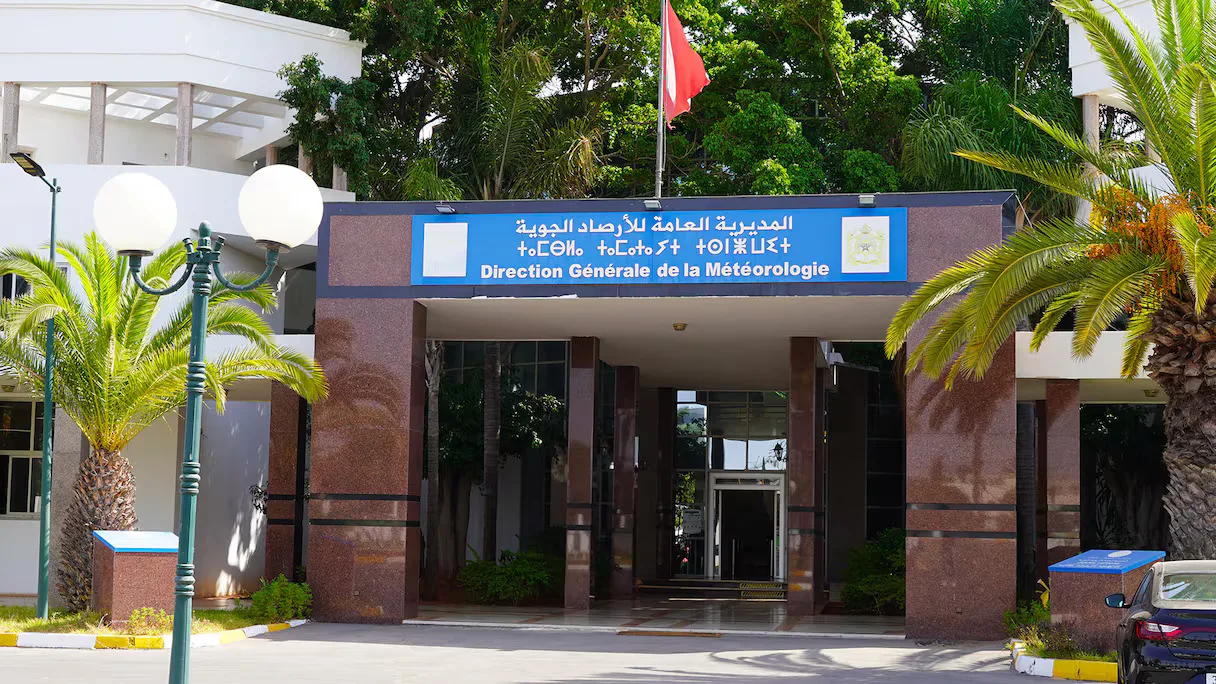
Marrakech – The Moroccan government has adopted a bill that will reshape the country’s meteorological infrastructure.
The government council, under the chairmanship of Aziz Akhannouch, approved project law No. 05.26 on Thursday last week. The law transforms the General Directorate of Meteorology (DGM) into a new public entity called the Moroccan Agency for Meteorology and Climate.
The bill, presented by Minister of Equipment and Water Nizar Baraka, was approved “taking into account remarks raised,” according to government spokesperson Mustapha Baitas. That phrasing indicates the adopted version was amended from the text initially circulated to cabinet members.
The directorate, currently attached to the Ministry of Equipment and Water and operating under the SEGMA framework for state services managed autonomously, will become a full-fledged public establishment. It will be endowed with legal personality and financial autonomy.
The rationale is primarily financial. Three structural bottlenecks have constrained the current model: a service catalog the directorate struggles to expand, funding channels too narrow for its ambitions, and a legal inability to directly receive certain international financial contributions.
At a time when multilateral green funds, World Meteorological Organization (WMO) programs, and bilateral climate cooperation agreements are multiplying, a conventional budget directorate cannot serve as a direct recipient. Funding must pass through the general state budget, with all the rigidity that entails. The public-establishment status removes that barrier.
A decade of institutional inertia
The diagnosis is not new. The Court of Accounts flagged these issues in its 2014 annual report, and the General Inspectorate of Finance confirmed them following an administrative audit covering the 2018-2021 period. Twelve years will have elapsed between the financial court’s first warning and the legislative response.
The Court of Accounts’ 2014 report described the directorate’s legal framework as “outdated.” It pointed to a “quasi-absence of effective partnership” between the weather service and the agricultural sector, despite European-funded efforts to adapt crop forecasting systems, a 2011 consortium with the Ministry of Agriculture and the INRA research institute, and a 2014 meteorological assistance convention with the agriculture department.
The Economic, Social, and Environmental Council (CESE) added its voice, explicitly recommending the directorate’s transformation into a public establishment.
The CESE noted that a majority of the directorate’s clients came from the public sphere and that its pricing remained rigid. It cited a direct precedent: the transformation of the Directorate of Public Equipment, another SEGMA entity under the same ministry, into the National Agency for Public Equipment (ANEP). The meteorological reform follows that exact template.
Exclusive authority and a national climate network
Under the new law, the agency will become the sole official source of meteorological and climate information in Morocco. It alone will have the authority to publish weather bulletins and public alerts.
The bill mandates the creation of a National Climate Network to bring the country’s observation stations under a common set of operating and data-sharing standards. The agency’s mandate spans the full data chain: collection, processing, storage, dissemination, and sharing.
Its competencies are broad. The 57-article bill tasks it with preparing and distributing weather and climate forecasts, safeguarding the national climate archive, exchanging data under international agreements, and providing studies, expertise, and technical assistance to both public institutions and private entities.
The agency will also support natural disaster risk management, serve national defense needs, and deliver meteorological services to aviation and maritime navigation – two historic clients of state meteorology. Cloud-seeding operations, including the Al Ghaith program, will fall within its scope.
Governance will rest on a board of directors and a director general. Staff currently employed by the directorate will transfer to the new entity with full retention of their rights and benefits, though the specific terms – personnel statute, salary grids – will be defined by implementing texts.
The bill also establishes a sanctions regime to protect observation stations and the data they produce. Existing station operators will have one year from the law’s entry into force to register with the agency. That declaratory obligation potentially affects a dense ecosystem: wind and solar developers’ measurement masts, private agro-meteorological stations, and networks run by highway and airport concessionaires.
The agency will also assume all state rights and obligations related to existing contracts for studies, works, supplies, and services currently under the directorate’s purview.
On the technology front, the directorate is set to acquire a supercomputer to sharpen forecast precision and accelerate alert issuance. It is also a cooperating member of the European Centre for Medium-Range Weather Forecasts (ECMWF), its only non-European state partner member.
One critical gap remains: the bill does not detail the agency’s revenue model. How it will balance budget subsidies, air navigation fees, private-sector service pricing, and access to international financing – the very issue driving the reform – is left to future regulation.
Adopted in the final stretch of the current legislature, weeks before the September 2026 elections, the bill must still clear both chambers of parliament. Its committee review will likely slip to the next legislature, unless an accelerated procedure is invoked during an extraordinary session.
Read also: Morocco’s Weather Network Spans 433 Stations Across 44 Regional Centers