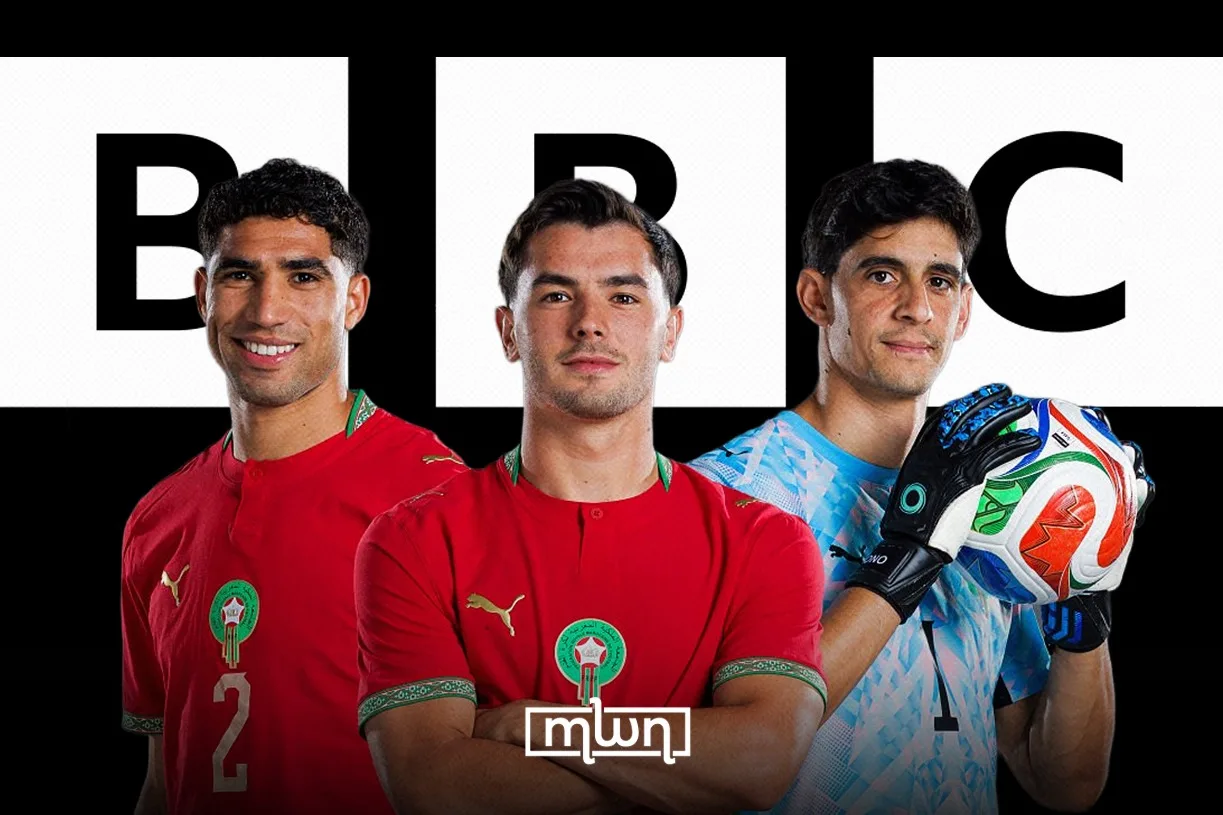
Rabat – Morocco’s rise on the international football stage is no longer being viewed as a one off achievement. According to the BBC, the North African country is laying the foundations to become one of world football’s next major powers through sustained investment, long-term planning, and an ambitious national vision.
In a feature exploring Morocco’s football transformation, the British broadcaster argued that the Atlas Lions’ success is “not an accident,” but the product of years of strategic development both on and off the pitch.
‘These people are serious’
Former Royal Moroccan Football Federation (RMFF) technical operations director Neil Ward told the BBC that Morocco has “the potential to be a powerhouse of world football,” pointing to the country’s modern infrastructure and long-term commitment to the sport.
Morocco has invested heavily in football facilities, including the Mohammed VI football Complex, regional training centers, stadium redevelopment projects, and thousands of amateur pitches across the country.
Ward said the scale of the investment demonstrates Morocco’s determination to compete with football’s biggest nations.
“When you come in and see a training facility of this calibre, it shows you these people are serious and want to be successful,” he explained.
The BBC also highlighted the role of King Mohammed VI’s support for football development, describing the country’s strategy as a part of broader efforts to strengthen Morocco’s international standing through sporting success.
Dedicated scouts
Beyond infrastructure, the report credits Morocco’s worldwide scouting network for helping assemble one of Africa’s strongest national teams. The federation maintains dedicated scouts across several European countries to identify talented players of Moroccan heritage from an early age.
Nineteen of Morocco’s 26-man World Cup squad were born outside the country, the BBC report noted, arguing that this illustrates how successfully the federation has integrated the Moroccan diaspora into the national project.
Former RMFF youth development director Simon Jennings said those players are fully embraced as Moroccans rather than viewed as representing a second nationality.
“They are totally into being Moroccan,” Jennings told the BBC. “It’s a passion they have and a nationality they feel strongly about.”
The report also recalled that Morocco attempted to recruit several dual-nationality prospects including Spain star Lamine Yamal, underlining how aggressively the federation has pursued elite talent.
While diaspora recruitment remains central to Morocco’s current success, the federation’s longer-term objective is to produce more homegrown internationals.
Former technical director Chris Van Puyvelde told BBC that Morocco’s goal by 2030 FIFA World Cup is to achieve a more balanced squad featuring both locally developed players and members of the diaspora.
Great expectations
The broadcaster argues that Morocco’s historic semifinal appearance at the 2022 World Cup fundamentally changed expectations around the national team, replacing hopes of merely reaching the knockout rounds with genuine ambitions of competing for major titles.
Following another deep run at the 2026 FIFA World Cup, the BBC suggests Morocco’s progress reflects a broader transformation that extends far beyond one tournament.
As the country prepares to co-host the 2030 FIFA World Cup alongside Spain and Portugal, the report concludes that Morocco is not simply building stadiums for the future.
“They are building the structure from the ground up,” Van Puyvelde said.
“Once you get a little bit of oxygen, like Morocco did in Qatar, you see this oxygen is spreading very fast. All over the country.”