 Join on WhatsApp
 Join on Telegram
Marrakech – Morocco’s two parliamentary chambers formally closed the second session of the 2025-2026 legislative year on Monday, marking the end of a five-year term defined by record lawmaking, an aggressive diplomatic push on Western Sahara, and a historic shift in the balance between government and member-initiated legislation.
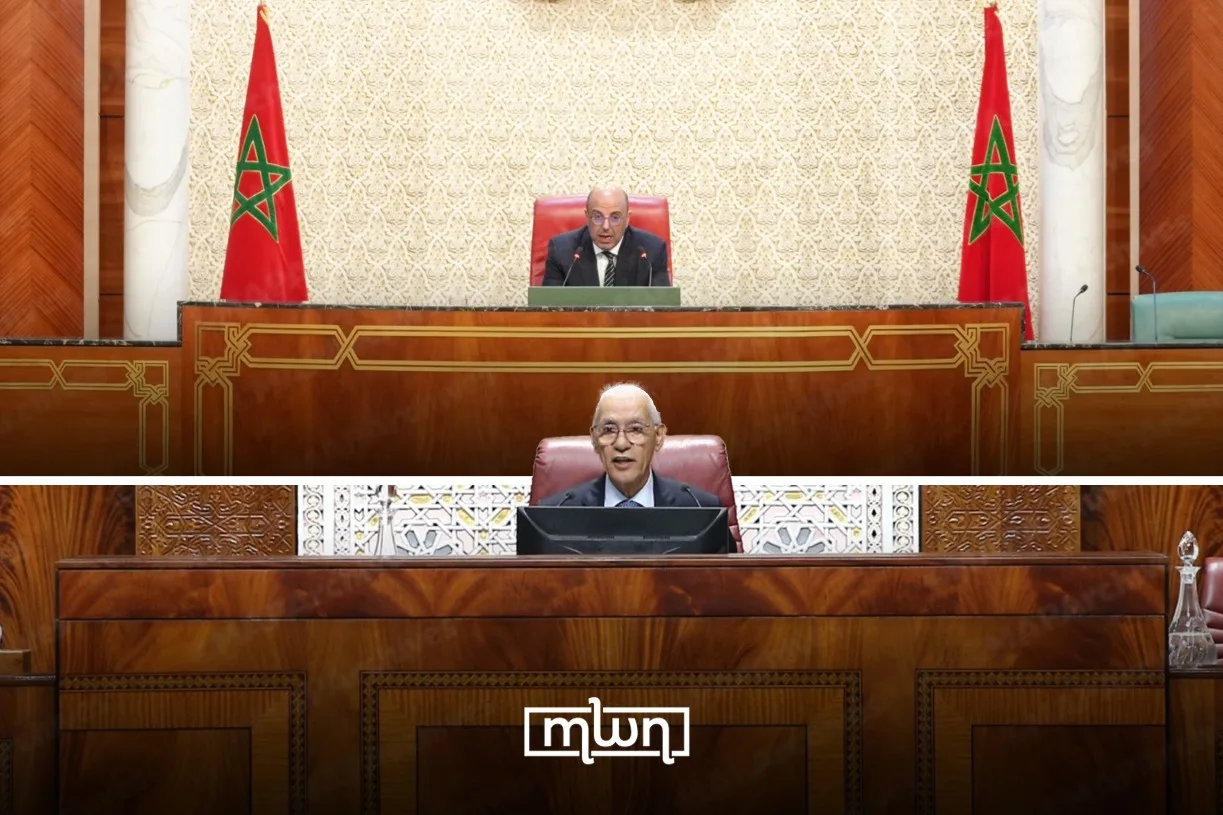
Both chambers now enter recess ahead of the general elections expected in September. The presidents of the House of Representatives and the House of Advisors each addressed their closing plenaries in Rabat, laying out detailed assessments of the session’s output before sending traditional messages of loyalty to King Mohammed VI.
Both chamber presidents address loyalty messages to the King
The Royal Cabinet received messages of loyalty from Rachid Talbi Alami, president of the House of Representatives, and Mohamed Ould Errachid, president of the House of Advisors, upon the formal closure of the legislature’s final session.
Speaking on behalf of all Representatives members, Talbi Alami conveyed “sincere sentiments of loyalty and gratitude” to the sovereign. He noted that throughout the 11th legislature – whose fifth and final legislative year came to a close Monday – the chamber remained “fully engaged in the exercise of its prerogatives,” guided by the spirit of the constitution and aligned with reform efforts launched under royal initiative.
The collective work of the chamber, Talbi Alami affirmed, focused on “enriching and modernizing the national legal arsenal” to keep pace with socio-economic, cultural, and human rights developments, and to meet the demands of the New Development Model.
Ould Errachid struck a similar tone. His message described the session’s legislative, oversight, and diplomatic results as “the fruit of the High Royal Vision” that established the foundations of “a strong state of institutions, faithful to its choices and confident in its future.” He pointed to institutional efficiency, good governance, and policy convergence as the constant pillars of that vision.
With the North African kingdom approaching the 27th anniversary of the King’s accession to the throne, Ould Errachid reaffirmed the Advisors’ “constant mobilization” behind the monarch and their “permanent engagement to serve the homeland and preserve its institutions.”
Record legislative output as member bills overtake government bills
The session’s most striking statistical marker came from the Advisors’ chamber. For the first time in its history, the number of member-initiated bills voted in plenary surpassed government-submitted bills during a single session.
Ould Errachid attributed this milestone to “the collective commitment of the chamber’s components to create a real dynamic aimed at valorizing and encouraging” parliamentary legislative initiative.
The numbers bear that out. Over the course of 10 plenary legislative sittings, the Advisors’ chamber examined and voted on 108 legal texts – 55 member-initiated bills and 53 government bills, including three organic laws. That total, Ould Errachid noted, represents “an unprecedented figure in terms of texts decided upon during a single legislative session since the chamber’s creation.”
The approved legislation touched a wide range of sectors. Structural reforms reorganized several public entities, converting the National Ports Agency (ANP) and the National Office of Hydrocarbons and Mines (ONHYM) into public limited companies. Regional Development Agencies were restructured, and new Regional Urbanism and Housing Agencies were created.
On the institutional front, lawmakers approved the transformation of the High Commission for Planning (HCP) into an independent governance body. New provisions strengthened banking sector risk prevention and resolution frameworks. Texts covering the administration of certain higher education institutions also cleared the chamber.
Health governance drew significant attention. Amendments to laws governing medical regulatory bodies, the pharmaceutical code, and the direct social aid regime all passed. The labor code was updated for private security agents, and new measures were introduced to incentivize companies providing job-insertion training.
The chamber further approved legislation reorganizing the professions of judicial experts, Adoul notaries, and attorneys. The National Press Council (CNP) was restructured, and the professional journalists’ statute was amended. Several international conventions in strategic fields received parliamentary ratification. An organic law setting the conditions for raising constitutional challenges to legislation was also adopted.
In total, members proposed 1,077 amendments across all texts. Of those, 115 were accepted.
On the oversight side, 458 oral questions were filed during the April session. The government responded to 264 – broken into 86 current-affairs questions and 178 ordinary questions – across 12 plenary sittings that involved 24 government departments. Written questions totaled 401, with 174 receiving government responses, some carried over from previous sessions.
The chamber’s six permanent committees convened 61 meetings, logging approximately 110 hours of work.
Policy evaluation also featured prominently. The chamber reviewed the government’s overall policy record and debated the presentation by the First President of the Court of Auditors on the activities of financial jurisdictions for 2024-2025. The monthly policy session tackled food security, while the annual evaluation session addressed “public policies on combating the effects of climate change and the level of preparedness of stakeholders.”
Government touts record responsiveness to parliament
Minister Delegate for Relations with Parliament Mustapha Baitas, also the government spokesperson, declared Monday that the current executive has been “more interactive and responsive than previous governments” toward parliamentary oversight mechanisms and legislative initiatives.
Responding to oral questions at the House of Representatives on the government’s legislative and oversight record, Baitas presented the figures as evidence of sustained institutional dialogue between the executive and legislative branches.
Over the course of the 11th legislature, the government received 29,396 oral questions and responded to 6,881. On the written side, 41,375 questions were filed, with 26,391 answered.
On the legislative front, Baitas noted that the government initiated legislation on “major and unprecedented dossiers,” centered on building the foundations of the social state through social support laws and accelerating the adoption of the new Investment Charter.
The minister drew a direct line between this parliamentary engagement and broader economic performance – pointing to sustained growth levels, controlled inflation, and rising tax revenues that he described as contributing to the financing of the national economy and the reinforcement of public investment.
Parliamentary diplomacy at the core of the Representatives’ agenda
Foreign relations and parliamentary diplomacy constituted “essential components” of the House of Representatives’ work throughout the 11th legislature, Talbi Alami declared in his closing address.
The chamber, he explained, operated within the framework of the diplomatic doctrine established by King Mohammed VI, treating the Sahara dossier as “the prism through which Morocco considers its international environment, and the measure of the sincerity of friendships and the effectiveness of partnerships.”
The adoption on July 31, 2025, of UN Security Council Resolution 2797 represented, in Talbi Alami’s assessment, “a decisive turning point” in the dispute over the Sahara. He characterized the resolution as a recognition of the region’s historical reality that generated “a new wave of international support for the Moroccan position, consecrating the historical rights of the kingdom over its southern provinces.”
Beyond Western Sahara, the chamber worked to “give parliamentary dimensions to royal initiatives at the international and continental levels.” Talbi Alami pointed specifically to the Atlantic Initiative for African coastal states and the initiative to provide Atlantic Ocean access to African island nations.
He also cited Morocco’s engagement on humanitarian causes tied to peace, coexistence, and the environment – including the organization of international congressional forums that have become “institutionalized traditions in international parliamentary practice.”
During the current legislature, those forums produced 11 international parliamentary reference documents, including global declarations. The hosting of numerous multilateral events, Talbi Alami argued, reflects “the high degree of credibility, esteem, and trust the kingdom enjoys at the international level.”
International cooperation programs also served as “an important lever” for the chamber’s external work. Activities included creating dialogue frameworks, exchanging best practices with longstanding parliamentary institutions worldwide, and sharing expertise.
The House of Representatives, Talbi Alami noted, is “among the rare parliaments in the world to have developed, adopted, and published practical reference guides” on parliamentary work from a comparative perspective – roughly 20 such documents during the current legislature.
Advisors’ chamber expands international footprint
Ould Errachid offered a parallel account of the Advisors’ chamber’s international activities, describing the session’s diplomatic initiatives as having “consecrated the place of the Moroccan Parliament within the international parliamentary system.”
The chamber’s participation in the 152nd Assembly of the Inter-Parliamentary Union in Istanbul stood out as “a landmark stage,” given the quality of Moroccan involvement and the gravity of issues under discussion amid what Ould Errachid called “the exacerbation of multidimensional crises.” On the sidelines, the Advisors’ delegation held bilateral meetings with several heads of national parliaments, senates, and parliamentary unions.
Those encounters served to reaffirm the Moroccan autonomy plan as “the sole solution to the artificial regional dispute over Moroccan Sahara,” Ould Errachid reported. He described the initiative as having become, through Resolution 2797, “a well-established political reality and an internationally recognized reference,” reflecting the growing international conviction that any solution “can only fall within the framework of full national sovereignty.”
The diplomatic engagement yielded concrete institutional results. Memoranda of understanding establishing durable parliamentary partnerships were signed with the Cambodian Senate, the National Assembly of Azerbaijan, the National Assembly of Djibouti, and the Parliament of Malawi.
The session’s flagship event was the 4th edition of the Marrakech Parliamentary Economic Forum for the Euro-Mediterranean and Gulf Region. Ould Errachid described the forum as “an important stage” given its level of parliamentary, governmental, and economic participation and the strategic questions it addressed.
Additional memoranda broadened the chamber’s cooperative network. A cooperation agreement was concluded with the Parliament of the Economic Community of West African States (ECOWAS). A separate memorandum linked the Association of African Senates with the Parliamentary Assembly of the Mediterranean. A joint declaration was issued between the Advisors’ chamber and the Parliamentary Unions of Latin America and the Caribbean.
The chamber also hosted the 18th General Assembly of the Union of Arab Parliamentary Scouts, focused on youth, education, and citizenship.
It convened the first interactive seminar of the South-South Parliamentary Diplomacy Platform for Africa. Ould Errachid characterized the initiative as “a landmark stage in the realization of the chamber’s strategic plan for Africa” and in establishing parliamentary diplomacy as “a permanent mechanism for dialogue, expertise-sharing, capacity-building, and consolidation of cooperation among African parliaments.”
Closing on a forward-looking note, Ould Errachid called for “greater seriousness and effort” in the sessions ahead to strengthen the constitutional roles of the legislature and ensure it remains “at the level of citizens’ expectations.”
Read also: What Has Aziz Akhannouch Achieved in Five Years of Government?