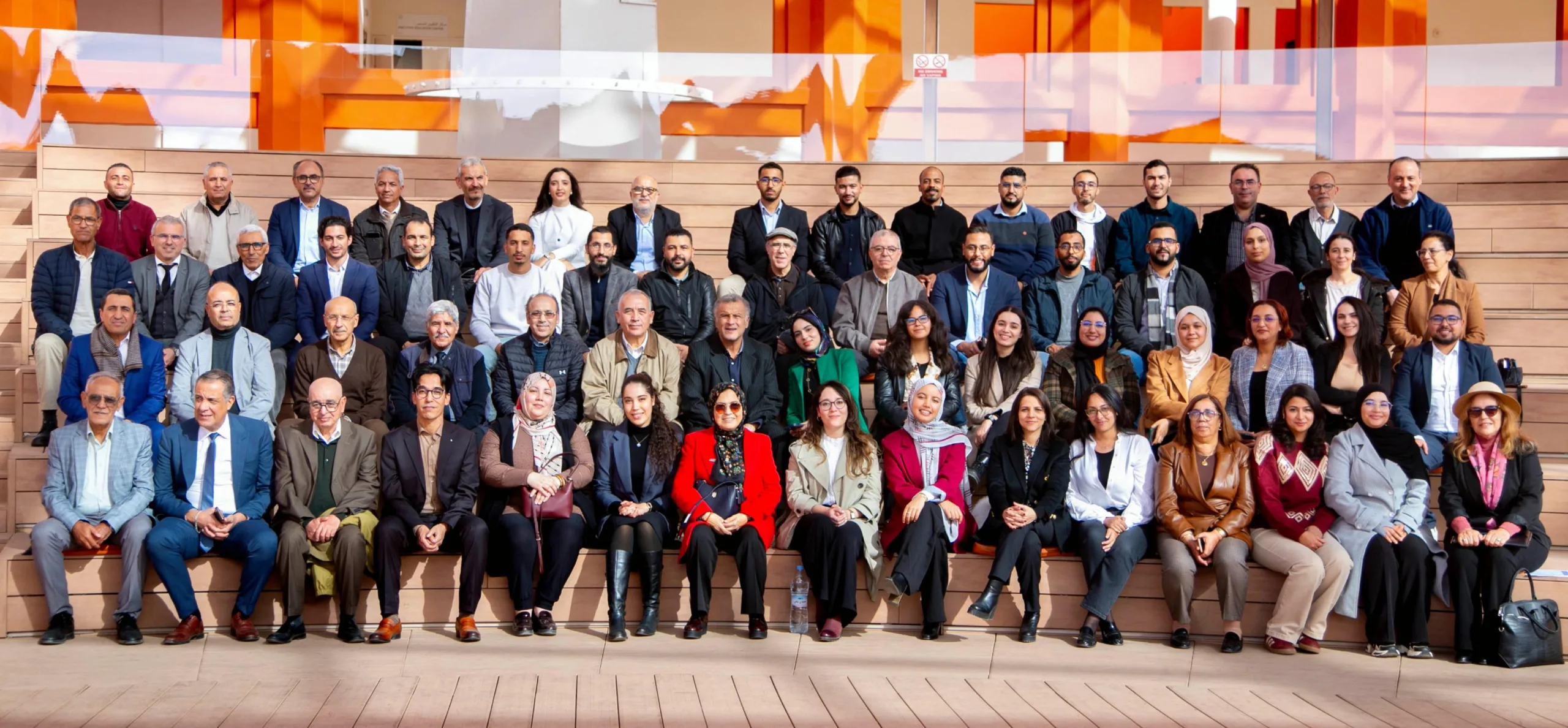
Marrakech – Mohammed VI Polytechnic University (UM6P)’s Fund Management Unit (UGF) marked five years of operation with the publishing of its first five-year report, according to a press release dated July 20. Since 2020, the unit has rolled out more than 25 research and innovation programs and supported over 150 projects.
Those programs mobilized more than 1,500 researchers and a network of over 1,000 national and international experts. They also drew in 11 Moroccan public universities along with a range of national research institutions, producing multidisciplinary and multi-institutional work in health, agriculture, energy, water, materials, the human sciences, and artificial intelligence.
The report traces how a structure originally built to professionalize the management of research funding and technology transfer grew into something broader.
Over five years, the UGF developed an integrated model covering the full life cycle of R&D programs, from identifying needs and launching calls for projects through scientific evaluation, contracting, operational monitoring, and impact measurement.
Beyond the mechanics of fund management, the unit accompanied a deeper shift in Morocco’s research ecosystem. By introducing shared standards for selection, evaluation, monitoring, and accountability, it helped move research programs away from a largely administrative logic toward one centered on performance, impact, and the valorization of results.
That work was built alongside the country’s main research actors. They include the Ministry of Higher Education, the National Center for Scientific and Technical Research (CNRST), several public universities, national research bodies, and industrial partners.
The numbers behind the programs point in the same direction. Projects supported by the UGF trained more than 390 doctoral students and mobilized over 210 postdoctoral researchers and research engineers.
They backed the development of new technologies and prototypes in health, agriculture, water, energy, and artificial intelligence, supported more than 25 projects through technological and commercial maturation, and led to over 236 scientific articles published in first-quartile (Q1) international journals.
The unit also introduced new steering tools and a continuous improvement process, which resulted in ISO 9001:2015 certification, the international reference standard for quality management.
For Ryad Mouline, Head of the UGF, that governance layer is not secondary to the science. The impact of research, in his account, “is prepared well before its results,” beginning with how projects are designed, evaluated, financed, supported, and monitored.
Five years in, he credits the UGF with helping install a culture of rigor in which the quality of governance becomes “a condition of scientific quality,” a collective dynamic the report is meant to put in perspective.
That trajectory now opens a new phase through the National Program for Support to Research, Development, and Innovation (PNARDI), deployed with the MESRSI and the OCP Foundation.
Within it, the UGF acts as the reference operator, running a unified process of evaluation, contracting, monitoring, and impact assessment for all public universities and national research institutions. The shift moves the unit from a program management structure to a direct contributor to national research and innovation policy.
The report lands during a period of upward movement in UM6P’s international standing. The university ranked among the top 200 worldwide in the THE Sustainability Impact Ratings 2026, placed between 351st and 400th globally in the THE 2026 World University Rankings, took 14th in the Arab world and first in North Africa in the THE Arab University Rankings 2026, and entered the CWUR Global 2000 for the first time at 1,763rd.