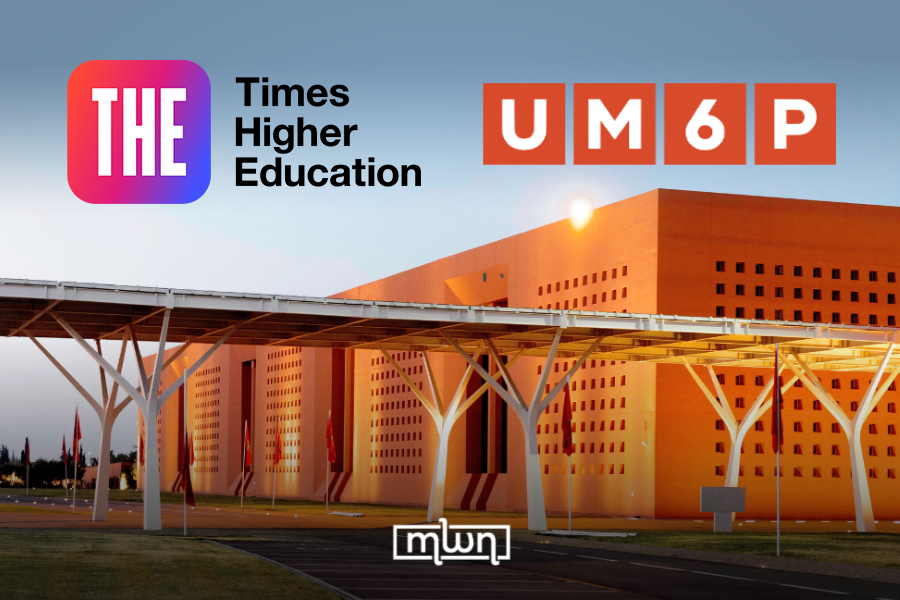
Marrakech – Mohammed VI Polytechnic University (UM6P) achieved 14th place in the Arab world and first position in North Africa in the Times Higher Education Arab University Rankings 2026, released Wednesday. The university advanced significantly from 38th place in 2024.
The ranking included 268 universities from 18 countries across the Middle East and North Africa region. King Abdullah University of Science and Technology in Saudi Arabia maintained its top position for the third consecutive year, followed by King Fahd University of Petroleum and Minerals and Qatar University.
UM6P’s achievement comes after the university placed between 351st and 400th globally in the THE 2026 World University Rankings released in October. This marked progress from its previous top 500 position in 2025, establishing the institution as Morocco’s premier university, North Africa’s leading academic center, and the fourth-ranked university across Africa.
The Arab University Rankings methodology evaluates institutions across five core pillars with adjusted weightings for regional priorities. Teaching accounts for 29.5%, research environment 29%, and research quality 30%. International outlook represents 7.5% while industry engagement comprises 4%.
Universities must publish more than 500 research publications between 2020 and 2024 to qualify for inclusion. The methodology incorporates 18 performance indicators, including teaching reputation, research productivity, citation impact, international collaboration, and industry income.
Read also: UM6P’s Rise as a Hub of Innovation, Excellence in African Higher Education
UM6P is a relatively young institution with a strategic backstory. Conceived as part of the Mohammed VI Green City project in Benguerir and led by the OCP Foundation, it was officially established in 2013 and inaugurated by King Mohammed VI in 2017.
From day one, it was designed less as a classic campus and more as a national laboratory for Morocco’s future where higher education, industrial policy, and Africa-focused development strategy intersect.
The university’s governance is closely linked to OCP and Morocco’s broader transformation agenda, which means the institution is structurally wired to serve real-world needs rather than remaining an academic island. What defines UM6P is its philosophy of applied research, experimentation, and “learning by doing” as the default setting.
The university’s model is built around living labs, experimental farms, pilot industrial units, and data-intensive research platforms, especially in areas like sustainable agriculture, fertilizers, water management, renewable energy, AI, and digital technologies.
Students oscillate between classroom theory, fieldwork, and industry projects, with entrepreneurship and tech transfer treated as core missions, not side activities.
A university with a distinctly pan-African mission
The orientation is explicitly pan-African. UM6P sees itself as a continental hub that trains and networks African researchers, policymakers, and entrepreneurs, with partnerships and collaborative programs spread across the continent.
UM6P’s research output demonstrates substantial growth. Between 2020 and 2025, the university produced more than 6,600 indexed scientific publications, with 85% appearing in Q1 journals and generating nearly 84,000 citations. The institution currently employs 379 permanent professors and hosts 1,300 doctoral students.
The university welcomes 8,756 students from 40 different nationalities, with women comprising 55% of the student body across 45 educational programs. The institution’s incubator and accelerator network has supported over 1,600 startups and project leaders throughout the continent, with 5,500 young people trained through incubation and acceleration programs.
Geographically, UM6P operates as a multi-campus ecosystem. The main campus sits in Benguerir at the heart of the Green City, with iconic architecture by Ricardo Bofill that blends minimalist, warm-toned buildings, open courtyards, and sustainable design. It has earned a STARS Silver rating for sustainability.
In Rabat, the campus leans toward governance, economics, social sciences, and public policy, hosting Africa Business School (ABS) and the Faculty of Governance, Economics and Social Sciences (FGSES). A third campus operates in Laayoune, while UM6P extends its footprint abroad through Global Hubs in Paris and Montreal.
The university houses the African Supercomputing Center with the Toubkal system, listed among the TOP500 supercomputers globally. UM6P participates in sustainability initiatives, including the Green H2A hydrogen technology platform with IRESEN and OCP, and Morocco’s National Hydrogen Commission.
Specialized schools include, among others, the School of Collective Intelligence and the School of Computer Science.
The institution recently established a US Global Hub with offices in New York and Cambridge to connect African researchers and entrepreneurs with North American ecosystems, signaling that the project is meant to be both rooted in Morocco and plugged into global knowledge circuits.