
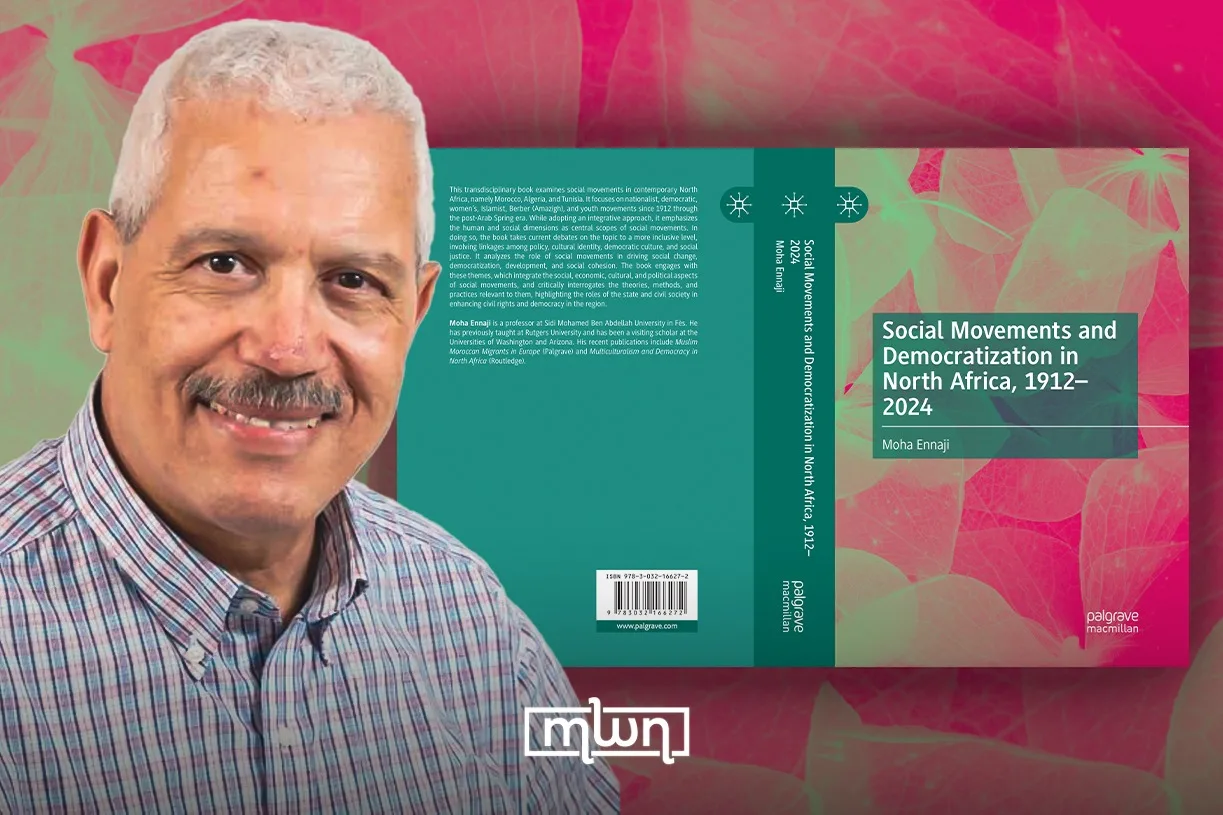
Casablanca – Moroccan university researcher and writer Moha Ennaji has released a new book titled “Social Movements and Democratization in North Africa, 1912–2024.”
Published by Palgrave Macmillan in New York and London, the 338-page book examines social movements in Morocco, Algeria, and Tunisia and analyzes their development as well as their implications for democracy and society.
The book consists of eight chapters inspired by growing academic interest in social movements, democratization, culture, youth, and women’s issues. It explores these subjects through historical, sociological, and comparative perspectives while examining the theories, methods, and practices linked to social movements.
It also looks at the respective roles of the state and civil society in advancing civil rights and democracy across North Africa.
The book identifies a close relationship between social movements and democratization in the region, and it investigates the social, economic, political, and cultural dimensions of activism through an integrative and holistic approach.
The study also examines the role of social movements during the Arab Spring uprisings and in the years that followed, looking at their opportunities, achievements, and limitations.
Ennaji gives particular attention to women’s movements, Islamist movements, human rights groups, youth movements, and the Amazigh movement.
Read also: Al Ousboue Assahafi Celebrates 60 Years with Launch of Mustapha Alaoui’s The Lost Truth Volume II
He also explores the cultures of these movements and their connections with international organizations and broader global trends. He further discusses the main obstacles facing democracy and social cohesion in North Africa.
The author argues that the situation across the Maghreb is more complex than it is often presented. The book says social and political conditions differ widely between Morocco, Algeria, and Tunisia, allowing social movements to continue mobilizing for social change and democratization well beyond the Arab Spring.
The study stresses that historical context and national circumstances play a central role in shaping democratic transitions and that there is no single model that guarantees success.
Instead, it argues that the interaction between domestic and international factors influences both the direction and the outcomes of pro-democracy movements. It also presents the Arab Spring and its different outcomes as useful material for refining theories of social movements and democratic transition.
Drawing on extensive empirical research and fieldwork, the book reviews the causes, evolution, objectives, and impact of North African social movements and their interactions with both the state and one another.
It concludes that these movements are driven by factors including nationalism, language through the Amazigh movement, religion through the Islamist movement, gender equality through the women’s movement, and socio-economic inequalities reflected in youth movements.
More broadly, Ennaji argues that uneven development, political exclusion, economic disparities, and the growing importance of identity-based discourse continue to shape social movements across the region.