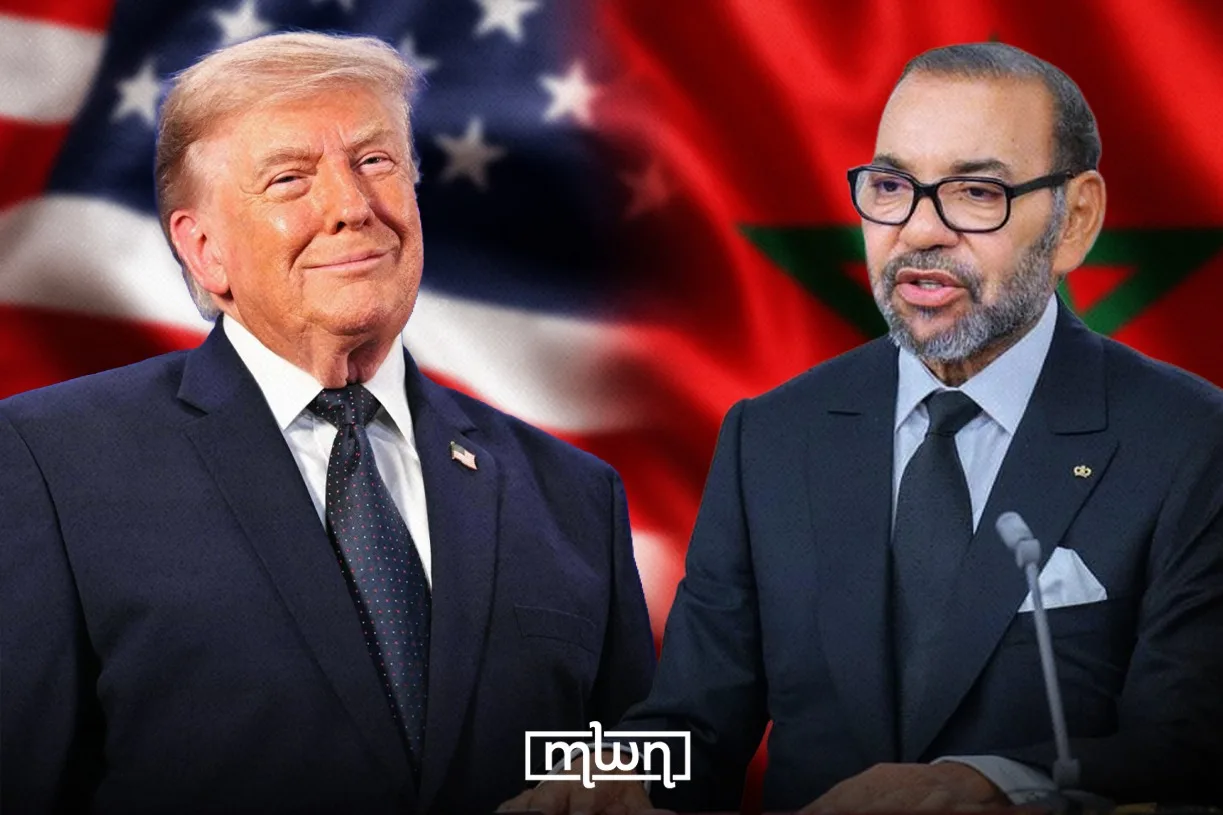
The congratulatory message President Trump sent King Mohammed VI on Throne Day 2026 is more than customary courtesy. Read against a bilateral relationship unbroken since 1777, it functions as strategic communication, a public reaffirmation, amid accelerating change in North Africa and the Middle East, that Washington regards the Moroccan monarchy as indispensable.
It followed the King’s own message marking the 250th anniversary of American independence, in which he called the relationship unprecedented in richness across Trump’s two administrations (Ministry of Foreign Affairs, African Cooperation and Moroccan Expatriates, 2026). This summary argues three things: the message is intelligible only against the 1786-1787 Treaty of Peace and Friendship, the oldest unbroken treaty relationship in American history (Chtatou, 2026d); it consolidates a policy architecture built substantially during Trump’s first term, chiefly the December 2020 recognition of Moroccan sovereignty over the Western Sahara, now extended through instruments such as the Board of Peace (Chtatou, 2026a); and ceremonial reciprocity of this kind performs real diplomatic work, stabilizing expectations and letting Rabat press its core priorities in a public register.
What follows traces this argument across the relationship’s historical, institutional, security, economic, and diplomatic dimensions in turn.
Historical roots and institutional continuity
The relationship’s depth is unmatched among Washington’s partnerships. In December 1777, Sultan Mohammed III became the first sovereign to recognize American independence, a consequential gesture for an isolated, vulnerable young republic. The 1786 Treaty of Peace and Friendship, ratified in 1787, remains in force, the oldest continuously operative American treaty (Chtatou, 2026d). It has survived the French protectorate, the Second World War, including the Roosevelt-Mohammed V wartime rapport, independence in 1956, the Cold War, and the post-Cold War reordering of North African geopolitics, with every American administration maintaining relations with Rabat regardless of party (Chtatou, 2026d). Few bilateral pairings in the modern state system can claim this unbroken continuity, and it is this historical depth that gives contemporary ceremonial gestures their real weight, read in Rabat not as isolated pleasantries but as the latest increment in a pattern of mutual recognition stretching back two and a half centuries.
Throne Day, or Eid al-Arch, commemorates the Alaouite dynasty’s continuity and the King’s dual political and religious authority as Amir al-Muminin, a role with no true analogue among Washington’s other regional partners. Addressing the King on this occasion is not diplomatically neutral; it implicitly acknowledges the monarchy’s constitutional centrality as guarantor of stability amid a region marked by coups, collapsed states, and contested constitutional orders, an increasingly prized asset for American policymakers as Sahel security partnerships erode elsewhere.
Reciprocity in the 2026 exchange
Trump’s Throne Day message completed a diplomatic circuit begun by King Mohammed VI’s Independence Day message, which commended deepening cooperation and singled out the Sahara recognition as a defining achievement (Ministry of Foreign Affairs, African Cooperation and Moroccan Expatriates, 2026).
Reciprocal ceremonial messaging has intensified since 2020, shifting from generic goodwill toward specific references to policy achievements, the Sahara recognition, expanding trade, and military exercises. Ceremonial language has thus become a vehicle for signaling substantive alignment without the friction of formal negotiation, reflecting the relationship’s transformation into a load-bearing element of both countries’ regional strategies.
This shift also reflects a broader change in how both governments treat public diplomacy: rather than confining substantive commitments to closed-door negotiations, they increasingly use national commemorations as low-cost, high-visibility occasions on which to restate and reinforce priorities that might otherwise remain buried within technical bureaucratic channels.
The Sahara question as strategic hinge
No decision has shaped the relationship more than Trump’s December 2020 recognition of Moroccan sovereignty over Western Sahara, part of a tripartite arrangement that also brought Morocco into the Abraham Accords (Carnegie Endowment for International Peace, 2025; Middle East Institute, 2026). Rabat treats the recognition as irreversible (Chtatou, 2026d). Biden-era ambiguity, including the unopened Dakhla consulate, did not reverse it, and by late 2025 the file had returned to the center of American diplomacy: in October 2025 Washington, as UN Security Council penholder, advanced a resolution calling Moroccan autonomy the most feasible solution, endorsed by France and other European states (Euronews, 2025).
Analysts debate whether parallel efforts to broker Algeria-Morocco reconciliation, including pressure to scale back MINURSO, risk generating friction rather than resolving it (European Council on Foreign Relations, 2025; Washington Institute for Near East Policy, 2025a). The trajectory- recognition, dormancy, renewed advocacy- shows why the Sahara remains the file around which Rabat calibrates its alignment with Washington (AllAfrica, 2025). The 2020 recognition also functioned as a permissive precedent for other states, including Germany, to move gradually toward the Moroccan position, extending its effects well beyond the bilateral relationship itself (AllAfrica, 2025).
The board of peace
In January 2026, Morocco became a founding member, first financial contributor, and first Arab state to commit militarily to Trump’s Board of Peace, unveiled at Davos to stabilize Gaza while reordering Middle Eastern governance; Foreign Minister Nasser Bourita signed the charter, positioning Morocco as the initiative’s Arab pivot (Chtatou, 2026a). Early, substantive participation secures continued American attention to the Saharan autonomy plan while building diplomatic capital usable with Algeria, the African Union, and European partners, though failure of the Board to deliver on Gaza would carry reputational risk for Rabat (Chtatou, 2026a).
Trump’s Throne Day message, arriving months later, implicitly acknowledges that risk. The commitment situates Morocco at the intersection of three converging dossiers: the Palestinian question, the Western Sahara file, and the broader reconfiguration of Middle Eastern multilateral governance, giving Rabat a stake in an American-led project whose ultimate success remains, as of this writing, unproven.
Security cooperation: African Lion
Exercise African Lion, now in its twenty-second edition and the largest annual multinational military exercise on the continent, engaged over 5,600 personnel from more than forty nations across Ghana, Morocco, Senegal, and Tunisia in 2026, jointly led by U.S. Army Southern European Task Force, Africa, and the Royal Moroccan Armed Forces (Chtatou, 2026b; U.S. Africa Command, 2026).
The 2026 edition added space operations, electromagnetic warfare, cybersecurity, and WMD-response training alongside humanitarian medical outreach (Morocco World News, 2026). This expanding scope reflects a shift from conventional bilateral training toward a multidomain platform for projecting American influence across the Sahel, Mediterranean, and Atlantic approaches, reinforced by intelligence sharing and maritime security cooperation (Chtatou, 2026b).
Morocco’s willingness to host the exercise’s most sensitive components, including technology validation involving more than thirty American defense contractors, underscores a degree of institutional trust matched by few other American partnerships in the region.
Economic convergence
The economic relationship has deepened since the 2004 Morocco-U.S. Free Trade Agreement, Africa’s only comprehensive American FTA, now spanning aerospace, automotive manufacturing, renewable energy, agriculture, and digital technology (Chtatou, 2026d). American firms increasingly treat Morocco as a platform economy offering stability and preferential access to both European and sub-Saharan African markets, with industrial clusters around Casablanca, Tangier, and Kenitra.
As firms diversify supply chains away from exposed regions, Morocco’s trade access, proximity to Europe, and expanding energy infrastructure, including the proposed Nigeria-Morocco Atlantic gas pipeline, make it an increasingly attractive node in reconfigured global supply chains, with aerospace and automotive investment representing sunk capital that gives both governments strong incentive to protect continued political stability. Manufacturing investment of this kind is considerably stickier than trade in raw commodities, since it creates durable interdependence that both capitals have concrete incentives to defend through continued institutional stability.
Morocco-Israel normalization
The December 2020 Abraham Accords normalization with Israel, part of the same tripartite process as the Sahara recognition, remains a signature Trump-era achievement, characterized as institutionalizing a centuries-old pattern of Jewish-Moroccan coexistence rather than a rupture (Chtatou, 2026c; Middle East Institute, 2026). Since 2020, the relationship has deepened through direct flights, cybersecurity cooperation, rising trade, and a defense memorandum of understanding (Chtatou, 2021). Rabat has sustained the framework despite domestic sympathy for the Palestinian cause during the Gaza war, judging the Sahara recognition secured in exchange to outweigh reputational costs (Chtatou, 2026c), a durability that Trump’s continued warmth toward the King implicitly rewards. Morocco’s long-standing promotion of its Jewish heritage, restored synagogues and mellahs, constitutional recognition of the country’s Hebraic component, further supplies a soft-power narrative that eases the domestic political costs, on both sides, of deepening security and economic entanglement.
Values, migration, and regional standing
Washington increasingly views Morocco’s state-supervised, moderate Islam, anchored in the King’s role as Amir al-Muminin, and its promotion of interfaith coexistence and Judeo-Moroccan heritage as assets in countering extremism, complementing rather than driving the relationship’s harder interest-based logic.
Migration governance has grown similarly salient: Morocco’s regularization apparatus and African Union leadership on migration give Rabat normative authority relevant to American concerns about trafficking and Sahel instability following the retreat of European security presences from Mali, Niger, and Burkina Faso. Compared to Gulf states (energy and arms) or Egypt (size and the Suez Canal), Morocco’s relevance to Washington is diffuse, spanning history, religion, migration, geography, and now the Board of Peace, a diffusion that has insulated the relationship from periodic frictions.
Morocco nonetheless competes implicitly with Algeria for American attention, a rivalry Washington manages rather than resolves (Washington Institute for Near East Policy, 2025a), and Trump’s personalized outreach to the King reinforces Rabat’s preferred framing as Washington’s primary Maghreb interlocutor. This combination of diffuse relevance and monarchical continuity is precisely what allows a single ceremonial gesture, a Throne Day message, to carry weight disproportionate to its brevity.
Personalized diplomacy and bipartisan continuity
Trump’s diplomatic style has consistently emphasized personal rapport over strictly institutional channels, treating Morocco as a trusted individual relationship between heads of state, which has facilitated rapid decisions such as the 2020 Sahara proclamation. Yet the relationship’s durability also rests on sustained bipartisan American support: both major parties have recognized Morocco’s contributions to regional security, economic modernization, and counterterrorism, a foundation that gives the relationship resilience beyond any single administration and that Trump’s Throne Day message draws upon without being reducible to. This dual foundation, personal warmth layered atop institutional consensus, helps explain why Moroccan-American relations have proven comparatively insulated from the swings that periodically unsettle Washington’s ties with other regional partners.
Conclusion
Read in isolation, Trump’s Throne Day message might seem a routine courtesy. Read against this context, it condenses a far denser reality: a 250-year relationship anchored in the oldest unbroken American treaty (Chtatou, 2026d); a monarchy whose institutional continuity has become a prized regional asset; a Sahara policy evolving from unilateral recognition into an increasingly institutionalized multilateral framework (Euronews, 2025; Chtatou, 2026a); a security partnership expressed annually through the continent’s largest military exercise (Chtatou, 2026b); a deepening economic relationship built on Africa’s only comprehensive American free trade agreement; and a normalization framework with Israel Morocco has sustained despite real domestic cost (Chtatou, 2026c).
Ceremonial diplomacy should not be dismissed as epiphenomenal: it is the compressed register in which governments signal the continuity and priority of relationships whose substance is negotiated elsewhere, in treaty rooms, military exercises, trade talks, and institutions such as the Board of Peace.
As both nations mark 250 years of friendship, the Trump-Mohammed VI exchange affirms that some alliances endure not because they are immune to geopolitical flux, but because they have repeatedly proven able to absorb it, adapting their institutional forms while preserving the underlying strategic logic that first bound Rabat and Washington together in 1777.
References
AllAfrica. (2025, April 9). Morocco: U.S. geopolitical choice on Moroccan Sahara underscores steady commitment to major international player – French political scientist. https://allafrica.com/stories/202504090293.html
Carnegie Endowment for International Peace. (2025). Trump’s lesser-known deal of the century? Resolving the Western Sahara conflict. https://carnegieendowment.org/russia-eurasia/research/2025/02/western-sahara-morocco-sahrawi-trump
Chtatou, M. (2021, January 5). Understanding Moroccan “normalization” with Israel. Fikra Forum, The Washington Institute for Near East Policy. https://www.washingtoninstitute.org/policy-analysis/understanding-moroccan-normalization-israel
Chtatou, M. (2026a, February 26). Morocco and the “Board of Peace”: A strategic gamble or a deliberate alignment? [Analysis]. Eurasia Review. https://www.eurasiareview.com/26022026-morocco-and-the-board-of-peace-a-strategic-gamble-or-a-deliberate-alignment-analysis/
Chtatou, M. (2026b, May 6). The African lion roars in real time: Exercise African Lion 2026, Morocco’s strategic centrality, and the geopolitics of a fractured world [Analysis]. Eurasia Review. https://www.eurasiareview.com/06052026-the-african-lion-roars-in-real-time-exercise-african-lion-2026-moroccos-strategic-centrality-and-the-geopolitics-of-a-fractured-world-analysis/
Chtatou, M. (2026c, June 22). From coexistence to strategic partnership: Morocco-Israel relations in historical and contemporary perspective [Analysis]. Eurasia Review. https://www.eurasiareview.com/22062026-from-coexistence-to-strategic-partnership-morocco-israel-relations-in-historical-and-contemporary-perspective-analysis/
Chtatou, M. (2026d, July 5). Morocco–United States: 250 years of friendship, respect, and cooperation (1777–2027) [Essay]. Eurasia Review. https://www.eurasiareview.com/05072026-morocco-united-states-250-years-of-friendship-respect-and-cooperation-1777-2027-essay/
European Council on Foreign Relations. (2025, November 13). Western Sahara shuffle: Trump’s foray could make or break peace. https://ecfr.eu/article/western-sahara-shuffle-trumps-foray-could-make-or-break-peace/
Euronews. (2025, October 29). Will Washington succeed in mending the Western Sahara rift? https://www.euronews.com/2025/10/29/will-washington-succeed-in-mending-the-western-sahara-rift
Middle East Institute. (2026, April 20). The Abraham Accords [Backgrounder]. https://mei.edu/backgrounder/abraham-accords/
Ministry of Foreign Affairs, African Cooperation and Moroccan Expatriates. (2026, July). HM the King congratulates U.S. President Donald Trump on Independence Day. Diplomatie.ma. https://diplomatie.ma/en/hm-king-congratulates-us-president-donald-trump-independence-day
Morocco World News. (2026, April 27). Morocco, US launch African Lion 2026 military exercise with over 5,000 troops. https://www.moroccoworldnews.com/2026/04/288905/morocco-us-launch-african-lion-2026-military-exercise-with-over-5000-troops/
U.S. Africa Command. (2026, April 16). Roaring into action: African Lion 2026 begins in Tunisia. https://www.africom.mil/article/36379/roaring-into-action-african-lion-2026-begins-in-tunisia
Washington Institute for Near East Policy. (2025a, October 23). An Algeria-Morocco “peace deal”? Managing U.S. diplomacy and expectations. https://www.washingtoninstitute.org/policy-analysis/algeria-morocco-peace-deal-managing-us-diplomacy-and-expectations
Washington Institute for Near East Policy. (2025b). Balancing U.S. relations in North Africa without undermining the Abraham Accords. https://www.washingtoninstitute.org/policy-analysis/balancing-us-relations-north-africa-without-undermining-abraham-accords