


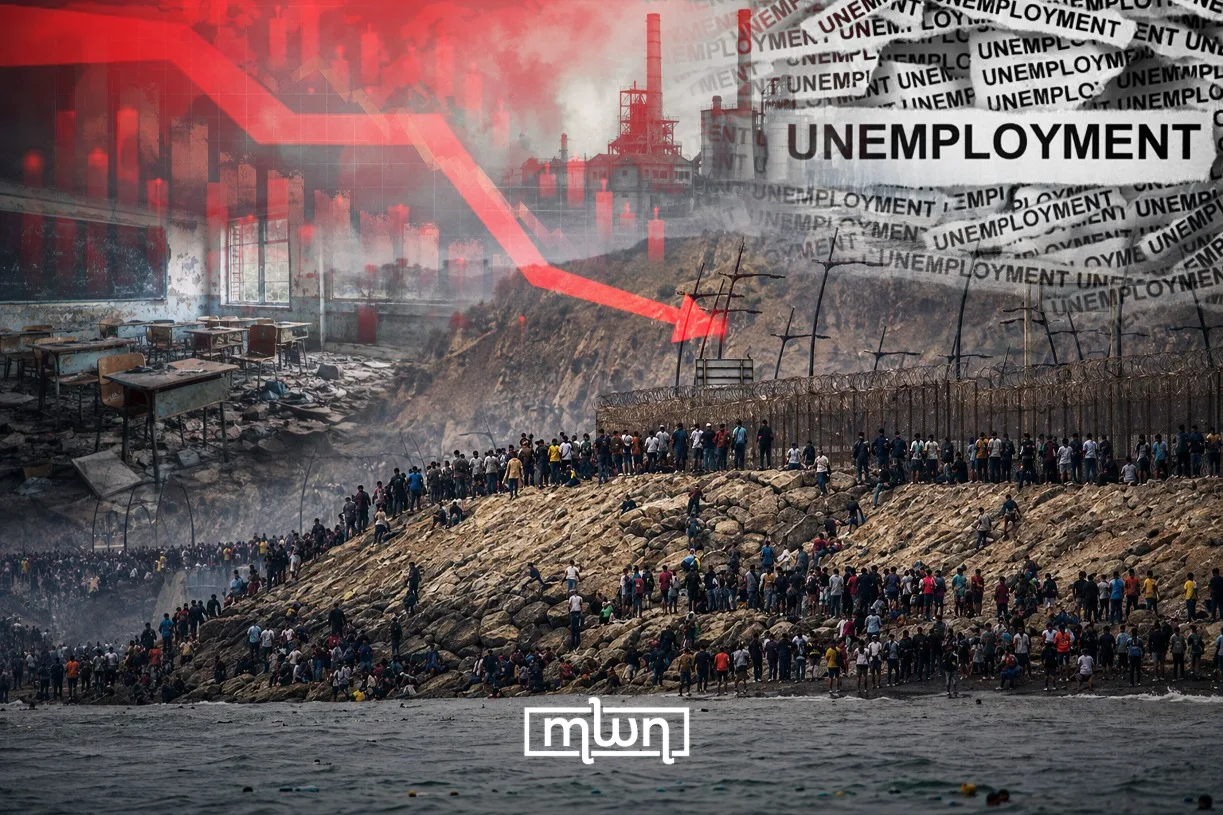
However consequential, no single factor can explain why tens of thousands of people moved toward Ceuta within the span of a single weekend. And so, to understand what we witnessed on July 29 and 30, one must first understand the multifaceted and interlinked forces that had already been quietly gathering for years, long before their culminated weight triggered the latest tragedy at the Ceuta crossing.
In an earlier – and longer – article, I attempted to capture the strategic, political, and geopolitical underlying reasons and ramifications of this Ceuta tragedy. Here, in a much shorter analysis, I want to highlight the economic, cultural, and sociological factors that have made the perilous and fatal irregular migration route both an appealing and viable option for thousands of Moroccan youths.
The economics of irregular emigration
As many other sense-making watchers of these past days’ events have pointed out, unemployment and poverty remain the primary forces pushing many Moroccans to see emigration as their only route toward a better future. According to Morocco’s High Commission for Planning, between 29 and 35 percent of Moroccans aged 15 to 24 are unemployed. While already concerning, this data gets even more glaringly alarming when one registers that this endemic of joblessness is taking place in a country whose overall unemployment rate hovers near 11 percent. Around 1.2 million Moroccans are neither employed nor engaged in education or training. For this segment of the population, migration has come to look like an inevitability, the only available path to achieving their dream of moving up on the Moroccan socio-economic ladder.
While unemployment remains a persistent challenge in Morocco, many reports point to a growing paradox: several industries are simultaneously grappling with labor shortages. Sectors including agri-food, textiles, construction, and electrical wiring (câblage) continue to report difficulties recruiting both skilled and unskilled workers, despite elevated unemployment levels. Industry representatives argue that the mismatch stems from structural factors, including inadequate vocational training, rising living costs, lengthy commuting times, and transportation expenses that have significantly reduced the attractiveness of many industrial jobs, particularly in major economic hubs such as Casablanca.
The trend reflects broader concerns highlighted by the World Bank, which notes that Morocco’s labor market continues to exclude two key groups—young people and women. According to the institution, around 29% of Moroccans aged 15 to 24 are classified as NEETs (not in education, employment, or training), signaling a large pool of discouraged youth at risk of long-term exclusion from the labor market.
Yet the absence of prospects does not necessarily denote the absence of opportunity. In fact, the Moroccan economy does generate jobs capable of absorbing a share of the country’s unemployed. Sectors such as construction and hospitality suffer from genuine labor shortages. Paradoxically, these shortages are so acute that many of the concerned companies now depend increasingly on Sub-Saharan migrants who had originally intended to reach Spain but ended up choosing to remain in Morocco instead.
The telling irony here is that while sub-Saharan migrants are eager to fill vacant positions that Moroccan workers themselves have largely abandoned, many of the same Moroccans are equally glad to accept identical jobs once abroad without proper health care or any other social protection.
A culture of romanticizing life elsewhere
Yet the pull toward emigration is not purely economic. It is also cultural, deeply embedded into the fabric of Moroccan society to the point that nearly every family counts at least one member living overseas. Each summer, members of the diaspora return home ostentatiously displaying a markedly comfortable standard of living, namely new cars, renovated homes, a certain ease that stands out against the daily grind of those who have stayed home. The effect of this annual homecoming is to convince those who remain – sometimes even including professionals and executives earning respectable salaries by both domestic and regional standards – that life abroad must be substantially more prosperous.
And this impression is reinforced by members of the diaspora who frequently describe conditions in Europe, the United States, or the Gulf in unduly rosy terms, further fueling the aspirations of relatives back home. In their exaggeratedly romanticized accounts of life elsewhere, few of these Moroccan homecomers dwell on the precariousness or the modest wages that often accompany life abroad.
Instead, what travels back with them to Morocco is the polished version of their lives overseas. It is little wonder, then, that opinion polls conducted in recent years consistently find more than 35 percent of Moroccans expressing a desire to leave the country. Economic necessity and cultural mythology have thus been working in tandem to make emigration a national preoccupation.
The interplay of pull factors
It is a universally accepted truth that where there is demand, supply naturally follows. And the smuggling networks that facilitate irregular migration have found fertile ground in this reality, extracting enormous profits from the desperation of young people dreaming of better lives for themselves and their loved ones.
Migrants in some cases pay up to €10,000 for a place aboard a makeshift boat bound for Spain. This, it goes without saying, speaks both to the scale of the demand and to the ruthlessness of those who profit from it. But it would be a mistake to treat these networks, or the migratory impulse they feed and instrumentalize, as self-sustaining phenomena.
In other words, the interplay between the overseas-based desperation of young Moroccans and the ruthless profiteering of smuggling networks could not have flourished in a vacuum. The two persist because they are sustained by powerful pull factors on the receiving end, thus rationalizing or downplaying the fatal dangers that abound on the irregular route to the fantasized life elsewhere.
As far as the recent surge to Ceuta and Melilla are concerned, chief among these factors has been the recurring decision of successive Spanish governments to regularize undocumented migrants working within the informal sectors of the Spanish economy. In the most recent instance, a Royal Decree adopted in May laid bare Spain’s plan to regularize the status of roughly 500,000 undocumented immigrants.
Far from being a decision made in isolation, this move seems to be a response to structural demographic pressures that Spain has faced for decades and that are only set to intensify. With a fertility rate of around 1.2 children per woman – well below the replacement threshold of 2.1 – Spain confronts an alarming demographic reality that leaves it little choice but to attract cheap foreign labor. The IMF and the European Commission estimate that the country will need between 200,000 and 250,000 immigrants annually through 2050 simply to sustain its economy and offset the effects of an aging population. Yet the same institutions have also warned that a highly restrictive immigration policy would come at a steep cost, namely a marked decline in GDP, diminished fiscal revenues, and a gradual erosion of Spain’s economic weight within the European Union.
The events of July 29 and 30 must be understood against this broader backdrop. The court ruling that has drawn so much attention merely acted as a catalyst, accelerating decisions that many had already been contemplating and offering what appeared to be a rare window of opportunity. Without the economic desperation, the cultural pull, and Spain’s own demographic calculus already in place, the ruling alone would have amounted to little more than a legal footnote.
In an algorithmic age when governments have largely lost the ability to control the spread of information and rumors, news that individuals who reach Spanish territory by swimming would not be immediately returned to Morocco spread with striking speed across social media. It reached hundreds of thousands of young people who had long been weighing the prospect of migration, many of whom came to believe that reaching Ceuta by swimming would allow them to remain, at least temporarily, while their cases were reviewed. This perception proved a powerful incentive for a population already contending with unemployment and constrained prospects, transforming a distant legal technicality into an immediate, tangible reason to act.
Attempts to reach Ceuta thus rose noticeably between July 8 and July 27, prompting Spanish media themselves to describe the situation as approaching a state of emergency. As the news continued to circulate, there seemed to emerge a solid, shared belief that the moment to cross had become unusually favorable, and that anyone who managed to swim to Ceuta would have their case examined rather than face immediate return.
Reading the surge correctly
In previous years, even at moments of heightened migratory pressure, attempted crossings had rarely exceeded roughly 1,500 people. That figure surged to somewhere between 50,000 and 60,000 people on July 29-30. By then, a narrow legal interpretation confined at first to courtrooms and administrative circles had acquired a life of its own in the collective imagination of would-be migrants.
What occurred at Ceuta, then, is best understood as the convergence of long-building pressures with a single, sharply timed trigger. Economic hardship, the decades-running romanticization of life, the narrative-setting and aspiration-feeding genius of smuggling networks, and Spain’s own demographic imperatives all supplied the incentive structure that made tens of thousands of better life-seeking youths think that the perilous destination was worth the risk.
Remove any one of these ingredients, and what happened on July 29 and 30 would not have taken place – at least not on the scale we witnessed. Thus understood, this migratory tragedy offers a lesson that extends well beyond the particulars that both leftwing and rightwing European politicians and intellectuals have tended to evoke. As such, any response that addresses only the immediate trigger, while ignoring the deeper economic and cultural currents that have long been feeding it, is unlikely to prevent similar episodes from recurring in the near or distant future.
Fair enough, in the aftermath of tragedies, there is a natural, even understandable, temptation to search for a single culprit. But the surge at Ceuta cannot be reduced to any one of its ingredients – legal, sociological, socio-economic – without distorting what actually happened.
As ever, this tragedy was the product of years of accumulated pressure released all at once by a trigger that happened to arrive at precisely the right moment to unleash it. Anyone who pretends otherwise is either deliberately engaging in a demagogical game of political point-scoring or is dangerously misinformed and unaware that they are unfortunately missing the forest for the threes.
Samir Bennis is the co-founder and publisher of Morocco World News. You can follow him on Twitter @SamirBennis.


