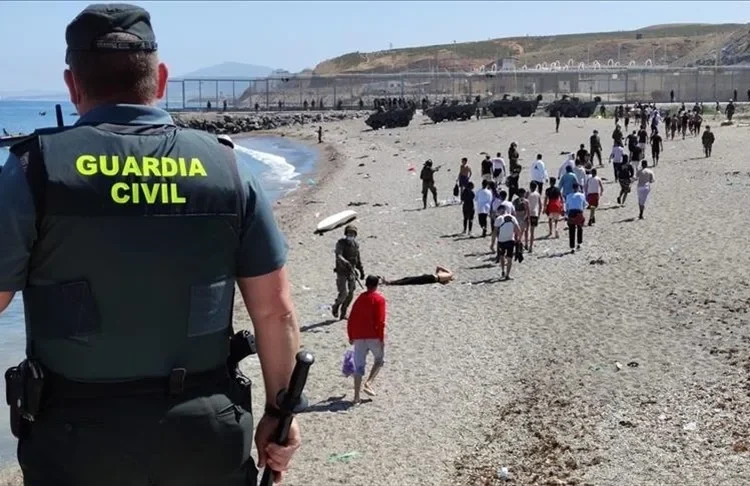
Rabat – The Moroccan Association for Human Rights (AMDH) has held the Moroccan state politically responsible for the recent mass migration attempts toward the occupied cities of Ceuta and Melilla, arguing that the crisis reflects deep social and economic problems rather than an isolated border incident.
The association released a statement on Sunday saying the large number of young people, minors, and families attempting to reach the two cities showed the growing despair among many Moroccans.
It blamed unemployment, poverty, inequality, corruption, limited opportunities, and worsening living conditions for pushing people to risk death at sea rather than endure the realities they face at home.
AMDH said the migration attempts were the result of a “deep structural crisis and the accumulation of decades of social and economic marginalization.”It added that the growing desire to leave the country reflected a loss of trust in public institutions, government policies, and the future.
The association also held the Moroccan state “politically responsible, as well as fully and immediately responsible,” for the conditions that led to the mass migration attempts and for the human rights violations that followed. It said the events raised serious concerns about the right to life, personal safety, and human dignity, particularly because many children and minors were involved.
The statement referred to circulating information suggesting that nearly 130 people had died, while dozens remained missing and many others were injured. However, it noted that official figures were still pending.
The Moroccan Ministry of the Interior said 11 Moroccan people died during the Ceuta events, including 10 people who drowned and one person who died after falling in a rocky area. Spanish officials said the death toll exceeded 70. However, reports said many of the recovered bodies were in advanced stages of decomposition, suggesting they are linked to earlier migration attempts.
Political leverage?
AMDH also accused authorities of using migration as a political tool in relations with Spain and the European Union.
The association condemned what it described as the use of the humanitarian situation and the suffering of poor and vulnerable people, including children, as leverage in political negotiations or diplomatic disputes.
It argued that migration is a human right and said vulnerable people should not be used as “bargaining chips” in geopolitical relations at the expense of their rights and dignity.
“Migration is a human right, and the suffering of the poorest and most marginalized people, as well as victims of failed state policies, must not be turned into tools of geopolitical maneuvering or drawn into political and diplomatic disputes at the expense of their fundamental rights and human dignity,” the statement said.
The rights group also criticized the “ambiguous silence” of Moroccan officials, saying the lack of clear communication contributed to the wider movement of people toward northern Morocco.
AMDH called for an independent investigation into the recent events and demanded accountability for any failure to protect vulnerable people. The association also urged the government to address the root causes of migration through major economic and social reforms, including the creation of decent jobs, stronger youth employment policies, and greater social and regional justice.
It said the response should go beyond security measures and focus on ensuring dignity, human rights, and better living conditions within Morocco.
Moroccan authorities detail response
The Ministry of the Interior broke the government’s silence on Sunday, saying the mass migration attempts were fueled by false information spread online, including misinterpretations of a recent Spanish court ruling, which encouraged tens of thousands of people to head toward the northern border.
The ministry said authorities worked to contain the situation and prevent further crossings, while stressing Morocco’s continued cooperation with Spain to strengthen border security and combat human trafficking.
“This strategy was based on the early monitoring of emerging indicators, raising levels of vigilance and mobilization, strengthening the preparedness of the various security services and territorial authorities, and intensifying both land and maritime surveillance,” the ministry’s spokesperson said.