
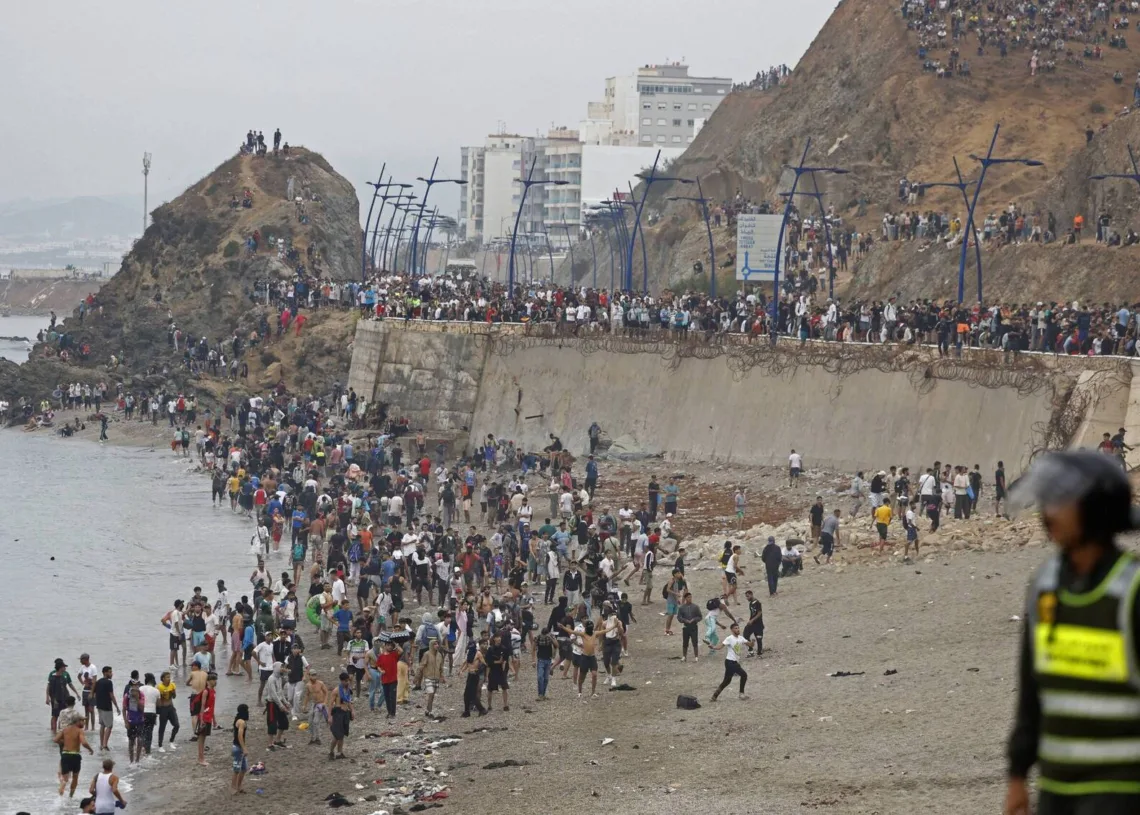
Thousands of young Moroccans have arranged to meet up in northern Morocco, in the enclaves occupied so far by Spain. Their aim was not to settle in Sebta or Melilla or to take up residence there. They knew that these two towns had lost their economic appeal, and were merely a stepping stone towards what they believe to be the European El Dorado. There are many reasons for this modern-day exodus, chief among them being the ruling handed down by a Spanish court on 8 July. This ruling stipulates that anyone who reaches Spanish territory by swimming cannot be subject to immediate deportation.
A review of the footage supports this argument. The young people who washed up on the shores of Sebta were equipped with makeshift gear to cope with the sea and the waves. Life buoys, tires and sometimes plastic bottles tied around their waists to keep them afloat. Inner tubes were salvaged from tractors or lorries to help several people swim at once. Others were more resourceful, using plastic sheeting or cling film wrapped around their bodies to protect themselves from the cold and the water. Undoubtedly, it was these rudimentary methods of reaching the shore at Sebta that led to a high number of deaths amongst them.
The heavy toll of this tragic crossing has plunged not only the families, but the entire Moroccan people into mourning. It has also tarnished the image of a Moroccan government nearing the end of its term, which failed to anticipate this exodus in time, and did not show sufficient concern for its young people to address their needs in terms of education, training, employment and leisure. These images of our young people fleeing the country, and of women with young children left without water or food, have made us witnesses to their tragic plight. This mass attempt by our young people to migrate is, in reality, simply the other side of Generation Z – the generation that, until recently, was demanding education, healthcare and work. It is the logical consequence and natural extension of that.
This mass migration also appears to be more problematic and risky than an individual migration attempt. It attracts more attention than a lone migrant who can evade checks and reach their destination. A person who chooses to migrate individually has a better chance of success than those who set off in groups and in broad daylight. Yet, paradoxically, it is these massive migrations that shape human history and transform the destinies of nations. For various reasons, groups of people one day set out – driven by conviction, fear, hunger, or quite simply the desire for a better life. The history of Europeans themselves bears witness to these mass movements to conquer distant lands, often through fire and blood.
And it is, quite rightly, the Spanish invasions that continue to undermine our independence through the occupation of our two northern cities and the adjacent islands. In this regard, it is worth recalling the crushing defeat suffered by King Sebastian I of Portugal in 1578 at Alkasr al-Kebir by the Moroccan King Abdelmalek Saadi. This Portuguese defeat could have led to the reconquer Portugal by the Moroccans, as it was customary in those days. But the King of Spain hastened to annex Portugal and became Philip I, thus uniting the two kingdoms until 1640. In the process, he seized the military forts formerly occupied by Portugal of Sebta and Melilla, following the Portuguese defeat. Since then, all the sultans and kings of Morocco have never ceased to demand the return of these garrisons to the motherland.
Weakened by its defeat at the hands of Morocco, Portugal gave Spain greater freedom and impetus to conquer the New World, namely the Americas. There, the Spaniards committed the most abominable crimes, which some historians describe as the gravest demographic disasters in human history. This followed on from the fate that had befallen millions of Andalusian Muslims and Jews since the 15th century. Military violence and the deliberate massacres of pre-Columbian civilizations, followed by the forced Christianization of the survivors, wiped out the cultural heritage of many tribes and peoples in the region. The Spanish, like other Europeans for that matter, unscrupulously added yet another crime against humanity to this: the slave trade.
It was not until the 19th century and the rise of American power that Washington, alongside the other European powers, finally drove the Spanish out of the American continent. The European powers then reorganized themselves to continue their ‘civilizing’ mission by agreeing to the partition of Africa at the Berlin Conference of 1884. Spain then established a presence in the Moroccan Sahara that same year, from which it would not withdraw until 1976 following the Green March. Throughout the French Protectorate in Morocco, Spain cooperated actively with Paris against Morocco’s interests, controlling the whole of northern Morocco, mainly from Sebta.
Under the leadership of Abdelkrim el-Khattabi, the armed resistance organized itself in the Rif from 1921 to 1926, culminating in the rout of the Spanish troops. The Spanish suffered thousands of casualties, putting the towns of Sebta and Melilla in direct danger. A new school of resistance was born, which inspired other liberation and guerrilla movements across the world, notably in Vietnam and Algeria. France then came to Spain’s aid to prevent the conflict from spreading to the rest of Morocco, and to save it at the last minute from certain defeat in the Rif. It would later intervene, in 1958 during Operation Ecouvillon in southern Morocco, in what was then called the Spanish Sahara, to prevent Spain from suffering another defeat at the hands of the Moroccan liberation army.
During the Rif War, the Spanish army did not hesitate to use prohibited weapons, such as chemical gas, against resistance fighters and the civilian population, the effects of which are still felt in the region today. Later, General Francisco Franco recruited thousands of Moroccan fighters from the Rif to fight in his civil war against the Republicans in Spain, which lasted from 1936 to 1939. The Moroccan soldiers joined the conflict more out of necessity than by conscious choice. They spearheaded the Nationalists’ early offensives against the Republicans and took part in all the major battles, such as the march on Madrid and the Battle of the Ebro, the bloodiest of the Spanish Civil War.
The recent exodus of our young people to the two occupied towns in northern Morocco is therefore merely the consequence of this entire turbulent history with Spain. This event has served to shine a light on the anachronistic colonial reality that the enclaves of Sebta and Melilla still represent. Several international media have reported on this and highlighted their plight, whilst also focusing on the migration phenomenon. They have examined the situation of these two towns, which are located neither in Spain nor in Europe, but firmly on Moroccan territory and in Africa. They have questioned what Spain is still doing in a part of the world that does not belong to it, and which it continues to occupy in defiance of common sense and good neighborly relations.
Other countries have tried to capitalize on the situation and have seized upon this strictly bilateral dispute to exploit it for their own gain. This is the case with Israel’s Permanent Representative to the United Nations, who stated that it was high time Spain explained to the world why it still maintains colonial enclaves in Africa. Similarly, the US State Department, led by Marco Rubio, criticized the Spanish Prime Minister, Pedro Sánchez, accusing him of facilitating illegal and mass immigration into Europe. Trump himself warned that if the Democrats return to power after him, the United States would be overrun by something worse than this invasion. As for the other Arab, Muslim or African countries, there is total silence, and in some cases a condescending satisfaction at seeing Morocco once again embroiled in a conflict with its northern neighbor and with Europe.
But this crisis – which is by no means the first between Morocco and Spain – will certainly not be the last. It is a time of recurring tensions and upheavals – tragic, to be sure – between these two close neighbors. It is a festering sore that causes tensions to flare up intermittently, and which is allowing this colonial issue to fester – an issue that needs to be addressed in order to resolve it once and for all. Solutions can be devised to safeguard Spanish interests whilst acknowledging Morocco’s legitimate claims. And Madrid should reflect on the example of its neighbor Portugal, which, following the Revolution in 1974, voluntarily relinquished its colonial status over Macao, which it handed back to Beijing in 1999.
Similarly, the United Kingdom had managed to resolve the handover of Hong Kong to China in 1997 in a peaceful manner, even though China is a long way from the European continent. What, then, is Spain and its political class waiting for to adopt the only sensible course of action – that of serving our common future – and to finally recognize Morocco’s rights over its northern enclaves and neighboring islands? Yesterday, young Moroccans marched towards the north for economic reasons, seeking to improve their life in Europe. Nothing can guarantee that tomorrow they will not attempt to march this time for historical and political reasons. So to our Spanish neighbors we shall say: lift the weight of your boot from our lands, return to us what was never yours, and leave our shores. Only then can a true alliance between equal and complementary nations be forged between our two countries.