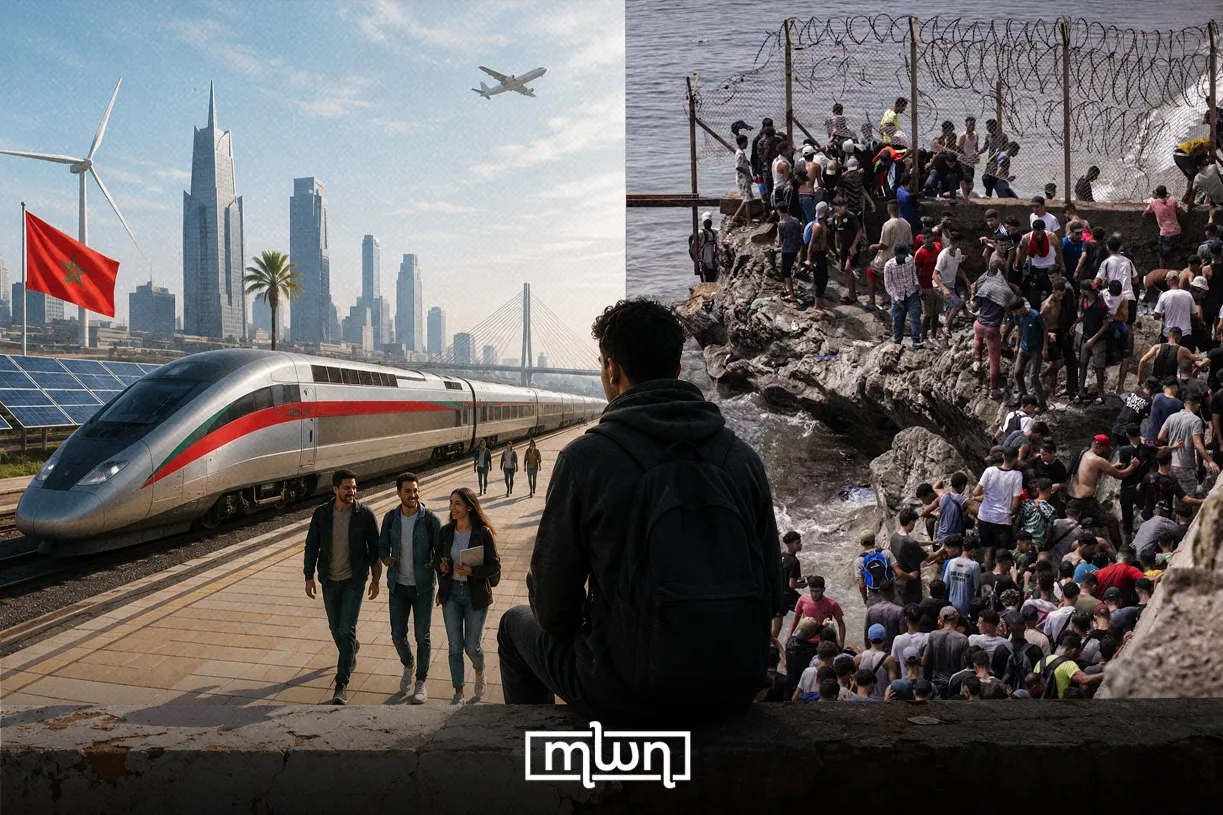
The recent rush of young Moroccans toward Ceuta prompted a serious discussion about why so many people were willing to risk their lives to reach Spanish territory.
Unfortunately, the incident revealed how quickly journalists, politicians, and commentators abandoned careful
analysis in favor of narratives that served their existing agendas. They treated them as an opportunity to confirm what they already believed, attack their political opponents, or advance a particular nationalist or ideological position.
The same images were used to tell entirely different stories. Some focused exclusively on irregular migration and border security. Others used the incident to revive the dispute over Ceuta and Melilla—two Spanish-controlled enclaves on the Moroccan coast that Morocco considers remnants of colonialism.
Another group interpreted the crisis through the changing geopolitical relationship among Morocco, Spain, Israel, and the United States, suggesting that Morocco’s increasingly powerful allies were helping it exert pressure on Spain. Meanwhile, official accounts of Morocco’s rapid economic progress stood in uncomfortable contrast to the desperation of the young people attempting to leave it.
Each of these issues deserves serious examination, but none should be reduced to a slogan or manipulated to support a predetermined conclusion.
The incident exposed four interconnected realities: the continuing pressure of migration, the unresolved question of Ceuta and Melilla, the influence of American and Israeli cooperation with Morocco on its relationship with Spain, and the contradictions of a rapidly developing Moroccan economy that is still leaving many people behind. Understanding what happened requires separating evidence from political messaging and examining each of these four issues on its own terms. This is the first of 4 articles focusing on each of these perspectives, starting with the current situation of the Moroccan economy through the lens of a young Moroccan.
The psyche of a young and disadvantaged Moroccan
The events in Ceuta reminded me of two young Moroccans I met during the migration surge at the U.S.–Mexico border under the Biden administration. I will call them Omar and Redouane. Their stories changed how I understood migration—not only to the United States, but also what I was now witnessing in Ceuta.
They had flown first to visa-free Brazil before traveling through South and Central America. For a month, they crossed dangerous jungles, paid smugglers, endured robberies and slept under the open sky. They witnessed migrants suffer terrible injuries, disappear or die far from home. By the time they crossed into the United States, they had survived one of the world’s most dangerous migration routes at the time.
After U.S. immigration authorities processed and released them pending hearings, they described the advice migrants exchanged about possible ways to remain in the country. Some discussed asylum claims based on religious conversion, which they believed would receive sympathy from Christian conservatives; sexual orientation, which they associated with support from liberals; or political persecution for openly opposing their governments. Whether these ideas accurately reflected American asylum law mattered less than what they revealed. To me, the latter choice was the obvious one especially after knowing how religious and conservative they are.
Omar and Redouane reacted in shock when I mentioned political asylum. They believed such a claim would prevent them from returning to Morocco, and that was off the table for them. Their answer puzzled me. If they were desperate enough to risk death crossing continents, why did the possibility of returning to Morocco still matter so much? While they were running away from the economic disadvantage, their love for their country was commendable. Their goal is not to flee Morocco, but to save enough money and come back to invest in Morocco or at least help the rest of their families have a dignified life just as the people who left before them. The billions of dollars remittance from the Moroccan diaspora not only encourages the rest to flee but even convinces some in government to assist them in achieving it. Unfortunately, I have no idea what came of the two young Moroccans. I wish them the best in accomplishing their dreams and at least get a piece of the American dream.
The economic advancement of the country
Morocco has built high-speed railways, modern ports, highways, industrial zones, renewable energy projects, football stadiums and airports. Tangier Med has become one of the Mediterranean’s major ports, while the automotive and aerospace industries have integrated
Morocco into international supply chains. The country is also investing heavily in preparation for the 2030 World Cup. The IMF estimated that Morocco’s economy grew by 3.2 percent in 2024 and projected faster growth of over 5% in 2026 by the OECD (Organization for Economic Cooperation and Development). International Monetary Fund
The economic advancement is not experienced through ports, trains or national growth figures alone. For ordinary people, development is measured through employment, wages, housing, schools, hospitals and the possibility of building an independent life. On these measures, Morocco’s transformation remains deeply uneven. The OECD (Organization for Economic Cooperation and Development) describes a labor market characterized by widespread informal employment, high youth unemployment, low female participation and significant emigration. The IMF similarly recognizes that Morocco continues to struggle with inactive youth, unequal opportunities for women and an economic system that does not distribute opportunity widely enough.
The NEET generation
One of the clearest measures of this exclusion is the number of young Moroccans classified as NEET—an acronym for people who are Not in Employment, Education or Training. The
category includes unemployed people who are actively looking for work, but it also includes
inactive young people who are neither studying nor searching for employment. It therefore
captures a larger and often less visible crisis than the unemployment rate alone
In April 2026, Morocco’s High Commission for Planning, known by its French initials HCP,
reported that approximately one in three Moroccans between 15 and 29 years old was neither working, studying nor receiving training. The HCP also found that young women were
disproportionately represented and that many NEETs were inactive rather than officially
unemployed. Among the narrower 15–24 age group, the OECD previously reported a rate of
approximately one quarter, with a sharp difference between rural youth, at 30.3 percent, and
urban youth, at 21.8 percent. Women represented nearly three-quarters of that group. HCP’s
2026 NEET study.
Available figures suggest that this is a regional North African problem rather than a uniquely
Moroccan one. However, comparisons must be treated cautiously because the year, age range and method can vary between sources.
| Country | Approximate NEET rate | Age group/source |
| Morocco | 29% | Ages 15–24, ILO comparison |
| Egypt | 28% | Ages 15–24, ILO comparison |
| Tunisia | 25% | ILO comparison |
| Algeria | 24% | Latest World Bank/ILO observation |
| Spain | 15.30% | Eurostat, 2025 |
| EU average | 12.80% | Eurostat, 2025 |
Sources: World Bank Gender Data Portal, Eurostat.
Although these figures are not perfectly comparable, the difference in scale is unmistakable.
Morocco’s NEET problem is roughly twice Spain’s. The elevated Spanish rate compared to the
European average explains European countries’ fear of mass Moroccan immigration once they cross the Spanish border. These young people are not simply “unemployed.” Many have become disconnected from the institutions that are supposed to carry them from adolescence into adulthood. They are not acquiring qualifications, gaining experience or earning the income needed to leave the family home, marry and raise children. They are living outside the very economic transformation their country is celebrating.
The soon to be missed opportunity
Morocco is also at risk of wasting its demographic dividend—the limited period when
working-aged people outnumber the children and elderly citizens who depend on them. Nearly one-third of Moroccans aged 15–29 are currently outside employment, education, and training, while the population is aging rapidly. People over 60 are projected to rise from 13.8 percent of the population today to 22.9 percent by 2050. If Morocco cannot employ and develop its young people before this window closes, it may grow old before becoming prosperous, leaving a smaller workforce to support a larger elderly population.
When progress feels like displacement
The contradictions of Morocco’s development are most visible among people at the bottom of the economy. Photographs and videos have shown families watching bulldozers demolish
shanties and deteriorated homes. The government’s objective is to replace unsafe settlements with modern housing, but the experience can be traumatic for residents. A structure that represents urban decay to a planner may be a family’s home, workplace and social-support system. Even when replacement housing is offered, families may face delays, disputed eligibility, debt, transportation expenses or relocation far from their livelihoods. The same goes for land used for roads, airports, tourist destinations, and public transportation. UN-Habitat report on informal settlements
Development can also harm disadvantaged people indirectly by increasing the cost of living.
New infrastructure, tourism and foreign investment can raise land values, rents and service
prices. Property owners and businesses may benefit, while tenants, pensioners, informal workers and families on fixed incomes pay more without receiving a comparable increase in earnings. Morocco’s consumer-price index increased by 21% in the last decade. Food is particularly important because it accounts for roughly 40 percent of the average Moroccan consumer basket and represents an even larger share of spending among poor households. Slower inflation numbers do not reverse these increases; it only means prices are rising less quickly. Consequently, many households continue suffering from the accumulated loss of purchasing power. Morocco’s High Commission for Planning, IMF analysis
Comparison to other countries in the past
Other countries had suffered similar growing pains. Singapore experienced disruption during its rapid transformation in the 1960s. Slums, farms and informal communities were cleared for
factories, roads and planned neighborhoods, and approximately 50,000 households were resettled between 1960 and 1972. Singapore’s success, however, did not come from demolition and infrastructure alone. The government combined redevelopment with mass public housing, education and industrial job creation, allowing the country to reach full employment by the early 1970s. Displaced residents were given a credible path into the emerging economy. The lesson for Morocco is that physical modernization cannot be considered successful merely because new buildings replace old ones. It becomes socially sustainable only when ordinary citizens can afford to live in the society being created. Morocco’s ports, railways, stadiums and industries are genuine accomplishments, but progress can become another source of hardship. For many of the young people who moved toward Ceuta, Morocco was not a country without progress; it was a country whose progress seemed to be benefiting others while making their own lives more difficult.
Is there trouble on the horizon?
The Moroccan government should not eliminate the risk that something bad is brewing. The king of Morocco, in his latest throne speech, delivered the same day as the Ceuta incident, asked for patience from his people, promising that the best is yet to come. This risk was expressed directly during the GenZ 212 demonstrations that began in September 2025. Organized largely through Discord, TikTok and Instagram, the decentralized youth movement demanded better healthcare, education, employment and greater accountability. The protests intensified after anger over deaths at a public hospital in Agadir and spread to cities including Rabat, Casablanca, Tangier, Marrakech, Agadir and Oujda.
One of the movement’s most powerful messages contrasted Morocco’s spending on sports
infrastructure with conditions in public hospitals and schools. Demonstrators used slogans such as “Health first” and “We want hospitals, not stadiums.” Their complaint was not that roads, railways or stadiums should never be built. It was that a modern country cannot be measured solely by the infrastructure visitors can see while the institutions its citizens depend upon remain inadequate.
The demonstrations gave political expression to the NEET statistics. The young people
protesting and those trying to reach Ceuta were not necessarily the same individuals, but both groups were responding to a similar absence of confidence. They did not believe that Morocco’s invisible economic progress guaranteed them a meaningful place within its future.