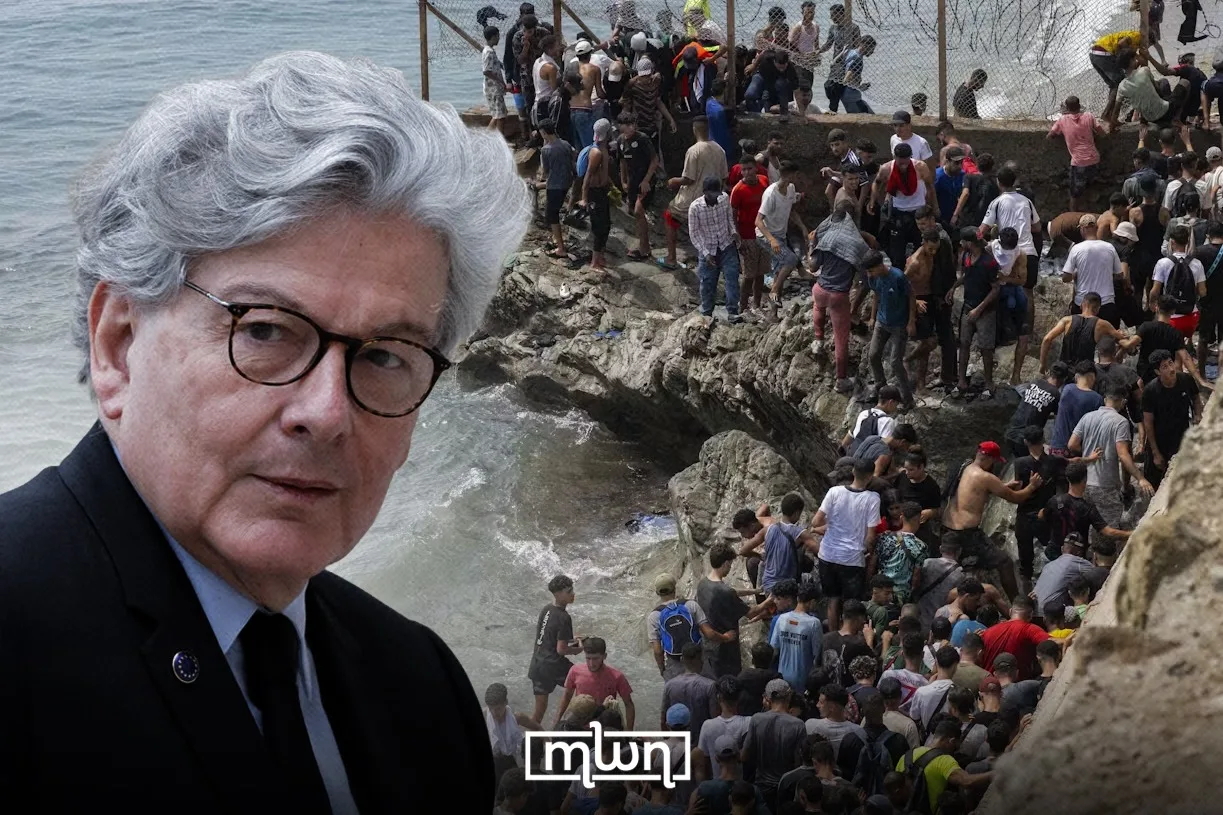
Rabat – Former EU Commissioner for Internal Market Thierry Breton urged the European Union to investigate what he described as a “hybrid attack” behind the mass crossings into the Spanish enclave of Ceuta in July.
For NATO, a hybrid attack is a combination of military and non-military actions to “destabilize a country.”
Breton made his remarks in an interview with Le Soir, describing the mass crossing as an “operation,” pointing to the role of social media and possible “state or non-state actors” behind the incident, without specifically naming a particular party.
He did not directly accuse Morocco of orchestrating the incident or identify any specific country as being behind it. However, his claims echo statements made by far-right political actors in Spain, who have sought to challenge Morocco’s migration policy and cooperation.
Far-right politicians, including those from Vox, have used the Ceuta mass crossing incident to challenge Morocco’s World Cup hosting rights, while also accusing Rabat of exploiting migration as a means of putting pressure on Spain.
In his interview with Le Soir, the former commissioner said that the crossing of 72,000 does not come “out of nowhere,” describing it as a hybrid attack or a “coordinated action combining military, informational, cyber and migration tools below the threshold of open conflict to weaken an adversary without giving it a cause.”
He drew a comparison with what he described as a “pattern” observed in 2021, accusing the government of Belarusian President Alexander Lukashenko of organizing the transfer of 17,500 people who attempted to cross the Polish border in October alone.
He also recalled Russia’s move to transfer around 1,000 migrants toward the Finnish border over three months.
Breton also alleged Morocco did not help prevent the mass migration from happening.
For him, Morocco did not do “what it usually does, that is, to stop people seeking to leave five, 10 or 20 kilometers from the border.”
He then proposed two possible interpretations, including “algorithmic pressure” that encouraged people to move toward the enclave or a “possible state signal,” speculating that a state could have deliberately allowed or facilitated the situation to send a message to Madrid or Brussels.
“What I am saying publicly, however, without beating around the bush, is that the only hypothesis I believe can be ruled out is that of chance.”
“Twenty thousand people in a Facebook group, 11 million impressions, a calibrated slogan, timing chosen at the beginning of a European tourism and political peak — that is not improvised in a garage,” he added.
A shared responsibility
While he did not attribute the situation to Morocco, Breton questioned the North African country’s efforts, despite Spain’s acknowledgment and praise of Rabat’s cooperation and its reaffirmation of Morocco’s commitment to facilitating the return of migrants.
Breton’s remarks come despite Morocco’s stated commitment to addressing irregular migration from the outset of the Ceuta crossings, particularly through its emergency response and agreement with Spain to facilitate the return of all migrants who entered the enclave irregularly.
Morocco and Spain announced the agreement on the same day as the crossings, with Rabat reiterating its commitment to tackling irregular migration and emphasizing the importance of its contribution to addressing the migration crisis without preconditions.
Morocco, however, has rejected criticism of its role, arguing that it should not bear the consequences of a Spanish judge’s decision to prevent the immediate or “hot” return of migrants. Rabat has also emphasized that it is not a “concierge” or police force for the European Union.
Rabat has reiterated that it will continue to shoulder its responsibilities in addressing migration, while emphasizing that efforts to manage migration challenges should be based on shared responsibility between the countries concerned.
Several reports also pointed out the presence of numbers with non-Moroccan phone codes involved in online campaigns, with reports stating that they were originating from Algeria.
Spanish EFE also said that authorities are not ruling out this possibility and that it is now monitoring a similar online campaign inciting another mass migration attempt on August 15.
Social media platforms such as TikTok and Meta also agreed to work with the EU on fact-checking social media content linked to migration attempts into the Spanish-occupied enclave of Ceuta from Morocco following the recent crossing incident.