
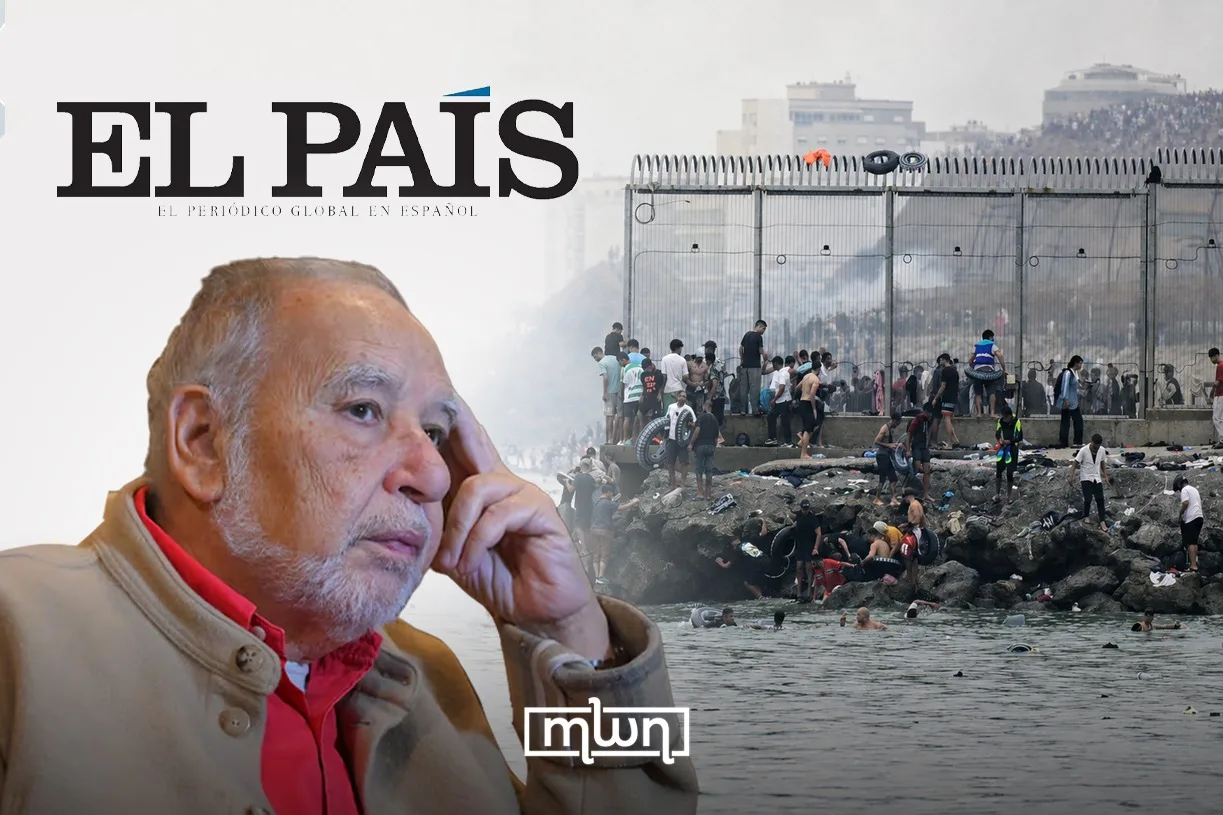
Rabat – In times of crisis, some words reassure, while others are deeply unsettling. Speaking from Tangier, writer Tahar Ben Jelloun appears to have chosen the latter, ill-timed path. Interviewed by El País in the aftermath of the rush on Ceuta on July 30 and 31, Morocco’s most decorated writer rightly began by denouncing the punitive hysteria of Giorgia Meloni and several European capitals. He also recalled, with good reason, that Morocco legitimately claims the return of these two enclaves, the last vestiges of European colonialism on Moroccan soil.
Yet between these two necessary truths, the writer above all chose to tell Spaniards what they seem to want to hear about this migration crisis.
“I don’t understand why they weren’t stopped in Tetouan. We have the most powerful police force in the Maghreb. It would have been enough to send them back home and tell them they had no business being in Ceuta. There was a glaring lack of political intelligence.”
From this perspective, the blame lies first and foremost with the Moroccan police, with their alleged “lack of political intelligence,” and with the eagerness to emigrate of young people who, according to him, should have been stopped in Tetouan.
Faced with this one-sided diagnosis, which appears to lend legitimacy to the conspiratorial narrative portraying Spain as the victim of geopolitical “blackmail,” I felt it necessary to offer a rebuttal—one that places the facts in their proper context and rejects the convenience of such a simplistic narrative.
For if there is indeed a fundamental difference between observing a tragedy and explaining it, I believe it is urgent that someone remind our writer of the true significance of that distinction. In other words, someone should tell him to stop telling Spaniards what they want to hear rather than what they need to hear. Positions such as his are infuriating because they invariably seek to please others- and Europeans in particular- when what is needed instead is to look them straight in the eye and tell them some uncomfortable truths.
Yes, what happened in Ceuta should never have occurred, and we are all, collectively, embarrassed by the way events unfolded. But it is both unacceptable and ill-advised to discuss what happened in such a reductive manner. The problem is all the more serious in this case because such a simplistic reading comes from an intellectual whose very role requires a thorough knowledge of history and, consequently, an obligation to place events within their broader political, social, geographical, and historical context.
Yes, successive Moroccan governments bear a heavy responsibility for what happened. On the one hand, they have failed to create an economy capable of absorbing the growing number of young people seeking employment. On the other hand, they bear responsibility for universities that continue to produce graduates whose skills are poorly suited to the needs of the labor market. One could also legitimately dwell on the scourge of corruption, which penalizes Morocco’s dynamic and productive forces while allowing a rent-seeking economy to prosper at their expense.
But does that mean we should remain silent about the responsibility of Spain- and, more broadly, Europe- in exacerbating the per capita income gap that has separated the two shores of the Mediterranean for decades?
A One-Sided Reading
Among many Spanish analysts, there is a deeply entrenched bias: a tendency to view Morocco with suspicion and to refrain from examining developments there with the objectivity, sobriety, and methodological rigor ordinarily reserved for countries of the Global North. Because, in their eyes, Morocco is not a democracy, its institutions are almost never given the benefit of the doubt when a crisis such as the one in Ceuta occurs. By extension, and even beyond the particularly instructive case of Ceuta, the historical record shows that Spain’s political, media, and intellectual establishment rarely treats an event occurring in Morocco in the same way it would treat an equivalent event in a European country.
Thus, when attempting to make sense of episodes such as the Ceuta crisis, Spanish media- and Western media more generally- too often seek to corroborate their preexisting assumptions by giving a platform either to the most outspoken opponents of the Moroccan state or to those who simply harbor no sympathy toward it. They almost never think to seeks the views of other Moroccans whose knowledge of the country may be considerably deeper and whose analysis may therefore be far more nuanced. Since July 29 and 30, I have read around a hundred articles published in the Spanish press about what actually happened during this episode of the migration crisis. Not a single major Spanish media outlet has gone beyond the simplistic accusation of Moroccan “blackmail,” nor has any seriously questioned the excessive securitization of the European Union’s migration policy.
I was particularly struck by a report from RTVE, whose author explained that, in an effort to understand the events in Ceuta, he had consulted “researchers and legal experts.” Yet he notably failed to mention that all those interviewed, including a member of the Polisario, were known for their opposition to the Moroccan state. How can one credibly claim to offer readers a balanced analysis when the only voices consulted belong to the same camp and share, with only minor variations, essentially the same analytical framework?
Hence the pressing need for Moroccan intellectuals who genuinely want to move things forward to speak up and set the record straight. For the role of any intellectual worthy of the name is not to tell the media what they want to hear, but rather to ask uncomfortable questions, venture beyond conventional thinking, and challenge ready-made analytical frameworks.
Since the latest rush toward Ceuta, Spanish intellectuals, diplomats, and academics have repeated ad nauseam that the per capita income gap between Spain and Morocco stands at roughly eight to one, arguing that this disparity is one of the principal reasons why young Moroccans view emigration as a way out of their economic and social difficulties. But what, concretely, do they propose to remedy this situation? Do they put forward even a single proposal capable of narrowing this gap? Most prefer, more simply, to place responsibility for the crisis on Morocco, notably by accusing it of “weaponizing” migration as a means of “blackmail” against the Spanish government.
Amid this avalanche of analyses that are as superficial as they are sensationalist, one truth has been conspicuously absent: not only has Spain never made narrowing this economic disparity a genuine priority, but for decades it turned a blind eye to an illegal economic activity that durably and severely weakened the Moroccan economy. Therefore, if Spain, and, more broadly, the European Union, genuinely intends to combat irregular migration, its strategy must rest on two complementary pillars.
First, it must substantially increase its financial support to Morocco. Morocco cannot reasonably be expected to shoulder, almost single-handedly, the enormous financial burden of securing the European Union’s southern external border.
Second, European leaders must move beyond the comfort zone of security-driven policies and finally acknowledge an essential reality: irregular migration cannot be sustainably reduced unless the structural conditions that drive millions of people across the Global South to view emigration as their only escape from poverty and their only path toward a better future are addressed.
Among these structural causes is a profoundly unequal international economic system in which European countries continue to impose rules that disproportionately disadvantage developing economies. The European Union could therefore begin by gradually dismantling the agricultural subsidy regime under the Common Agricultural Policy, as well as the asymmetrical trade and migration policies it has long adopted towards African countries. There is broad consensus among economists and development specialists about the harm these subsidies inflict on the competitiveness of African farmers. By heavily subsidizing European agricultural products, they enable them to undercut- and, in most cases, displace- local production in African markets.
The sad irony, which many self-styled analysts fail to acknowledge, is that the asymmetrical trade policies pursued by the European Union toward countries such as Morocco contribute to the emergence of new pockets of poverty and destitution, pushing growing numbers of people to view emigration as a solution to their economic and social hardships. Yet European leaders seek at all costs to suppress a phenomenon partly fueled by their own self-serving and hard-nosed economic policies, while expecting Morocco to behave in an exemplary manner and systematically act as Europe’s gendarme.
And when an event like what happened on July 29–30 takes place, an army of so-called analysts and opportunistic politicians unleashes a torrent of scathing, acerbic criticism aimed at damaging Morocco’s reputation, while resoundingly failing to address the heart of the issue.
At the same time, Spain should channel substantially greater levels of productive investment into the principal countries of origin of migratory flows, particularly into sectors capable of creating large numbers of jobs for unemployed young people. While Spanish observers repeatedly dwell on the income gap between Morocco and Spain, they rarely stop to ask why Spanish investments in Morocco represent only a fraction of Spain’s investment in Latin America.
That is the real debate Spaniards should confront if they genuinely intend to combat irregular migration in a sustainable manner. Border controls may temporarily reduce migratory flows, but only economic development can reduce them over the long term.
The Anachronism of Ceuta and Melilla
The second issue conspicuously absent from Spain’s media and political debate is the very one that history itself has stubbornly left unresolved. Put plainly, it is the anachronism represented by the continued presence of two Spanish enclaves on Moroccan territory, a vestige of an inglorious past in which few Spaniards should take pride. The presence of these two enclaves has historically generated serious economic and security problems with which Morocco has had to contend and coexist for centuries.
Consider the case of smuggling, which for decades constituted the principal economic lifeline of Ceuta and Melilla, before Morocco gradually succeeded in addressing the problem through the construction and development of the Tangier port and the port of Nador, as well as through the closure of the customs post at Beni Nsar on the border with Melilla and the Tarajal crossing on the border with Ceuta. As I demonstrated in a book I published in 2008 on relations between Morocco and Spain, the geographical constraints of these two enclaves, their extremely limited territory and the absence of any meaningful agricultural activity, made them structurally dependent on this parallel trade.
Although their combined population did not exceed at the time 130,000 inhabitants, their ports received a considerable number of cargo ships every day carrying volumes of merchandise that vastly exceeded the needs of their local populations. Given the enclaves’ status as free zones, the real economic objective for Spanish exporters was to flood the Moroccan market with products that escaped both customs duties and value-added tax.
And this occurred at the cost of progressively weakening Morocco’s domestic economic fabric. Thanks to the porous borders separating the enclaves from their Moroccan hinterland, and the ease with which smugglers who depended on this activity could move goods across them, products of every kind poured into the Moroccan market on a daily basis: cosmetics, tires, detergents, food products, insecticides, televisions, vehicle license plates, clothing, and much more.
Thus, while the volume of legal trade between Morocco and Spain barely exceeded €4.9 billion in 2006, the turnover generated for Spaniards by this illegal trade amounted to approximately $1.5 billion. In addition to the resulting loss of customs duties and value-added tax revenues, Morocco faced a trade deficit that this smuggling- which Spaniards euphemistically, and not without a certain hypocrisy, referred to as “atypical trade”- only continued to widen. Adding the €130.2 million trade deficit Morocco recorded with Spain in 2006 brought the total to approximately $1.8 billion, more than the combined value, at the time, of all the aid Madrid provided to Morocco and the remittances sent home by Moroccan immigrants residing in Spain.
More seriously still, this massive influx of smuggled goods dealt a severe blow to Morocco’s economic fabric. Unable to withstand such unfair competition, many Moroccan businesses were forced to reduce their workforce, while others simply ceased operations altogether, further exacerbating unemployment. A statement by Hassan Chami, then an official at the General Confederation of Moroccan Enterprises (CGEM), captures the extent to which smuggling had become a cancer eating away at the national economy: “Our producers must take smuggling into account as a factor of unfair competition. It is more difficult to sell on the domestic market than to export. When we export to European countries, we face fair competition.”
According to Chami, smuggling was responsible for the disappearance of nearly 400,000 jobs per year in Morocco. A study conducted in 2002 by the American Chamber of Commerce in Morocco reached a similar conclusion: every job generated by smuggling resulted in the loss- or non-creation- of ten legal jobs. And when one considers that nearly 35,000 people depended on this activity in the border areas of Ceuta and Melilla alone, the sheer scale of the damage inflicted on the Moroccan economy becomes clear.
The flood of smuggled goods originating from these two enclaves thus contributed directly to the closure of General Tire in Morocco and the loss of 700 jobs, as well as the elimination of 150 positions at Goodyear Morocco. This is precisely what the dominant narrative, in Madrid and elsewhere, stubbornly chooses to overlook.
It is, therefore, as scandalous as it is irresponsible to portray Spain simply as the victim of a migration crisis supposedly orchestrated by the Moroccan police, whether deliberately or inadvertently. Such a narrative conveniently absolves Spain of any responsibility while stripping the crisis of the broader historical, economic, and structural context necessary to understand it. A fairer reading, and one genuinely concerned with identifying appropriate and lasting solutions, would instead recognize Spain as jointly responsible for a crisis it shares with its Moroccan neighbor.
Samir Bennis is the co-founder and publisher of Morocco World News. You can follow him on Twitter @SamirBennis.