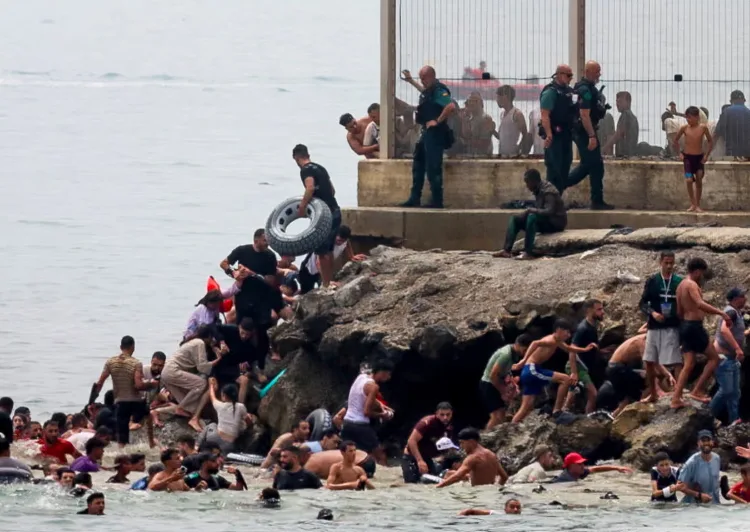
Rabat – UNICEF Spain has urged Ceuta authorities to prioritize the identification of unaccompanied migrant minors who entered the enclave during the recent mass crossings.
Europa Press quoted UNICEF’s statement, which also called for individual assessments of the minors, rejecting their return without guaranteeing the protection provided under Spanish and international law.
The organization also described the situation as serious, calling for family reunification whenever possible.
UNICEF Spain Executive Director José María Vera said protecting minors is not “only a legal duty” but also a matter of “humanity that we cannot turn a blind eye to.”
“Behind the figures we see every day in the media are the stories of children and adolescents who are particularly vulnerable,” Vera said, recalling that those who crossed into the enclave are “alone, frightened and unable to communicate with their loved ones.”
The UNICEF statement came a few weeks after one of the largest mass crossings to hit the Moroccan-Spanish border.
On July 30, tens of thousands of migrants, including minors, crossed or attempted to reach the enclave.
Spanish reports claimed their number was between 70,000 and 80,000, while Morocco’s Interior Ministry estimated the number at 40,000.
Spanish reports indicate that 20,000 people are still in the enclave, including more than 1,000 minors.
Spain recently updated the number of minors who arrived in the enclave after 1,527 were registered through National Police stations.
Spanish Justice Minister Félix Bolaños also pledged his government’s efforts, in coordination with Morocco, to achieve family reunification in Morocco for those minors.
Morocco demands minors’ return
Earlier this week, Justice Minister Abdellatif Ouahbi said Morocco is demanding the return of Moroccan minors, accusing Spanish authorities of repeatedly obstructing efforts to repatriate them.
“We are demanding their return. This is not an issue that emerged today, yesterday, or because of the latest incident,” Ouahbi said, adding that discussions between Rabat and Madrid have continued without reaching an agreement.
While Rabat agreed to the return of all those who entered the enclave illegally, Spanish politicians, including those from the far right, have continued to spread accusations against Morocco.
Vox, for example, has accused Morocco of deliberately allowing migrants to cross to pressure Spain.
Morocco, however, has rejected such criticism, emphasizing its continued cooperation and long-standing efforts to combat irregular migration.
Rabat has repeatedly emphasized that Morocco is not a “concierge” or police force for the EU, arguing that the risks associated with irregular migration cannot be addressed through the efforts of one country alone and that tackling the issue requires shared responsibility.