
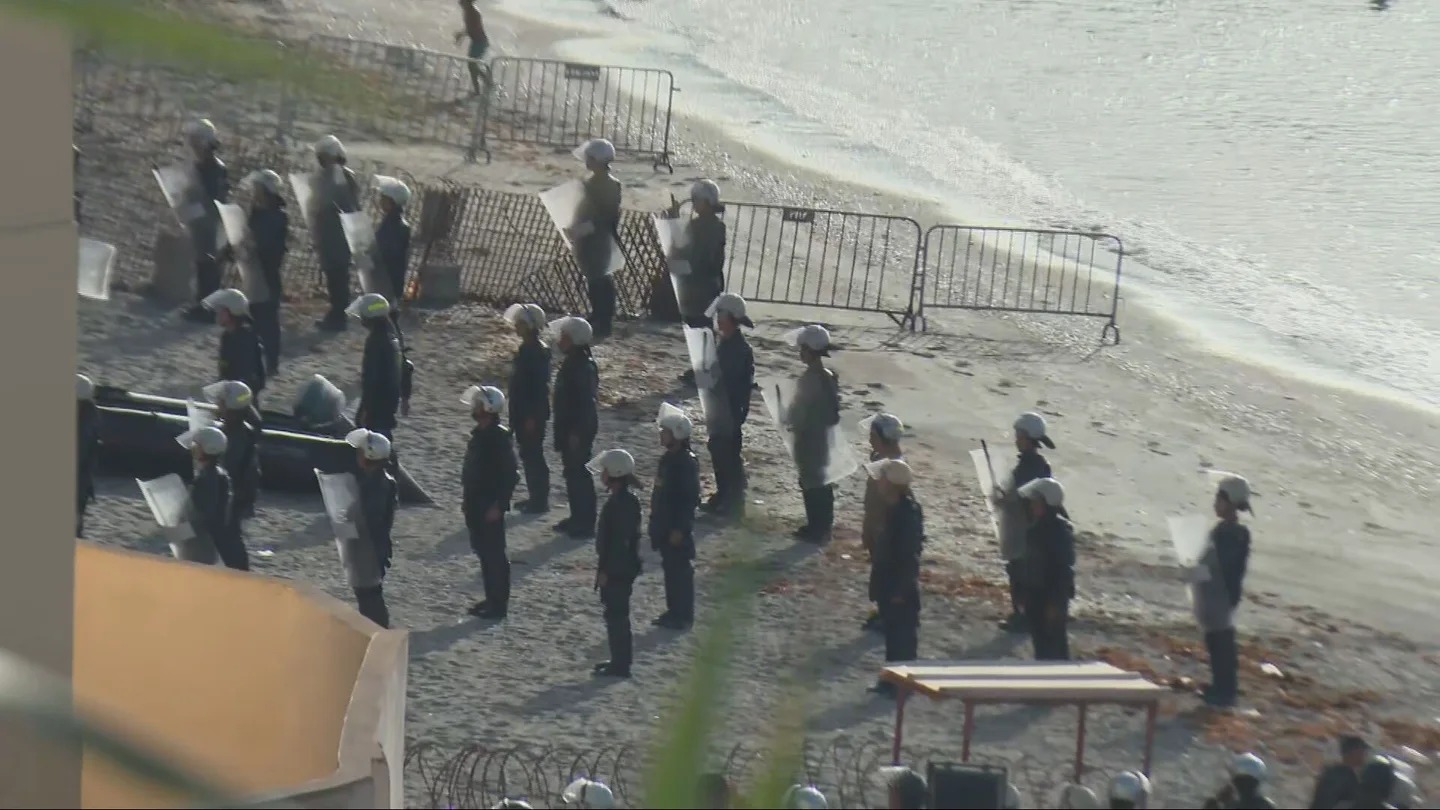
Rabat – Morocco has deployed hundreds of riot police near the border with the Spanish-occupied enclave of Ceuta as authorities prepare for a possible new mass migration attempt on August 15, Spanish broadcaster laSexta reported today.
The broadcaster filmed the deployment on Wednesday afternoon at the Benzú border area, opposite Ceuta’s Tarajal crossing. Hundreds of Moroccan officers were seen on the beach wearing helmets and carrying shields.
laSexta said the deployment was unusual because Benzú is not normally used by migrants attempting to enter Ceuta. The officers were withdrawn overnight, leading the broadcaster to suggest that the deployment may have been a training exercise ahead of Saturday.
No large police deployment was visible at Tarajal on Thursday morning, where the mass entry of migrants took place in late July. However, border barriers remained in place and Moroccan maritime surveillance continued, added the report.
According to laSexta, eight Moroccan Navy vessels were positioned off the coast near Castillejos and were conducting patrols along the shoreline.
The increased security comes amid hundreds of calls circulating on social media for a new mass crossing into Ceuta and Melilla on August 15.
Read also: Morocco Seeks Fairer Spain Partnership to Protect Unaccompanied Minors, Expert Says
Moroccan security forces have reportedly been intercepting people on roads leading toward areas near the two Spanish cities and returning them to their cities of origin.
Spain’s Guardia Civil has also warned against attempts to cross the border, saying in a social media post that “the border with Spain is not open and will not open.” It added that new containment barriers had been installed and warned that people who cross them will be returned.
The latest developments come as tensions between Morocco and Spain over migration continue to grow following the July mass arrivals in Ceuta.
Moroccan Justice Minister Abdellatif Ouahbi has criticized Spain’s approach to migrants, saying Morocco works to prevent people from leaving the country but that Spain accepts those who manage to reach its territory, mainly referring to minors still in Ceuta.
In an interview with EFE, Ouahbi also warned that Morocco could suspend the application of its extradition agreement with Spain, citing what he described as a lack of reciprocity between the two countries.
“We prevent the departure of migrants, not only Moroccans but also others, but when they arrive in Spain, they are accepted and their situation is regularized,” Ouahbi said.