
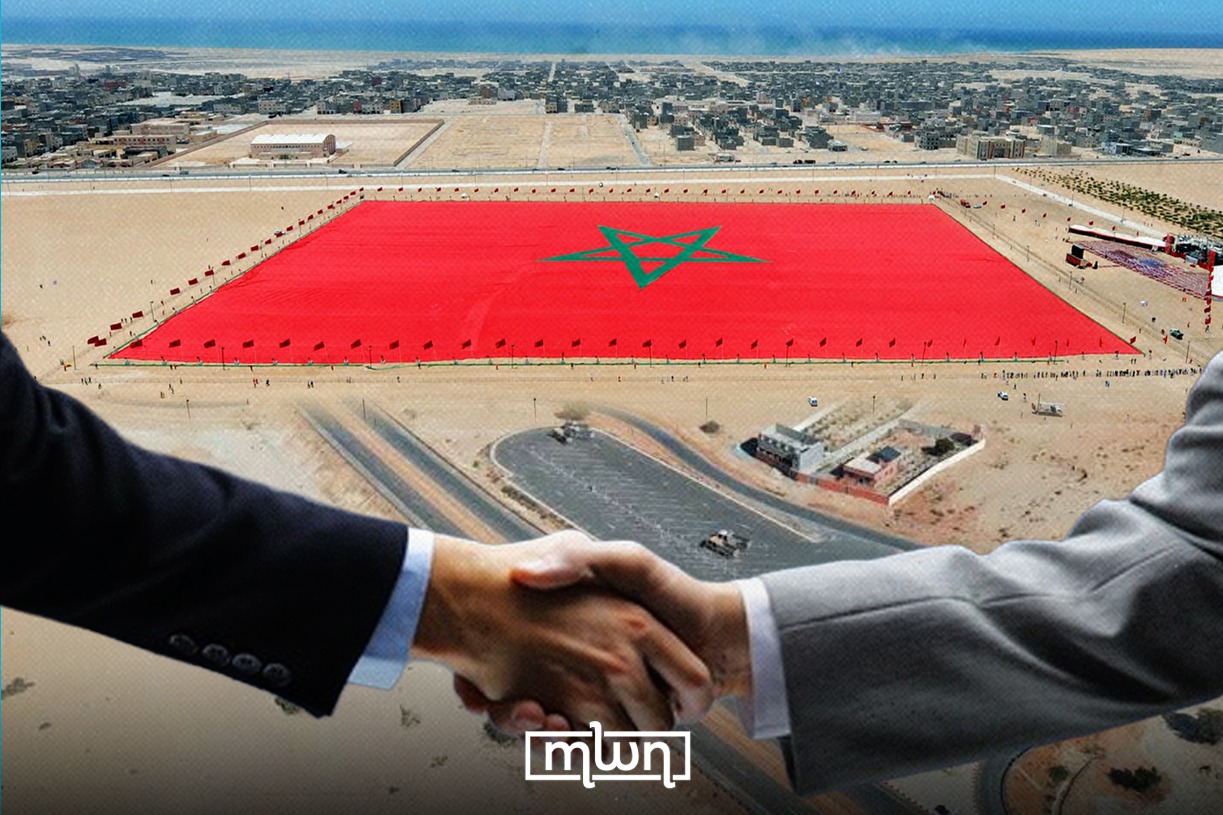
When Morocco announced that the Tiznit–Dakhla Expressway would bear the name of Donald Trump, followed by Trump’s public expression of gratitude to King Mohammed VI for the tribute, the announcement carried a significance that went far beyond the symbolism of a road sign. The decision was not simply about naming a major infrastructure project after a foreign political figure; it represented another milestone in Morocco’s long-term strategy of consolidating international support for its sovereignty over the Sahara and highlighting the strategic importance of its southern provinces.
The gesture reflected the convergence of several dimensions: diplomatic recognition, strategic partnership, economic development, and geopolitical positioning. It illustrated how Morocco has progressively transformed the Sahara from a prolonged political dispute into a central pillar of its national vision and international engagement. The highway became a symbol of a broader transformation: physically connecting Morocco’s northern regions with its southern provinces while projecting a message of territorial integration, economic ambition, and strategic confidence.
To understand the significance of this development, one must look beyond the ceremony itself and examine the broader trajectory of Morocco’s Sahara policy under King Mohammed VI. Over the past two decades, the Kingdom has pursued a comprehensive strategy combining proactive diplomacy, large-scale investment, regional integration, and international partnership-building. Rather than allowing the Sahara issue to remain trapped in an endless cycle of political debate, Morocco has sought to create a new reality based on development, stability, and strategic engagement.
From defensive diplomacy to strategic development
For much of the late twentieth century, Morocco’s approach to the Sahara issue was primarily focused on defending its historical, political, and legal position while navigating a complex international process. Rabat consistently reaffirmed its sovereignty over the territory and rejected proposals that it considered unrealistic or incompatible with regional stability. However, the issue remained largely confined to diplomatic negotiations and international discussions.
Under King Mohammed VI, this approach underwent a profound transformation. Morocco moved from a primarily defensive posture to a strategy based on initiative and long-term vision. The Sahara was no longer treated only as a territorial question requiring diplomatic defense; it became a strategic national asset capable of supporting economic growth, strengthening national cohesion, and expanding Morocco’s influence across Africa and the Atlantic region.
This transformation was built on a fundamental principle: sovereignty in the modern era is reinforced not only through political arguments but also through effective governance, economic development, and the creation of tangible realities on the ground. Morocco therefore invested heavily in infrastructure, transportation networks, renewable energy, ports, agriculture, fisheries, education, healthcare, and social development projects throughout the southern provinces.
The objective was to transform the Sahara from a territory internationally associated with political u uncertainty into a dynamic region of investment, connectivity, and opportunity. Major projects in Laayoune and Dakhla have contributed to the emergence of new economic centers capable of attracting investment and strengthening Morocco’s position as a gateway between Africa, Europe, and the Atlantic world.
The Tiznit–Dakhla Expressway represents the clearest expression of this vision. It is not merely a transportation project; it is part of a wider geopolitical strategy. By improving connectivity between northern and southern Morocco, the highway reinforces national integration while creating a strategic corridor toward West Africa. It symbolizes the idea that infrastructure can serve as an instrument of diplomacy, economic influence, and territorial development.
Diplomacy and the push for international recognition
Alongside this development strategy, Morocco has pursued an ambitious diplomatic effort to reshape international perceptions of the Sahara issue. At the center of this approach is the Autonomy Plan, presented by Rabat in 2007 as a realistic and credible framework for achieving a political solution while preserving Morocco’s sovereignty.
From Morocco’s perspective, the Autonomy Plan represents a balanced approach combining local governance, democratic participation, and regional stability. Rather than maintaining an open-ended dispute, the proposal seeks to establish a durable solution based on compromise, realism, and sustainable development. Over time, it has received increasing international support, with many countries describing it as a serious, credible, and pragmatic basis for resolving the issue.
This diplomatic evolution has been reflected in the growing international engagement with the southern provinces. The opening of consulates in Laayoune and Dakhla by several countries has sent a significant political message, demonstrating stronger ties with the region and greater confidence in Morocco’s development strategy.
For Rabat, these developments are not isolated diplomatic achievements but part of a broader transformation in the international understanding of the Sahara. Morocco argues that the combination of political stability, economic development, and regional integration provides the most realistic foundation for a lasting solution.
The Sahara strategy takes on a broader geopolitical dimension
The United States has played a particularly important role in this transformation. The American recognition of Morocco’s sovereignty over the Sahara in 2020 represented a major diplomatic turning point. It strengthened the strategic partnership between Rabat and Washington and reinforced Morocco’s argument that the future of the Sahara should be approached through realism, stability, and political pragmatism.
The importance of this recognition extends beyond the bilateral relationship. As a major global power and a permanent member of the United Nations Security Council, the United States’ position influenced the broader diplomatic environment surrounding the issue. From Morocco’s perspective, this development encouraged a wider reassessment among international partners and reinforced the credibility of its approach.
Morocco has also strengthened its relations with Arab and African partners. Through its expanding economic presence across Africa, the Kingdom has promoted a model of South-South cooperation based on investment, infrastructure development, and shared prosperity. The Sahara occupies a central place in this vision, serving as a platform for Atlantic connectivity and a gateway toward the African continent.
This African dimension is particularly significant because Morocco’s strategy goes beyond the traditional framework of territorial disputes. Rabat seeks to position the southern provinces as a meeting point between Africa and the global economy, supported by ports, energy projects, logistics networks, and trade corridors. The Sahara is therefore integrated into a broader vision of Morocco’s role as a regional hub.
The human and developmental dimension remains equally central to Morocco’s approach. Rabat emphasizes that the legitimacy of any political vision must be accompanied by improvements in the daily lives of populations. This is why development projects have focused on employment creation, education, healthcare, infrastructure, and economic opportunities.
From the Moroccan perspective, development is not separate from sovereignty; it is one of its strongest expressions. A territory becomes more stable and more integrated when citizens benefit from growth, investment, and improved living conditions. The transformation of the Southern Provinces is therefore presented as evidence of a model linking territorial integrity with social and economic progress.
This approach has allowed Morocco to redefine the Sahara issue within a broader geopolitical context. It is no longer viewed only as a territorial question but as part of wider discussions about regional security, economic integration, migration cooperation, energy transition, and Africa’s future development.
A new vision for sovereignty, regional influence
The evolution of Morocco’s Sahara policy under King Mohammed VI reflects a transition from defensive diplomacy to strategic initiative. The Kingdom has combined infrastructure, diplomacy, economic investment, and international partnerships to create a new dynamic around the issue. Its strategy is based on the conviction that lasting influence comes not only from political arguments but also from credibility, performance, and the ability to build constructive alliances.
Today, the Moroccan Sahara represents more than a national cause. It has become a reflection of Morocco’s broader vision of the state: a country that links sovereignty with development, identity with strategic interests, and territorial integrity with international influence.
The Tiznit–Dakhla Expressway therefore represents much more than a highway. It symbolizes a new phase in Morocco’s approach, where infrastructure becomes diplomacy, development becomes a tool of influence, and the Sahara becomes a platform for regional integration and international cooperation.
The central message of Morocco’s strategy is clear: sovereignty is strengthened not only through declarations but through achievements. By investing in its southern provinces, expanding international partnerships, and promoting a vision based on stability and development, Morocco seeks to transform the Sahara from a historic challenge into a strategic opportunity for the future.