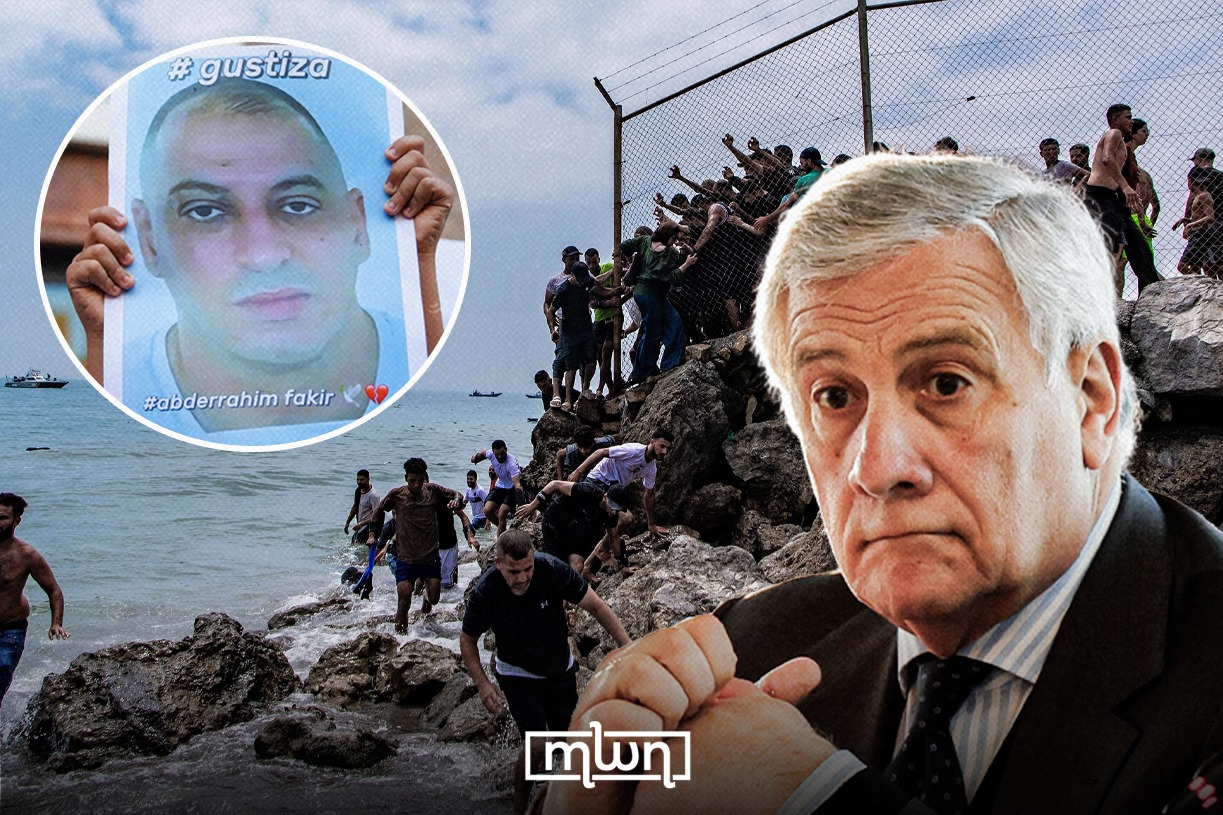
Rabat – Italian Foreign Affairs Minister Antonio Tajani claimed Spain should “worry about Morocco,” alleging that’s where “problems are coming from.”
He made his remarks in an interview with Corriere Della Sera, in which he spoke about a recent political row with Spain.
Asked about Italy’s temporary suspension of Schengen toward Spain, the Italian official said his country is not waging “any kind of battle against Spain,” claiming his government is monitoring migrant arrivals.
“Spain should worry about Morocco: That’s where the problems are coming from, certainly not from our controls, which serve everyone’s purpose of preventing illegal immigrants, and worse, potential terrorists from reaching Europe,” he said in the interview.
His remarks appear to come in line with the ongoing anti-Morocco rhetoric, blaming Morocco, the North African kingdom, for the recent mass crossings in Ceuta.
One of the largest crossings took place on July 30, when tens of thousands of migrants swam to the Spanish-occupied enclave.
Spanish authorities shared different and contradictory numbers since the crossing, with some—including authorities—alleging that between 70,000 and 80,000 entered the enclave.
Moroccan official estimates said 40,000 people headed to Ceuta, while more than 1,000 attempted to cross to Melilla.
Tajani’s remarks come as Morocco continues to strengthen its border controls and respond to calls for new mass crossings amid a lack of limited funds from Europe.
Earlier this week, Morocco tightened its border control and responded to a small number of migrants who sought to cross the enclave in response to a social media campaign inciting a new crossing on August 15.
Morocco arrested at least 290 migrants, including sub-Saharan migrants, who attempted to cross to the enclave.
Tajani’s comments also mark anti-Moroccan rhetoric despite Morocco’s repeated appeals for a shared responsibility to contain irregular migration and cooperate with European authorities.
While Spain’s government acknowledged Morocco’s efforts, other politicians from the cabinet itself and parties on the far right and main opposition attempted to lecture Rabat despite their limited efforts to help tackle the issue of migration.
Some directly blamed Morocco for the influx of July 30, while others accused it of attempting to blackmail.
Morocco, however, strongly responded to the campaign targeting its efforts, emphasizing that the issue of migration should be addressed with responsibility from all parties and not one specific party.
It also emphasized its role as a contributor to tackling the issue and that it should not be regarded as Europe’s guard or concierge.
In response to accusations and complaints, Morocco’s Ministry of Interior called on Spanish authorities to assume their responsibilities and work to speed up the procedures for returning unaccompanied minors.
“Combating irregular migration and human trafficking networks cannot rely on the efforts of one party alone. Rather, it requires all parties to assume their responsibilities and fulfill their commitments within the framework of shared responsibility,” the ministry said through its spokesperson earlier this month.
Morocco also emphasized that it will continue to fulfill its duties with firmness and responsibility, ensuring that tackling migration is not only limited to a specific date.
Italy’s Paradox
Tajani’s attempts to lecture Morocco come as his country is under scrutiny and has been using the Ceuta migration to overshadow one of the heartbreaking cases in Italian history.
On July 19, two police officers used physical brutality to restrain a Moroccan man called Abderrahim Fakir, who suffocated to death.
A video documented the moment when the two police officers knelt him down with his face on the ground while they were also pinning his feet and pressing his chest on the floor for several minutes while he was pleading with them to stop and for help.
The killing of Fakir took place in front of witnesses, particularly four medical workers who stared at the police without taking action until he lost consciousness.
Reports said Fakir also had his lungs full of blood, and an autopsy was carried out to investigate the cause of death, while the investigation is also involving police body cam.
Despite the horrific scene, the two police officers came back to work amid the investigation, while politicians, including those from the government, backed the police force against migrants.
Right-wing Italian Deputy Prime Minister Matteo Salvini has sparked backlash for remarks that overlooked a viral video documenting police brutality and a fatal intervention against Fakir.
“I stand by the two police officers in Bologna and the four emergency medical workers from the 118 ambulance service. And, of course, I also stand with the victim’s family, whom I urge not to speak of revenge,” he said.
He added that he hopes the judiciary clarifies what happened as soon as possible to “prevent mud from being thrown by people who do not understand what occurred and who have no respect for those who risk their lives to protect ours. Clearly, nobody wanted anyone to die,” he claimed.
He also accused Fakir of “behaving violently and causing a disturbance,” stating that the neighborhood where he was killed is home to “many decent people who are tired of living alongside those who make their lives difficult.”