
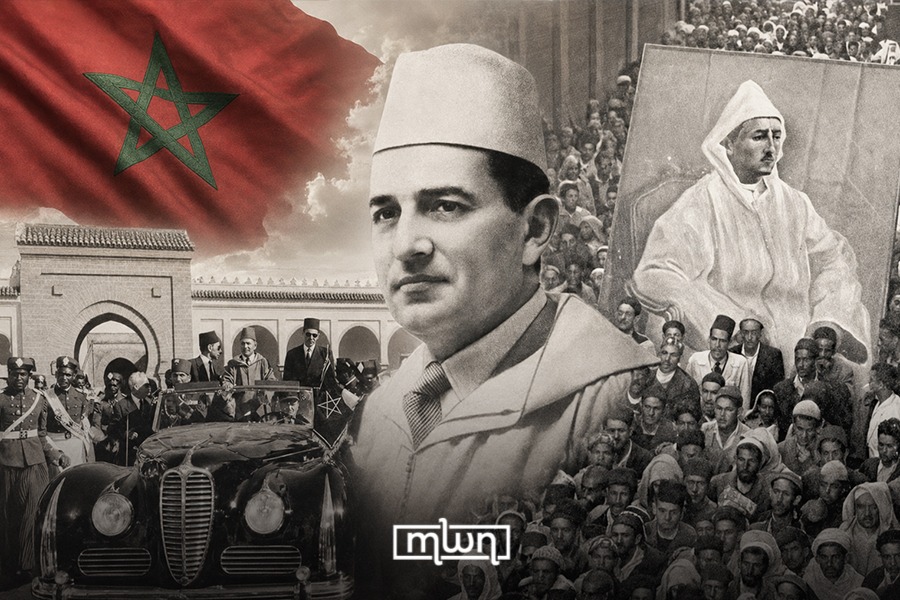
Casablanca – Morocco marks the Revolution of the King and the People on August 20, a date linked to the forced exile of Sultan Sidi Mohammed Ben Youssef in 1953 and the resistance that followed it.
The period between August 20, 1953, and November 16, 1955 lasted 27 months and saw the independence movement move beyond political negotiations and into widespread popular resistance. The French colonial administration had expected the removal of the Sultan to weaken nationalist agitation and isolate the Istiqlal Party. Instead, his exile turned him into a central symbol of national and religious legitimacy.
The crisis had been building for years. After Mohammed Ben Youssef’s April 9, 1947 speech in Tangier, in which he linked the monarchy with territorial integrity and Arab-Islamic identity, colonial authorities looked for ways to limit his influence. The Sultan also refused to sign colonial decrees that would strengthen French control.
On August 15, 1953, French authorities declared the Sultan stripped of his religious title as Imam. Five days later, French military forces surrounded the Royal Palace in Rabat and forced the royal family into exile, first to Corsica and later to Madagascar. Mohammed Ben Arafa was installed as a replacement ruler.
Resistance moved beyond the battlefield
Resistance had already begun. Demonstrations broke out in Marrakech on August 14 and 15, while Oujda saw an armed uprising on August 16. Local Istiqlal militants attacked colonial police facilities, railway infrastructure and figures linked to Thami El Glaoui. The French response included mass arrests and the prosecution of nearly 100 Moroccan militants.
For many Moroccans, resistance also took less conventional forms. Worshippers walked out of Friday prayers when Ben Arafa’s name was mentioned in the khutba. In Fez, Rabat and Sale, many avoided central mosques and prayed at home instead. During Eid al-Adha, households across urban and rural areas boycotted the purchase and sacrifice of sheep, rejecting a royal ritual carried out under the authority of the replacement ruler.
Shopkeepers joined the campaign through coordinated closures known as “iron shutter” strikes in Casablanca, Fez, Meknes and Rabat. Consumer boycotts also targeted French cigarettes, matches, processed sugar, imported textiles, state lotteries and colonial municipal transport.
The resistance later became increasingly armed. On September 11, 1953, Allal Ben Abdallah attacked Ben Arafa’s vehicle in Rabat and was killed by French security forces. In Casablanca, Mohamed Zerktouni helped build an underground network that carried out sabotage and attacks, including the December 24 bombing of the Marche Central, which killed 19 Europeans. Zerktouni died by suicide in June 1954 after French forces surrounded his safehouse.
Read also: King Mohammed VI Leads Swearing-In Ceremony for New Military, Security Officers
Women also played a role in keeping the underground movement operating. They carried weapons and ammunition through checkpoints, used homes as safehouses and medical stations, and helped warn neighborhoods about approaching police raids. Workers joined the struggle as well.
Fatima Zahra Bent Moulay Hassan Belghiti is remembered as the first female martyr of the resistance, killed during the August 15, 1953 demonstration at the Mechouar in Marrakech against the French decision to exile Sultan Mohammed V.
On March 20, 1955, 30 trade unionists and nationalist organizers secretly founded the Moroccan Union Labor (UMT) in Casablanca. The union later organized strikes involving miners, dockers, railway workers, and factory workers.
Resistance spread into rural areas. On August 19 and 20, 1955, more than 20,000 armed tribesmen from the Ouardigha confederation attacked the colonial administrative center in Oued Zem and nearby mining areas. French forces responded with armored units, artillery, and air strikes.
By late 1955, urban resistance, strikes, and rural fighting had placed growing pressure on the Protectorate. Moroccan political representatives at the Aix-les-Bains talks demanded the removal of Ben Arafa, the return of Mohammed Ben Youssef, and recognition of Moroccan sovereignty. Ben Arafa later abdicated, while Mohammed Ben Youssef negotiated the framework for independence.
On November 16, 1955, Mohammed V returned to Rabat-Sale Airport to huge crowds. Formal independence followed on March 2, 1956, ending 44 years of colonial rule.