
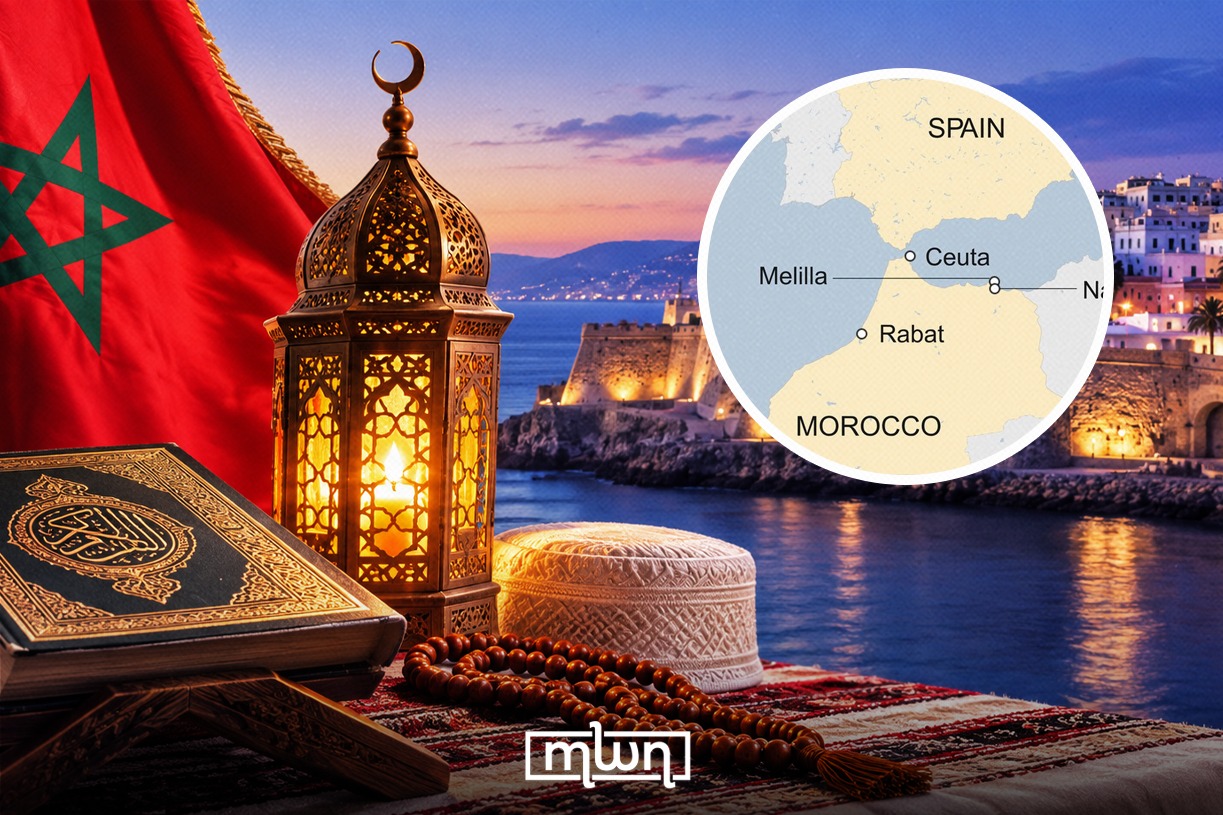
Occupied Ceuta was invoked on Monday evening, August 24, during the religious evening chaired by King Mohammed VI, Commander of the Faithful, at the Royal Palace in Rabat in commemoration of Eid Al-Mawlid Annabawi Asharif. The reference came during a speech delivered before the King by Minister of Endowments and Islamic Affairs Ahmed Toufiq on the activities of the Supreme Council of Ulema and local Ulema Councils.
Ceuta was mentioned as Toufiq discussed the Moroccan nation’s devotion to Prophet Mohammed, which he described as having two expressions rooted in religion, one political and the other emotional. He linked the political dimension to Moroccans entrusting their supreme imamate to the noble descendants of the Prophet through Bay’ah, or the pledge of allegiance. The goal of this political allegiance is “to safeguard the land and the nation’s constants and ensure fair arbitration among the components of the nation,” Toufiq argued.
He then turned to Morocco’s religious heritage, citing the works of Cadi Ayad, “Treatise on the Healing Virtues of Knowledge of the Prophet’s Rights,” and Abu Abbas Al-Ozfi, “Anthology of Poems Composed in Celebration of the Birth of the Illustrious Prophet,” stressing that both scholars were from Ceuta.
This sequence is important to understanding the significance of the reference. The speech began with Bay’ah as a bond explicitly tied to safeguarding the land and the nation’s constants, then moved to Ceuta through two major figures of Morocco’s Islamic scholarly heritage, before turning to Imam Jazouli and his work “Guides to the Paths of Goodness.” Toufiq recalled that its prayers were invoked by Moroccans in their struggle to liberate the occupied cities along the Atlantic Ocean at the dawn of the modern era.
Ceuta is foundational in Morocco’s memory of resistance to oppression and occupation
The city therefore did not appear in the speech as a geographical name detached from its context. It was placed within a connection bringing together the Commandery of the Faithful, Bay’ah, the land, scholarly heritage, and the memory of resistance to occupation.
These remarks were also made not at a political meeting or during a media debate, but at an official religious ceremony commemorating Eid Al-Mawlid Annabawi Asharif, chaired by the King in his capacity as Commander of the Faithful and attended by senior state officials, military and security leaders, members of the Islamic diplomatic corps and ulema.
The references to Cadi Ayad and Abu Abbas Al-Ozfi return Ceuta to its Moroccan historical setting through a dimension that is difficult to separate from the city’s identity over the centuries. Cadi Ayad, one of the most renowned scholars of Morocco and the Islamic West, authored a work that became a central reference in Moroccan religious culture. Al-Ozfi, for his part, belonged to a scholarly and political family that ruled Ceuta, whose intellectual legacy played an important role in establishing the celebration of the Prophet’s birth in the region.
This reference places Ceuta within Morocco’s scholarly and religious history long before it became the subject of a contemporary political dispute. The city formed part of the space in which Moroccan scholars, states and religious traditions developed, producing figures and works that left a deep imprint on religious practice in the Kingdom. Mentioning Ceuta through Cadi Ayad and Al-Ozfi therefore carries a meaning that goes beyond simply identifying their birthplace.
The sovereign dimension becomes clearer when the reference is read alongside the phrase that preceded Ceuta’s mention: Bay’ah “to safeguard the land and the nation’s constants.” In Morocco’s political system, Bay’ah is not merely a religious concept, but one of the pillars of the state’s historical legitimacy and of the relationship between the Commandery of the Faithful and the nation. Linking it to safeguarding the land explicitly places territorial unity within the function described by the minister before the King.
A historical continuing Morocco will not forget
The reference to Imam Jazouli’s “Guides to the Paths of Goodness” and its connection to the mobilization of Moroccans to liberate occupied cities along the Atlantic Ocean completes the same historical context. From the late fifteenth century into the early modern period, Morocco went through a prolonged phase of resistance to Portuguese and Iberian presence in a number of its coastal cities, with religious mobilization forming part of the social and political landscape of that period.
This invocation comes at a time when Ceuta has once again moved to the forefront of political and media debate following the migration events of July and the tensions and extensive controversy they triggered in Spain over Morocco. Yet the discourse from Rabat operated on a very different level, returning to Morocco’s history, institutions, and religious memory and placing Ceuta within a historical continuum far older than today’s border crises.
The timing was particularly notable. On the same day, the Spanish government announced its intention to elevate the management of the Ceuta crisis to the level of national security by declaring a “situation of interest for national security” and establishing a unified command to coordinate the response, nearly a month after the events of late July.
The decision came amid a sharp escalation in Spain’s political and media debate, with direct accusations against Morocco resurfacing from opposition parties as well as actors within the governing political landscape, alongside media coverage that continued to place the Kingdom at the center of explanations for the crisis. Against this escalation, Ceuta was invoked in Rabat through the language of history, institutions and religious reference, without shifting the discussion into an emotionally charged political register.
This way of invoking the city reflects the consistency of Morocco’s approach to occupied Ceuta. Morocco does not view it as an issue born out of modern disputes, but as part of its historical memory and national territorial unity. It therefore appears at times through politics and diplomacy, and at others through history, scholarship and religious heritage.
The passage delivered before the Commander of the Faithful on Eid Al-Mawlid brought these dimensions together with particular clarity: a Bay’ah intended to safeguard the land and the nation’s constants, two scholars from Ceuta who contributed to Morocco’s religious heritage, and the memory of Moroccan mobilization to liberate occupied cities.
Together, these elements place the city deep within the history of the Moroccan state and society, underscoring that for Morocco and Moroccans, Ceuta is not only about the borders of the present, but also about history, sovereignty and a national memory extending across centuries.