
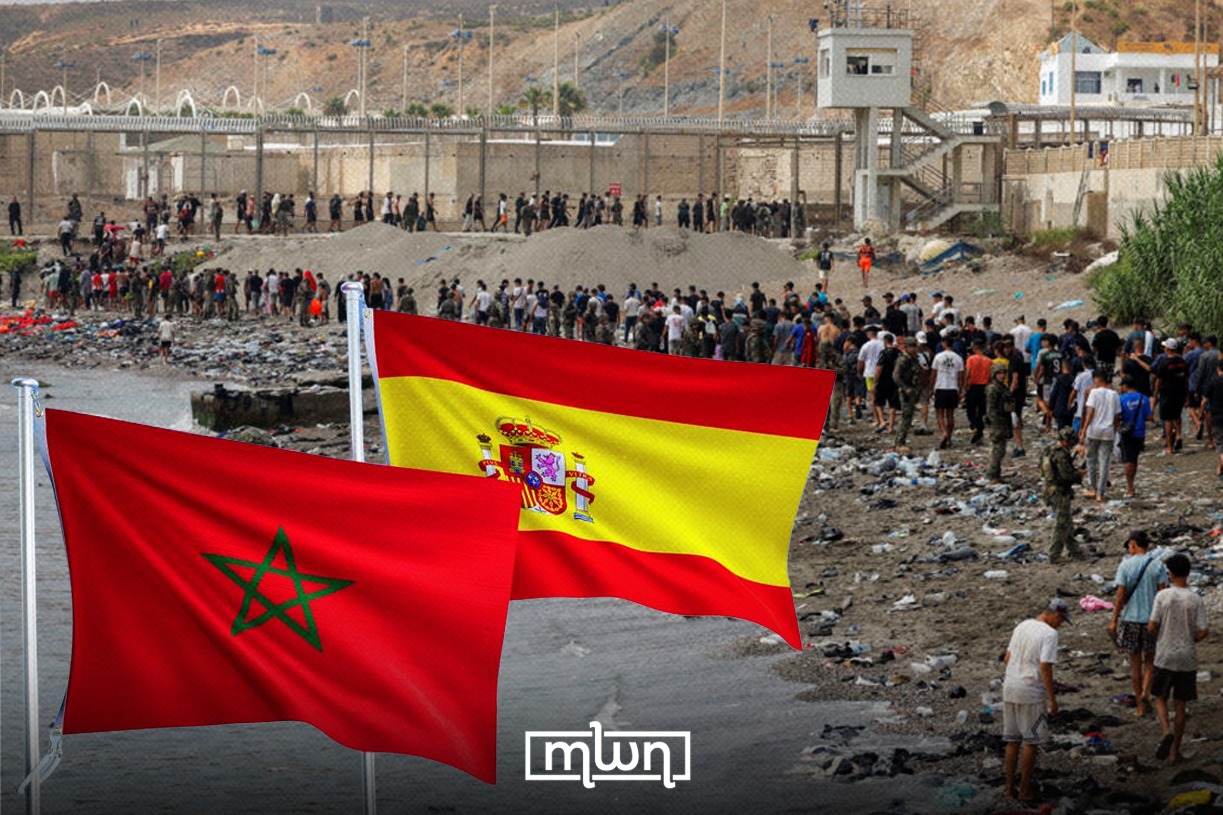
Rabat – It appears that Morocco has finally begun to show its anger and frustration at the rather crude way in which the Spanish press and political class have weaponized the Ceuta crisis, turning Morocco-bashing into a tool for winning votes and generating revenue.
Since the events in Ceuta on July 29 and 30, Morocco has said remarkably little about what happened, limiting itself to a statement from the Ministry of the Interior and a brief account carried by the state-owned news agency MAP from a source who spoke on condition of anonymity. Rabat, it seems, believed that the statements issued by the Spanish government, together with the conclusions of Spain’s own intelligence services – which found no evidence of a deliberate attempt to trigger such a massive influx of migrants – would eventually be enough to dispel the doubts and suspicions surrounding Morocco’s alleged orchestration of the Ceuta crisis.
But two weeks have now passed, and it is clear that neither the Spanish press nor certain political parties are willing to let such a golden opportunity slip away. For the media class, this crisis is above all a chance to boost audiences and revenues. For the political class, meanwhile, it is a chance to win votes. And so, it has turned out, restraint is far more profitable for Rabat than it is for those on the other side of the story.
Morocco as bogeyman and scapegoat
And yet, faced with the persistence of certain media outlets and opposition parties in maintaining an openly hostile tone toward Morocco, Rabat has begun to signal its displeasure. The first sign came in an interview that Moroccan Justice Minister Abdellatif Ouahbi gave to Sky News Arabia, in which he urged Spanish politicians to stop using Morocco as a political tool in their electoral campaigns.
If anything, this appeal showed that Rabat is fully aware of the recurring tendency of certain Spanish politicians to cast Morocco as a bogeyman or convenient scapegoat whenever an election looms. Rabat understands that Spain’s media and political elites are keen to demonize and disparage Morocco and its king because this can yield tangible political and media dividends.
This inherently hostile Spanish posture towards Morocco has a long history, with Morocco being systemically portrayed in a particularly grim and unflattering light in Spanish textbooks. In the history books Spanish pupils have read for generations, Morocco is frequently presented as a permanent threat to Spain and as an inherently unreliable neighbor that cannot be trusted.
As I have painstakingly documented it in my 2021 book about the “tumultuous history” of Spain-Morocco relations, this Spanish paternalistic conduct and dismissive attitude from Spain’s media and political elite is the culmination of centuries of cultivating a racial and cultural superiority complex among generations of Spanish students and pupils. It is precisely because this anti-Morocco narrative runs so deep, and has been left unchallenged for so long, that the Moroccan government now appears to have decided to say, plainly and publicly, that it can no longer tolerate having its stability and its image systematically converted into electoral currency in Spain.
The second signal from Rabat came in a statement Ouahbi himself made to EFE on Wednesday, in which he said Morocco is considering suspending the application of its extradition agreement with Spain. The minister argued that Morocco cannot accept what it regards as negligence and a failure by Spain to fulfill its obligations whenever the extradition of a Moroccan national wanted by Moroccan justice is at stake.
Spanish policy undermining the Spain-Morocco migration management cooperation
Disagreements between the two governments over Spain’s strict implementation of the 2009 extradition agreement are nothing new. Traditionally, however, both sides have resolved such disputes through diplomatic channels, away from the media spotlight. In this sense, particularly telling about Ouahbi’s statements is that Morocco’s frustration has far less to do with the extradition agreement as such. Instead, it especially has to do with Rabat’s growing exhaustion at watching certain Spanish politicians exploit the migration issue for electoral gain, at the direct expense of Morocco’s image and of the broader relationship between the two countries.
The past two weeks have laid bare the contradiction at the heart of the very relationship Madrid has long hailed, at times calling Morocco an indispensable and highly critical ally. On one hand, Morocco is expected to act as Europe’s “gendarme,” deploying considerable resources and manpower to stem irregular migration toward Ceuta and Melilla, the Canary Islands, and southern Spain more broadly. On the other hand, the very same Spanish government that demands such a demanding security commitment from Rabat simultaneously adopts measures that function as a genuine pull factor.
As I showed in a previous article, chief among these factors has been the mass regularization of migrants already residing illegally on Spanish soil. Minister Ouahbi made this contradiction explicit in his remarks to EFE: “This is the current situation: we prevent migrants from leaving, not only Moroccans but others as well, but when they arrive in Spain, they are accepted and their status is regularized.” In other words, the newfound Spanish migration policy quietly but decisively undermines Morocco’s efforts to keep its end of border security with Spain.
Read also: Ceuta: What Tahar Ben Jelloun’s Partial and Flawed Reading Leaves Out
To make matters worse from Rabat’s perspective, rather than acknowledging this contradiction, certain Spanish politicians instead routinely choose to lay the blame squarely on Morocco. One statement that appears to have finally exhausted Rabat’s patience came from Popular Party leader Alberto Núñez Feijóo, who declared in televised remarks on Monday, referring to the Moroccan minors who arrived in Ceuta on July 29 and 30, that “the logical and appropriate thing to do is to return these minors to Morocco.”
There is, however, a fundamental fact that Feijóo, for reasons of political convenience, chose to overlook. And that is that what prevents these minors from being quickly returned to Morocco – or, in some cases, from being returned at all – is not a lack of cooperation on Morocco’s part, but the very requirements of Spanish law governing unaccompanied foreign minors.
This category of migrants is covered by a 2007 agreement between Morocco and Spain establishing mechanisms for the return of unaccompanied Moroccan minors. Morocco has repeatedly expressed its willingness to implement that agreement in full and has urged Spain, on more than one occasion, to expedite the process. This past Wednesday, the Moroccan government once again renewed its call on Spain to shoulder its responsibility and accelerate the return of these minors.
The problem is that implementation of the 2007 agreement is constrained by Spanish and European legislation, which affords minors heightened legal protection. Once an unaccompanied minor sets foot on Spanish soil, Spain cannot simply return them automatically. Each case must be examined individually, weighing the “best interests” of the child, their family circumstances back in Morocco, and a range of other legal and social considerations. As a result, although Morocco has consistently signaled its willingness to receive these minors, Spanish authorities are not in a position to return them immediately. And in the meantime, many remain in Spain while these procedures run their course.
Moreover, since the agreement came into force in 2012, Spain has continuously violated the provisions of paragraph 3 of its article 2 which stipulates that “to achieve the objectives of this Agreement [the contracting parties] should promote the assisted return of minors to their families or to the guardianship institution of the country of origin, as well as their social reintegration.” Yet since that agreement came into force, Spain has systematically placed Moroccan minors under the care of foster families, reception centers or NGOs working in the protection of illegal migrants.
Spain’s systematic non-implementation of the 2007 agreement
What is even revealing about Spanish political and media elites’ duplicity and exploitation of the issue of illegal immigration for crude political purposes is that- with the notable exception of the Ceuta migration crisis in May 2021 following which Spain returned 55 minors to Morocco- the 2007 agreement has never been faithfully implemented by the Spanish government, despite Morocco’s repeated attempts to encourage it to do so.
Answering a question for a parliamentary group regarding the repatriation of unaccompanied Moroccan minors, the Spanish government acknowledged on March 20, 2020 that “Since September 2007, no repatriation of unaccompanied Moroccan foreign minors has materialized.” The exact same admission was reproduced in the Official Bulletin of Spain’s Parliament in November 2022, and in April 2025 suggesting that up until today this agreement has not faithfully been implemented.
There was not a shortage of attempts by the Moroccan government to encourage its Spanish counterpart to discharge its end of the bargain. For example, in April 2019, Morocco sent a delegation to Madrid to identify, interview and ensure the repatriation of 23 unaccompanied minors. Yet due to the opposition of the Red Española de Inmigración y Ayuda al Refugiado- which said “these deportations should be halted regardless of the aforementioned agreement, which had not been previously activated,” the Moroccan delegation efforts to reactivate the 2007 agreement eventually came to nothing.
And even in the only instance when Spain did seem to be willing to implement the 2007 agreement, the repatriation stumbled into the opposition of ONGs, Spain’s Ombudsman and the Prosecutor office. Roughly three months after the illegal crossing of 10,000 illegal migrants into Ceuta on May 17 and 18 2021, Rabat and Madrid reached an agreement for the return of 700 unaccompanied Moroccan minors. But the implementation of that agreement was suspended by the same government of Ceuta whose President, Juan José Vivas, accused Morocco an “unreliable” partner, on the grounds that the repatriation was not in conformity with Spanish laws. To add insult to injury, Spanish Supreme Court issued a ruling in January 22, 2024 stating that the return of Moroccan minors in August 2021 “was illegal”.
This is precisely what will also happen to the case of the the roughly 1,100 minors who crossed into Ceuta on July 29 and 30. Morocco has requested their return, while the competent Spanish authorities continue to review each case individually. At the of the review process, not a single minor will be returned to Morocco. This explains why Morocco’s Justice Minister stated on Wednesday that Spain should either return these minors to Morocco or reunite them with their families already residing in Spain. The Moroccan government reiterated that same call on Thursday, once again urging its Spanish counterpart to accelerate the process.
Of note here is the fact that this legal reality can itself become a pull factor. The procedural hurdles that Spanish law imposes on the implementation of the 2007 agreement risk creating, in the minds of these minors, the perception that once they succeed in reaching Spanish territory, it is extremely hard – almost practically impossible – for authorities to enforce the principle of sending them back to Morocco.
And it seems that the Spanish government has already gotten the message. During a visit to Ceuta on Thursday, Spain’s Interior Minister, Fernando Grande-Marlaska, acknowledged for the first time that Spain’s decision to regularize the status of undocumented migrants may have sent the wrong message to would-be migrants, creating the impression that anyone who managed to enter Spain illegally could eventually obtain legal residency. Hence his insistence that “none of those who crossed into Ceuta” would be regularized.
This is a dimension that has been entirely absent from the public debate. We cannot reasonably expect Morocco to prevent every single one of these minors from attempting the crossing while simultaneously ignoring the existence, on the Spanish side, of a legal framework that may have – intentionally or not – strengthened the very incentive to attempt that crossing in the first place.
The legal hurdles that Spanish authorities and NGOs working to protect migrants place in the way of the smooth return of unaccompanied minors to Morocco run counter to the letter and spirit of Article 3 of the 2007 agreement. That provision states unambiguously that, in order to prevent the emigration of unaccompanied minors, the Contracting Parties will work jointly “to raise awareness among minors, their families, and society at large about the risks associated with the migration of unaccompanied minors.”
Instead of raising awareness among minors about the risks of irregular migration, Spain’s permissive immigration policies and the legal and procedural hurdles surrounding the return of unaccompanied minors risk producing the opposite effect. They can create the impression among this age group that they have everything to gain by making it into Ceuta, since once they reach Spanish territory, returning them to Morocco becomes considerably more difficult.
And the very fact that Morocco has now chosen to bring this issue into the open constitutes, in my view, a clear indication that Rabat believes the overwhelming majority of Spanish media outlets and political actors have gone too far in their campaign to demonize and discredit the kingdom. The Justice Minister’s two media interventions, together with the statements issued by the Ministry of the Interior, should therefore be read for what they are: a warning shot directed at Spain.
With such targeted messaging, Morocco is unambiguously signaling that with certain boundaries having been crossed, it is no longer willing to remain silent while its image, its institutions, and its relationship with a key European partner are treated as convenient instruments of domestic political and media confrontation.
Samir Bennis is the co-founder and publisher of Morocco World News. You can follow him on Twitter @SamirBennis.