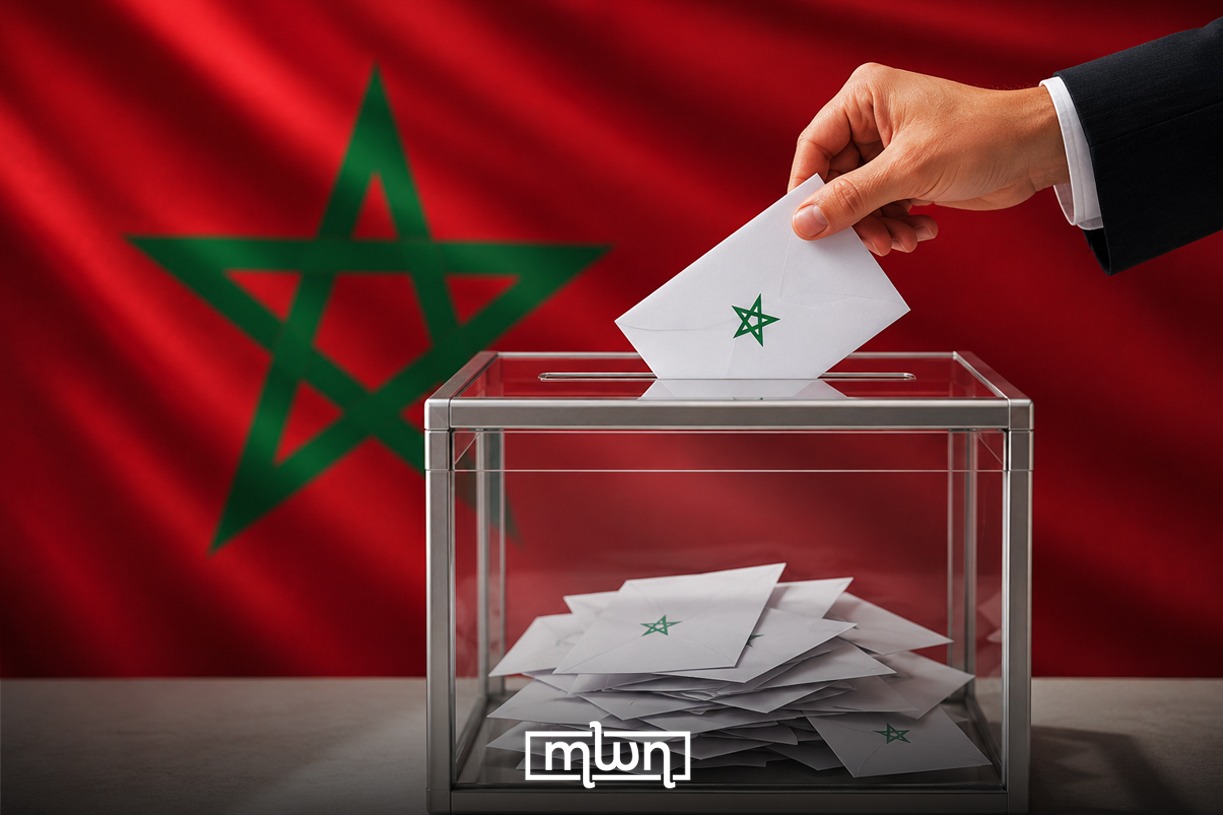
Morocco votes on September 23, and the mood among young Moroccans heading into yet another electoral cycle is closer to exhaustion than anticipation. That exhaustion has a recent history, a live scandal, a quieter pattern of legislative retreats, and now a strange new face all its own.
Since last autumn’s Gen Z 212 protests, politicians have failed to recover trust in political parties, and the deficit may even hit rock bottom by September. Those demonstrations, which spread from Rabat to Casablanca to smaller towns across the country, are remembered above all for the passing of three demonstrators near Agadir, the first deaths at the hands of Moroccan security forces during a protest movement in decades.
A trust deficit with a body count
The line that has stuck came from PJD parliamentary leader Abdellah Bouanou, who told Akhannouch directly during a monthly accountability session in parliament that bullets had not been fired on protesters in Moroccan streets since 1981, until this government came to power. The remark (though inaccurate since bullets were fired and casualties did fall during the riots of Fez in 1990) was serious enough that the House Speaker’s office discussed it internally, even as it ultimately took no formal action.
For the young Moroccans who organized and joined Gen Z 212 protests, the chief accusation was not really about any single policy. It was that the political class, across parties, serves its own interests first and dresses the rest up as governance.
A conflict of interest hiding in plain sight
Nothing has done more to lend credence to that accusation in the public mind than the seawater desalination affair and the ever-soaring prices of fuel. Akhannouch’s Akwa Group, through the companies it owns, has a bulky share in the consortium awarded an 887 million euro contract to build a desalination plant supplying Casablanca and its surrounding region. The same pattern is glaringly seen in the fuel sector, where a handful of companies control what Morocco imports and sells, with the head of the government’s Afriquia Gaz accounting for roughly a third of the nation’s fuel market.
Opposition figures, led by Benkirane, have called it a deplorable example of conflict of interest.
They have pointed out that ONEE, the national water and electricity office in charge of the desalination project, is headed by Akhannouch himself, and that a government statement made days before his parliamentary declaration had listed desalination among projects to be granted public support.
Akhannouch has consistently defended the deal as the product of an open, transparent tender in which his consortium simply offered the best terms. Neither side has fully proven the other to be at fault, and the dispute remains unresolved heading into the vote. To voters, this is a live reminder that the country’s most powerful officeholder is also one of its wealthiest businessmen, with the two roles never quite clearly separated.
A pattern, not an accident
What makes the desalination affair land as hard as it does is that it fits a pattern rather than standing alone. Just days into a new legislative session in January 2025, Akhannouch’s government withdrew the long-awaited penal code amendment that would have criminalized illicit enrichment by public officials, a text that had already survived nearly a decade of parliamentary delay. Transparency Maroc, which had pushed for the reform, called the withdrawal a clear indicator that the government intended to bury the long-pending article rather than reform it, and the NGO has since suspended its participation in the government’s own anti-corruption commission, citing three years without a single meeting being called.
A second, quieter change followed with the new Code of Criminal Procedure, which entered into force in December 2025. Championed by Justice Minister Ouahbi over sustained protest from rights groups, it strips civil society associations of their ability to sue high-ranking public officials over the embezzlement of public funds t, and subjects their right to join corruption cases as civil parties to a new government-issued authorization requirement. The national anti-corruption authority, the INPPLC, publicly objected that the changes restrict access to justice and run against the spirit of the constitution; Ouahbi has defended the measure as protection against associations that weaponize corruption accusations for leverage rather than genuine oversight.
A third thread runs through the press. Public subsidies to newspapers and news sites have grown heading into the election season, but the federation representing Morocco’s publishers has accused the ministry overseeing them of applying the funds through untransparent, shifting criteria that leave smaller and regional outlets excluded. It has openly described the process as an attempt to bolster the government’s control over the sector as its mandate nears its end.
That followed an earlier, more direct attempt in February 2026 to place the press under a transitional government-appointed commission, a move dropped after journalists’ unions warned it would strip the self-regulating National Press Council of its independence. The council’s own elections, now scheduled for mid-September under a new reorganization law, have themselves become a dispute over which list of professional cards gets to vote, a technical-sounding argument that determines whose voices count in choosing the body meant to keep the profession in check.
The fourth thread concerns the lawyers. A bruising, months-long standoff between the Justice Ministry and Morocco’s bar associations over a reform of the legal profession produced strikes, a sit-in outside parliament, and eventually a collective threat by bar presidents to boycott their own professional elections. The reform cleared parliament in May, but rather than resolving the dispute, it was referred to the Constitutional Court, where it remains, its final shape still unsettled and the profession still, by its own account, unconvinced its independence from the ministry has been preserved.
None of these four episodes made for a single dramatic headline. Together, they describe a governing coalition that has spent its term narrowing, one law at a time, the very mechanisms, an anti-corruption statute, civil society standing, a free press, an independent organizing body for lawyers, that would ordinarily hold whoever wins in September accountable to anyone at all.
Enter the football man
Into this landscape has walked Fouzi Lekjaa, the budget minister and football federation president whose formal entry into the Party of Authenticity and Modernity in late July has scrambled expectations for September. His record running Moroccan football through a period of genuine success, culminating in the country’s role co-hosting the 2030 World Cup, has made him, for some, a plausible face for the government that will need to deliver on that promise. Analysts have entertained the idea, however speculative, of a “World Cup 2030 government” built around his profile: managerial, results-driven, allergic to the machinery of party politics of which a significant population of, if not most voters have grown weary.
For others, his sudden partisan turn reads differently. It comes across as one more technocrat borrowing a party label to reach for power, no different in kind from the businessman-politician model Akhannouch himself represents. Critics have thus accused him of joining a party they see as weakened by scandal and in need of exactly this kind of star power. Whether Lekjaa is a genuinely new option or simply a familiar formula wearing a football jersey remains, for now, an open question.
But the more pertinent question underlying both interpretations is the same one Gen Z 212 raised in the streets last autumn, and the same one the pattern of legislative setbacks keeps raising in its own quiet way. And that has to do with whether any face emerging from Morocco’s political parties can still claim real independence from the deeper, unelected centers of power that many Moroccans believe shape the course of how the country is really governed, regardless of who sits in government. But it will be the first chance Moroccans have had, since the protests and since Ceuta, to say something about it at all.
Read also: The Morocco That Is Moving Forward While the Young Moroccans Being Left Behind