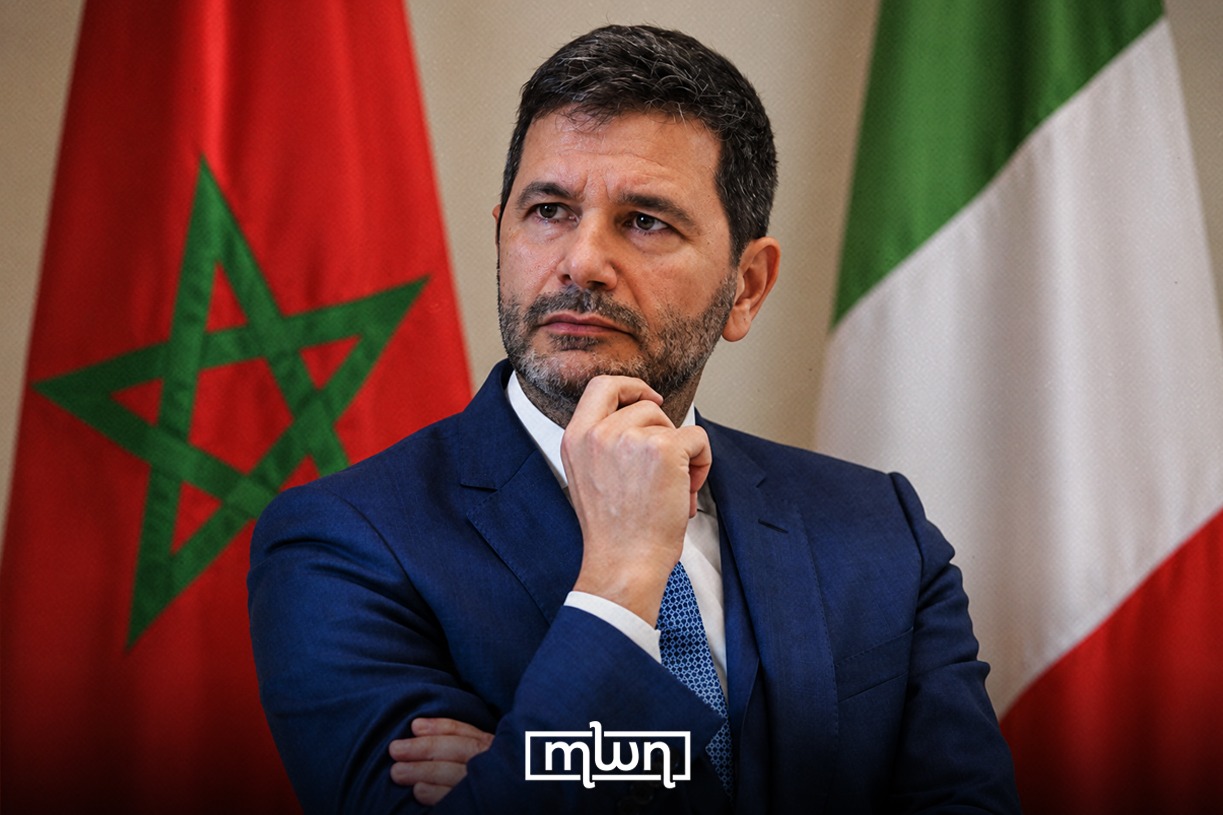
Marrakech – Italy’s Ambassador to Morocco, Pasquale Salzano, cast the commercial ties between Rome and Rabat as a relationship of real substance, as new data put the two countries’ annual exchanges near five billion euros.
Trade between Italy and Morocco reached €4.75 billion in 2025, according to figures from the Economic Observatory of Italy’s Ministry of Foreign Affairs and International Cooperation (MAECI). Salzano offered his reading of those numbers to the Italian news agency AGI.
The two countries “have built over the years an economic relationship of great substance,” in the ambassador’s words. He tied the headline figure to activity on the ground, telling AGI that nearly five billion euros in exchanges means “companies working together, investments, technology, skills, and increasingly connected production chains.”
The 2025 total rested in part on stronger Italian sales to the kingdom. Italian exports grew 8.1% over the year, approaching three billion euros. That trend reflected firmer Moroccan demand alongside a wider presence of Italian products, technologies, and skills within Morocco’s industrialization and economic transformation.
The fuller ledger shows Italian exports at €2.995 billion and imports from the kingdom at €1.757 billion, leaving Italy a surplus of €1.238 billion, wider than the year before. The annual total itself marked a retreat, since trade had peaked at €4.998 billion in 2024 before slipping 4.9%.
Early 2026 pointed to a softer start, with trade between January and April down 5% to €1.541 billion as Italian exports fell 8.5% to €921 million. Beyond goods, the stock of Italian direct investment in Morocco stood at €1.904 billion in 2025, and roughly 200 Italian firms operated in the country at the close of 2023, employing 13,838 people on combined revenue of €1.6 billion.
The two flows carry different profiles. Transport equipment dominated Moroccan sales to Italy at €926 million, or 52.7% of the total, followed by food products, beverages, and tobacco, then textiles, electrical equipment, and chemicals.
Italy ranks as Morocco’s second-largest supplier of machinery. Italian shipments to Morocco are led by machinery and equipment, worth €516 million, or 17.2% of the total, alongside refined petroleum products, base metals, textiles, chemicals, and electrical equipment.
For Salzano, the numbers point to a partnership that runs past the simple exchange of goods. Morocco stands as “a strategic partner in the Mediterranean and in Africa” for Italy, per the ambassador, who pointed to an interest in growing the relationship further through new investments, industrial partnerships, innovation, and closer collaboration between companies in both countries.
He framed the current moment as a foundation rather than a ceiling. “A very solid base already exists,” the ambassador told AGI. “Now we must aim to do more, creating new opportunities for Italian companies in Morocco and for Moroccan companies interested in Italy, and developing common projects capable of generating growth and value in both countries.”
That reading sits within a broader view of Morocco’s economic position. The kingdom ranks among the main economic hubs of the Mediterranean and Africa, a standing tied to the diversification and modernization of its productive base. Italian economic activity in the country already touches numerous sectors of the Moroccan economy.
Salzano also portrayed Morocco as more than a market. For Italy, the country can serve not only as a destination but as a platform for investment and industrial collaboration, one that draws on its geographic position and its links to Europe and the African continent.
In his view, the potential covers both access to an expanding market and the building of production partnerships aimed at African markets.
The next stage, as the ambassador framed it, will turn on turning trade growth into something deeper. The challenge will be converting the rise in exchanges into greater integration between the two production systems, through new investments, joint projects, innovation, and long-term collaboration.
On that account, the €4.75 billion recorded in 2025 marks a starting point. Salzano positioned the figure as a base already firm enough to carry a wider economic partnership between the two countries, one built on shared projects capable of generating value on both sides of the Mediterranean.