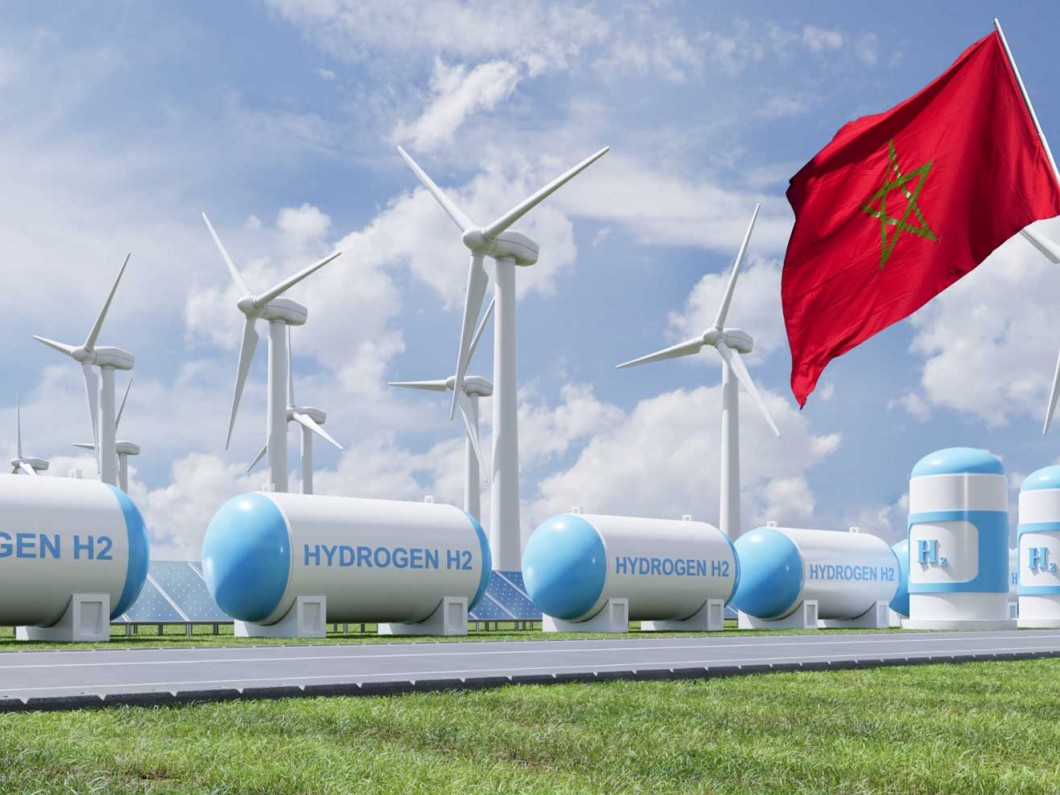
Marrakech – The African Development Bank (AfDB) has selected Morocco’s Guelmim Green Hydrogen Valley for a reimbursable grant of $5.28 million, placing the Nareva Holding-sponsored project among four African developments chosen for support under the Africa Green Hydrogen Programme.
The bank announced the decision on September 18, following a call for proposals that ran from April 10 to May 11.
Kevin Kariuki, the AfDB’s vice president for power, energy, climate change and green growth, presented the outcomes at the Africa Green Hydrogen Summit 2026 in Cape Town. Pending approval by the bank’s Board of Directors, the funding will come through the Sustainable Energy Fund for Africa (SEFA).
The grant is not construction financing. It is meant to move private projects toward investment readiness and bankability, covering the feasibility, engineering, environmental, and financial work needed before a final investment decision.
The initiative is also expected to expand renewable-energy deployment, cut emissions, improve access to desalinated water and electricity, support industrialization and exports, and create jobs through technology and skills transfer.
Guelmim was one of four winners drawn from 81 proposals submitted across 18 African countries. The others are Project ‘Ra’ in Egypt, sponsored by DAI Infrastruktur GmbH ($3.55 million); the Hyphen project, backed by Hyphen Hydrogen Energy ($5.93 million); and Saldanha Hydrogen DRI in South Africa, developed by Enertrag SE with ArcelorMittal South Africa ($5.24 million).
The Moroccan, Egyptian and Namibian projects target sustainable marine and aviation fuels, while South Africa’s focuses on low-carbon iron. Together, the four represent an estimated $23 billion in potential investment, 20 GW of solar and wind capacity, 7 GW of electrolyzers and 2,950 MWh of battery storage.
According to Daniel Schroth, the AfDB’s director for renewable energy and energy efficiency, Africa’s renewable resources give the continent a chance to become “a competitive player in the emerging global green hydrogen and derivatives market,” with the program moving high-potential projects closer to investment.
The Guelmim award builds on an official chain that began on March 6, 2025, when Morocco selected Nareva under the “Morocco Offer” for Green Hydrogen to develop green ammonia, synthetic fuels and green steel, with public land of up to 30,000 hectares per project.
Nareva describes itself as the only Moroccan developer selected under the offer and is advancing green hydrogen, green ammonia and synthetic-fuel projects in southern Morocco for domestic use and export, including intermediate projects focused on e-methanol for maritime transport and eSAF for aviation, alongside larger industrial-scale developments.
The wider program is larger still. In June 2025, Energy Transition Minister Leila Benali placed the selected projects across Guelmim-Oued Noun, Laayoune-Sakia El Hamra and Dakhla-Oued Eddahab, targeting roughly 20 GW of renewable generation, 10 GW of electrolysis and output approaching 8 million tonnes of green-hydrogen derivatives.
Morocco has earmarked nearly one million hectares for the effort, about 300,000 in the first phase. The policy covers not simply hydrogen plants but the wider value chain, including renewables, electrolysis, industrial processing, desalination and infrastructure.
By September 17, 2025, the government’s steering committee valued the three-region portfolio at about MAD 319 billion ($31.9 billion). At the same meeting, it confirmed that the preliminary phase of the Chbika 1 project had been completed and authorized preliminary land-reservation agreements for the other selected investors.
At a February 2026 meeting in Rabat attended by Head of Government Aziz Akhannouch and MASEN Director General Tarik Moufaddal, representatives of selected Moroccan and foreign investors signed preliminary land-reservation contracts covering five strategic green-hydrogen projects in Morocco’s three southern regions.
Nareva currently says it is also developing a portfolio of renewable-powered desalination projects totaling 900 million cubic meters per year, including facilities planned for Guelmim and Tan-Tan, among other locations.
The hydrogen support sits within a deep partnership. On September 17, Morocco and the AfDB signed two agreements worth €405 million in Rabat: €205 million for rail infrastructure along the Kénitra-Marrakech corridor and a high-speed line extension, and €200 million for the “Cap Compétences 2030” vocational-training program.
Since 1978, the bank has mobilized more than €15 billion for over 150 Moroccan projects.