
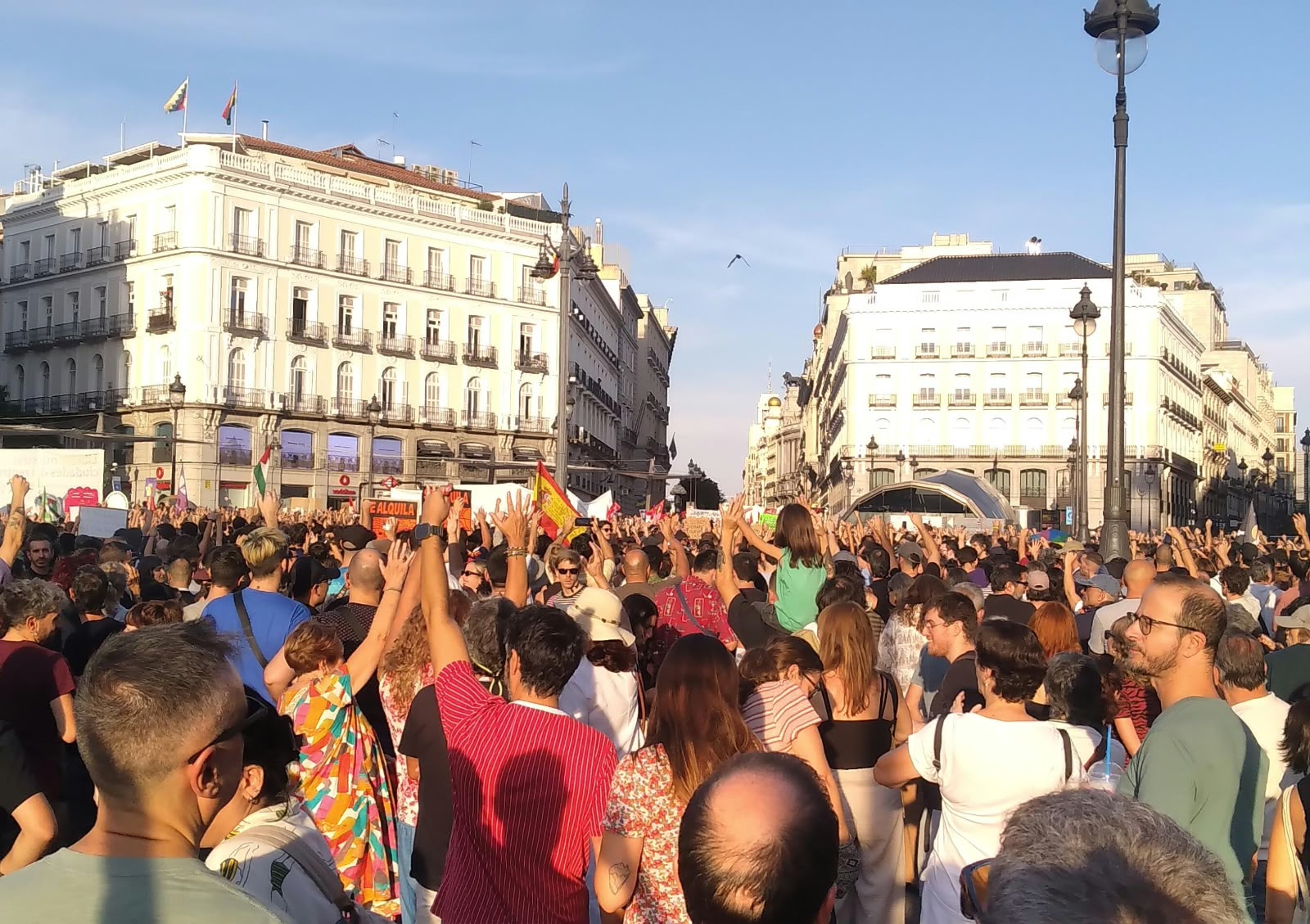
Agadir – Tens of thousands of people took to the streets of Madrid on Saturday to protest the Spanish government’s handling of irregular migration and the ongoing migrant crisis in Ceuta, with demonstrators calling for early elections and stronger border controls.
Civil society platform Sociedad Civil Española organized the rally, which received support from Spain’s conservative People’s Party (PP) and Vox. The two political parties continue to push smear campaigns targeting Morocco since the July 30 mass crossing in Ceuta.
The march began at Plaza de Cibeles and ended near the Arco de la Victoria in Moncloa.
Estimates of the turnout differed sharply. Madrid’s government delegation put attendance at around 20,000 people, while organizers claimed that 180,000 participated.
The protesters criticized Prime Minister Pedro Sánchez’s government over its response to the mass arrival of migrants in Ceuta at the end of July. They called for general elections to be held before November 15, although Spain’s next general election is not currently due until 2027.
PP Secretary-General Miguel Tellado attended the march, alongside Vox leader Santiago Abascal. Tellado accused the government of negligence over the situation in Ceuta and called for political action over its handling of the crisis.
Read also: Spain to Introduce Decree-Law to Speed Up Migrant Returns From Ceuta
Abascal has also called for the deportation of migrants who entered Ceuta during the July influx. During Saturday’s protest, Vox and other demonstrators reportedly used strong and aggressive language to describe the situation in Ceuta.
The protest follows the large-scale arrival of migrants in Ceuta on July 30 and 31. More than 70,000 people entered the city during the episode, after which most were returned while thousands remained in Ceuta.
The Spanish government estimates that between 6,000 and 10,000 migrants remain stranded in the city. Spanish media have reported that the government is preparing a decree-law to accelerate procedures for returning migrants who remain in Ceuta to Morocco.
The Ceuta crisis has also become a focus of Spain’s domestic political debate, with far-right figures and other opposition politicians using the issue to criticize the government’s migration policy and Morocco’s role in border management.