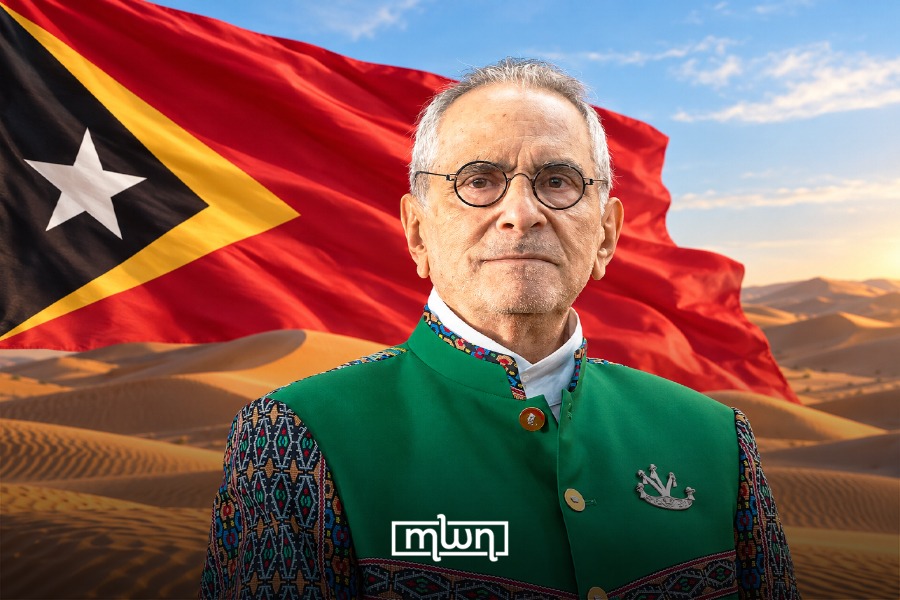
Marrakech – Timor-Leste, long one of the separatist Polisario Front’s closest partners outside Africa, has opened the door to Morocco’s Autonomy Plan for the Western Sahara.
President José Ramos-Horta announced the shift from the podium of the UN General Assembly on September 23. “Regarding Western Sahara, we welcome the Moroccan proposal and the recent Security Council resolution as an opportunity for dialogue,” he told the 81st session.
The statement marks a clear break in tone for Dili. For more than two decades, Timor-Leste drew a direct parallel between its own independence struggle and the cause promoted by the self-proclaimed “Sahrawi Arab Democratic Republic” (SADR).
Ramos-Horta paired his welcome with familiar caveats. He argued that the people directly concerned must be consulted on the territory’s future status and called for “a just, comprehensive settlement” between Moroccan authorities and the Polisario.
Timor-Leste’s national news agency, TATOLI, later described Dili’s position as continued support for self-determination alongside a preference for dialogue.
Even so, the change stands out given the depth of Dili’s past ties with the separatists. Nor do Ramos-Horta’s references to consultation and self-determination contradict his welcome of the Moroccan proposal.
Autonomy is itself a form of self-determination, a principle reflected in UN Security Council Resolution 2797, which frames genuine autonomy as a particularly feasible outcome within a final solution providing for self-determination.
Timor-Leste established relations with the self-styled “SADR” upon restoring its independence on May 22, 2002. It granted the entity’s mission full diplomatic representation in Dili in 2010 and has provided it with regular financial support. As recently as March 25, the Timorese cabinet approved MAD 600,000 ($60,000) for the entity’s permanent mission.
Dili’s rhetoric followed the same line until only months ago. At the UN Special Committee on Decolonization this year, Timor-Leste referred to the need for the Sahrawi people to freely determine their political future. Prime Minister Xanana Gusmão was still calling for a self-determination referendum in a June 25 speech.
The presidency itself maintained links with the Polisario leadership. In August 2024, Ramos-Horta invited Polisario leader Brahim Ghali to Dili for celebrations marking the 25th anniversary of the 1999 UN-organized popular consultation. In that vote, held on August 30, 1999, 78.5% of Timorese voters rejected autonomy within Indonesia.
Ghali met Ramos-Horta, Gusmão, and UN Secretary-General António Guterres during the visit.
The consultation was organized by the UN Mission in East Timor (UNAMET), led by Ian Martin as the UN Secretary-General’s Special Representative. Timor-Leste’s UN experience later crossed paths with the Sahara file through Wolfgang Weisbrod-Weber. He served as chief of staff of the UN Integrated Mission in Timor-Leste (UNMIT) from 2006 to 2008 before heading MINURSO, the UN mission in the Sahara, from 2012 to 2014.
Within this context, the president’s UNGA remarks reflect the weight of UN Security Council Resolution 2797. Adopted in October 2025, the resolution called for negotiations taking Morocco’s Autonomy Proposal as the basis and stated that genuine autonomy could represent a particularly feasible outcome.
That formula has given governments once wedded to the referendum thesis a path toward Rabat’s framework. Timor-Leste has not yet announced a withdrawal of its recognition of the “SADR,” and the entity’s embassy remains listed on the Timorese Foreign Ministry website.
However, a presidential endorsement of the Moroccan proposal as a basis for dialogue further narrows the separatists’ shrinking diplomatic space.
Timor-Leste is not an isolated case. Mauritius, which recognized the “SADR” in 1982, withdrew that recognition in 2014, and restored it in 2015, formally decided on May 22 to align its position with Resolution 2797. At this month’s UNGA, Foreign Minister Dhananjay Ramful went further, describing autonomy under Moroccan sovereignty as the “most credible solution.”
Latin America, once a Polisario stronghold, has moved in the same direction this year. Bolivia suspended its relations with the fictional republic in February, and Honduras announced a similar move in April. Colombia recognized Moroccan sovereignty in August and froze relations with the Polisario’s paper state, while Chile, Panama, and Peru backed Morocco’s sovereignty and its Autonomy Plan in New York this month.
The European Union also updated its collective position in January, accepting Morocco’s Autonomy Plan as the basis for negotiations. With more than 130 countries now backing Morocco’s sovereignty over its southern provinces, including major powers such as the US, diplomacy is increasingly moving beyond Cold War-era ideological solidarities toward pragmatic, interest-based cooperation.
A handful of capitals continue to echo the Polisario’s outdated narrative. South Africa, for example, used its September 24 UNGA address to reaffirm support for self-determination in the territory.
Yet the direction at this year’s General Assembly was difficult to miss. Governments once counted among the Polisario’s firmest backers are increasingly treating Morocco’s Autonomy Plan as the starting point for any settlement, leaving the separatist project with fewer defenders on the international stage.
Read also: Boulos Says Algeria-Backed Polisario Is Obstructing UN-Led Process on Western Sahara