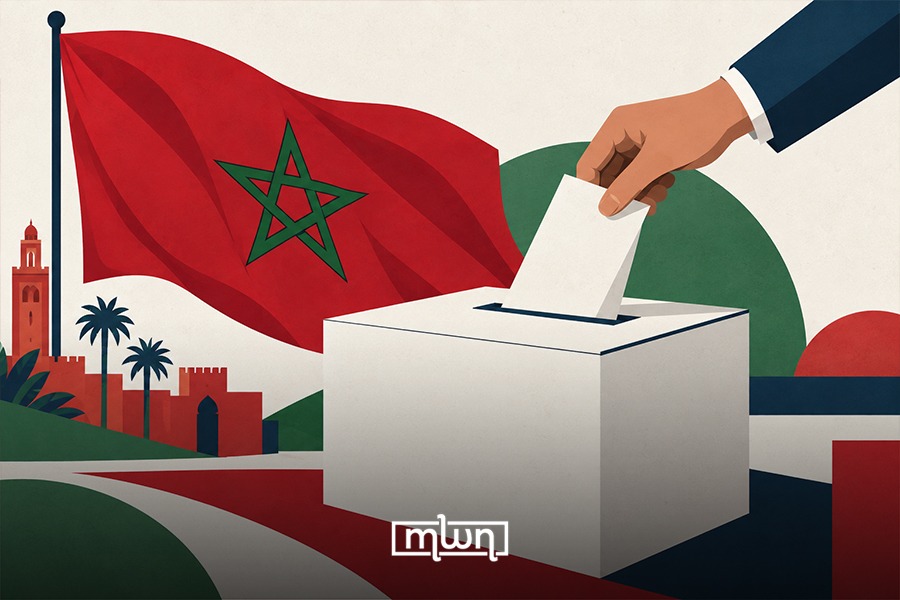
Marrakech – The International Organization of La Francophonie (OIF) has concluded that Morocco’s September 23 legislative elections took place “in a free, reliable, and transparent manner, and in accordance with the legal framework in force.”
The finding appears in the preliminary statement of the Francophonie Electoral Mission (MEF), issued in Rabat on September 25. According to the statement, the vote unfolded “calmly and with discipline,” in a “generally calm climate.”
OIF Secretary-General Louise Mushikiwabo deployed the mission at the invitation of the President of Morocco’s National Human Rights Council (CNDH), Amina Bouayach. Andre-Magnus Ekoumou, Cameroon’s Ambassador to France and the personal representative of Cameroon’s head of state to the OIF, led the delegation.
The mission also included the President of Benin’s High Court of Justice, who sits on the country’s Constitutional Court, and a member of Canada’s House of Commons from the youth network of the Parliamentary Assembly of La Francophonie. Experts from OIF member states and governments completed the team.
Present in Morocco since September 15, the mission met national authorities, election institutions, civil society groups, and several political parties. It also held talks with accredited national and international observer missions and with the Group of Francophone Ambassadors and Delegates in Morocco.
Before the vote, the OIF supported the deployment of observers from the Associative Collective for Election Observation (CAOE). It also backed SimSim, an organization that promotes civic participation through digital technology. The OIF framed both efforts under Chapter 4 of the Bamako Declaration on free, reliable, and transparent elections.
The mission’s pre-election assessment found that the legal framework “respects the principles of democratic elections.” It pointed to amendments aimed at strengthening candidate integrity and increasing the participation of women and young people, including an incentive-based funding mechanism for political parties.
The mission also found that audiovisual media legislation guarantees parties equitable access and balanced coverage during the campaign.
Still, it flagged two points of contention. The method of calculating the electoral quotient, based on registered voters, and the drawing of constituency boundaries “do not enjoy consensus.” It also noted low youth registration relative to the group’s share of the population and a limited number of young candidates on party lists.
On election day, mission members visited 34 polling stations in Rabat, Temara, Harhoura, Skhirat, Kenitra, Mehdia, and Chelihat. They also received the findings of the CAOE, which deployed 1,622 observers nationwide with OIF support.
The mission reported that polling stations opened and closed on time and that electoral materials were available at all stations visited.
Staff were fully present and showed a good command of procedures, though the mission recommended further training on rules governing national and international observation. Women and young people were well represented among polling staff and party representatives.
Some shortcomings emerged. Voter lists were not systematically posted outside polling stations. National observers also recorded certain irregularities, though these did not call “into question the integrity of the vote.” Security forces maintained a “discreet and appropriate” presence, according to the statement.
The mission also recorded “low voter mobilization,” putting turnout at 38.02%. The Interior Ministry reported a slightly different figure.
Interior Minister Abdelouafi Laftit announced a national turnout of 38.08%, down from 50.86% in 2021 and 42.27% in 2016. Nearly 6 million of the 15.8 million registered voters cast ballots across 40,694 polling stations. Turnout reached 77% in the Laayoune-Sakia El Hamra region, 61% in Dakhla-Oued Eddahab, and 53.48% in Guelmim-Oued Noun.
According to the final results, the Authenticity and Modernity Party (PAM) came first with 97 seats. The National Rally of Independents (RNI) followed with 66 seats, ahead of the Istiqlal Party (65) and the Justice and Development Party (54).
In total, 28 parties submitted 1,847 lists with 7,277 candidates, including 2,659 women, about 37% of all candidacies. Laftit put the number of observers at 3,006: 2,023 from civil society, 783 from the CNDH, and 200 foreign observers.
Looking ahead, the OIF mission will issue a final report with recommendations to consolidate Morocco’s electoral framework. The mission also hailed Moroccan voters who fulfilled their civic duty “with a sense of responsibility,” demonstrating “their attachment to the democratic exercise of their rights.”
Before the announcement of the final results, the mission had urged all parties to use “only legal channels” to contest the outcome and to maintain a calm climate throughout the process. The delegation concluded by thanking the Moroccan people for the “warm welcome” it received, as well as national authorities for facilitating its deployment and the smooth conduct of its mission.
Read also: Council of Europe: Morocco’s Election Ran Smoothly, 38% Turnout Raises Questions