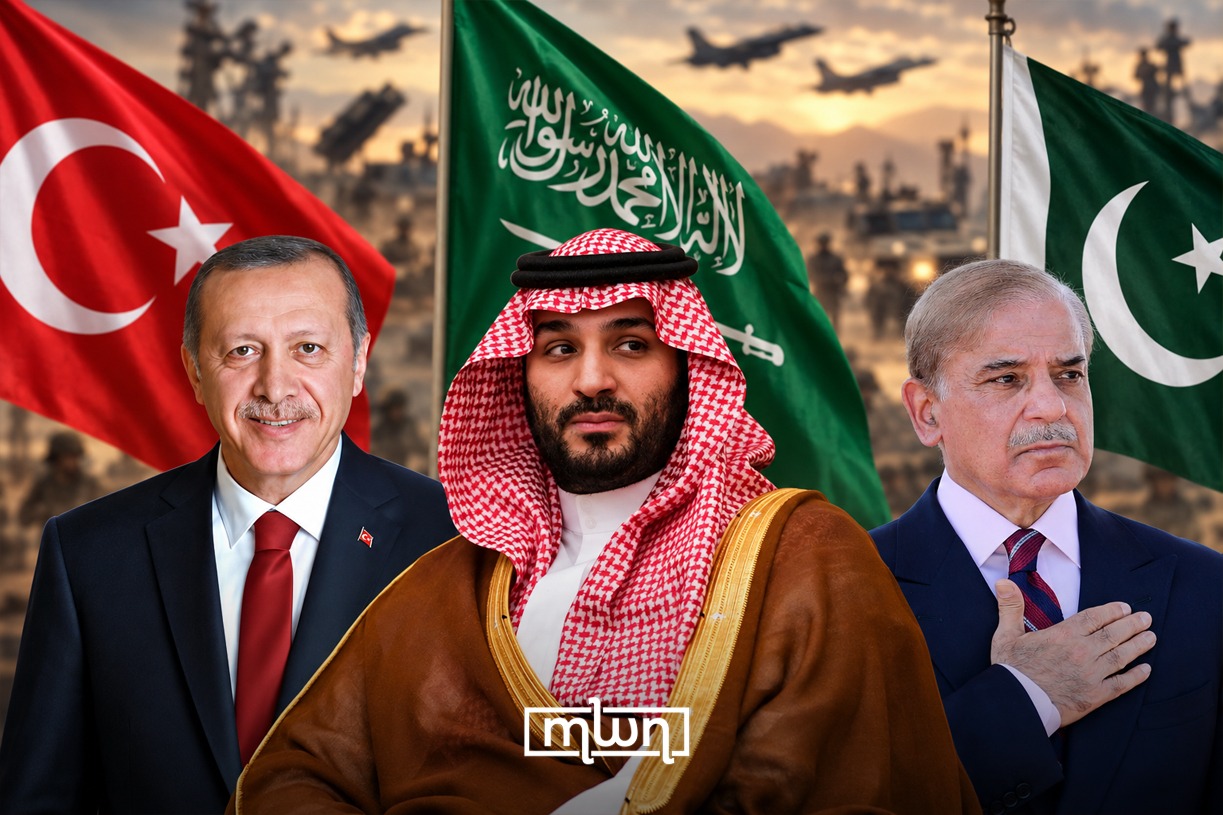
On September 25, the military chiefs of Saudi Arabia, Pakistan and Turkey met in Riyadh and pledged to “immediately translate” the commitments of their new defence pact into effective military cooperation. They condemned the Houthi attacks targeting Mecca and the kingdom’s civilian and economic infrastructure, and discussed intelligence sharing, military coordination and the integration of their capabilities.
The same day, Turkey’s parliament speaker Numan Kurtulmus told reporters in Ankara that the agreement had not yet come into effect. International agreements need parliamentary approval, he said, and the meetings being held under the pact were “preparatory.” He expected it to be submitted for ratification when parliament returned from recess on October 1. Turkish officials had already said that any support to Riyadh at this stage would be largely bilateral. Kurtulmus added that the pact was not directed against Iran, and that Iran could even join it one day.
In other words, the same pact was presented on the same day as both ready to take immediate effect and still at a preparatory stage.
To be sure, the Mecca Joint Defence Agreement was signed on August 7 and states that an armed attack on any one of its three members shall be regarded as an attack on all. Within five weeks, one of them was under repeated attack. But what followed did not show that the pact was hollow. It showed something more useful: who decides what a mutual-defence promise means once it is tested. And the answer to that is not decided by the state being attacked alone.
For years, Gulf states and other middle powers have been described as hedging between competing powers: buying Western weapons, trading with China, joining forums such as BRICS, and signing new security arrangements alongside existing partnerships rather than relying on a single patron. The word usually attached to that strategy is autonomy. September 2026 suggests a more precise one. Hedging does not remove dependence. It distributes it across several capitals, each of which retains room to interpret its own commitment.
A forum, not a shield
The loosest layer was never meant to be anything else. BRICS has no mutual-defence clause or collective military obligation, and it works by consensus, which lets any member block a joint position. That design is why rivals can sit inside it. It is also why the bloc could not turn its political forum into a collective security mechanism once two members stood on opposite sides of a war.
BRICS foreign ministers failed to agree on a joint statement in May, and India, as chair, issued a chair’s statement instead. On August 18, after the UAE said it had detected two missiles fired from Iran at maritime traffic, a claim Tehran denied, Abu Dhabi suspended all trade and financial transactions with Tehran.
On September 13, less than a month later, Iran and the UAE backed the same BRICS declaration in New Delhi, a text that called for “maximum restraint.” Two weeks earlier, India had joined a Shanghai Cooperation Organisation declaration condemning military strikes on Iran, while the BRICS text it chaired did not.
Yet such a development is no scandal. A forum that can hold rivals at one table cannot also stand between them. BRICS offered a room in which Tehran and Abu Dhabi could still meet. It never offered protection, and the war confirmed the difference.
A pact that promised defence, not war
The second layer was meant to be more concrete: a mutual-defence pact with language resembling NATO’s Article 5. The Mecca agreement extended the pact Saudi Arabia and Pakistan had signed in September 2025 into a trilateral one with Turkey, bringing together Pakistan’s nuclear capability, Turkey’s defence industry and Saudi Arabia’s financial and strategic weight.
It was tested almost at once as the Houthis launched a large drone and missile barrage into Saudi Arabia on September 8, striking military and energy infrastructure. Later that month, Saudi forces said they had brought down a Houthi drone heading towards Mecca and intercepted a ballistic missile fired at Riyadh.
The response from the kingdom’s allies came first in words, and the words moved in several directions. On September 8, Pakistan’s defence minister Khawaja Asif said that a spillover of the Yemen war into Saudi Arabia would mean the agreement would “definitely” become operational. The following week, he said the pact applied to Pakistan and that it would fulfil its duty, while declining to say what that duty involved.
Asif went further on September 29, saying Pakistan would use “whatever means are available” to defend the kingdom. Ten days earlier, Turkish Foreign Minister Hakan Fidan said Saudi Arabia had come under very serious attacks on its territorial integrity and sovereignty and might have military needs, particularly on technical issues, which Ankara would have no problem meeting. Fidan had earlier said that, as in NATO, an attacked member has to request and define the specific help it needs.
But the problem is that Riyadh did make requests. According to two regional officials cited by the Associated Press, the kingdom asked France, Britain, Pakistan, and Egypt for air-defence support as American interceptor stocks dwindled over six months of war with Iran. Three of those four capitals sit outside the pact altogether. Turkish and Pakistani officials, for their part, told the agency that they had not received a Saudi request for support in response to the Houthi escalation.
Meanwhile, Pakistan’s military commitment to Saudi Arabia predated the pact. Under its existing security relationship with the kingdom, the country had already deployed thousands of troops, fighter aircraft and air-defence systems to Saudi soil.
But the bilateral pact did not require automatic military intervention, and the trilateral one essentially leaves the degree and form of assistance to consultation. Its full text has not been made public. Its members have begun setting up a secretariat, but according to the Arab Center in Washington, it establishes no joint command or standing forces, and analysts quoted by the Associated Press said the trigger and threshold for activating it had not yet been set. Pakistan has stressed that it does not replace any existing commitment its members hold with other countries, and Islamabad has also acted as a channel between Washington and Tehran during the war.
But, of course, this does not mean that the Mecca pact is pointless, or that it has been a colossal failure. The sober truth is that recent developments have simply exposed the ambiguity at the heart of this regional pact.
As the International Institute for Strategic Studies has noted, earlier regional pacts, including the Arab League’s 1950 joint defence treaty and the Gulf Cooperation Council’s 2000 defence agreement, have failed to deliver. The Mecca clause says what an attack means; it does not say what anyone must do about it. That part is decided later, in several capitals, by governments weighing their own security interests, borders, and relationships.
The strongest objection
The case for hedging deserves its best form. No single partner could provide every capability the Gulf states need, and each layer delivered something real in 2026. BRICS provided a forum in which Tehran and Abu Dhabi could still meet despite being on opposite sides of the war. Pakistani troops and air defences stood on Saudi soil. Turkey publicly offered military help.
In March, Pakistan’s foreign minister said he had obtained assurances from Riyadh that Saudi territory would not be used to attack Iran, and conveyed them to Tehran. Several imperfect commitments can provide multiple layers of protection, even if they do not guarantee a common response. The pact’s value may lie in its very ambiguity, the Middle East Political and Economic Institute has suggested, arguing that an undefined commitment can deter without ever having to be invoked.
All of that is true, and it is precisely the point. What the stack of commitments produced was mitigation, not prevention. It added defenders, but it did not stop the missiles from being fired.
If that ambiguity was meant to deter, it did not deter the Houthis, whose large barrage on September 8 came a month after the signing. And at every layer, the response still depended on decisions beyond the capital under attack, namely consensus in New Delhi, Islamabad’s reading of its obligations, a Turkish parliament that had not yet voted, and a clause that leaves assistance to be requested and defined.
Hedging lets a state choose its friends. It does not let it choose its enemies. The Houthis made that choice for Saudi Arabia, and warned Turkey and Pakistan that they would face an “iron fist” if they entered the war. Its partners, in turn, reserved the right to decide how far that war was theirs, and one of them left the door open to Iran, which backs the Houthis, joining the very pact meant to defend the kingdom.
Immediate and preparatory
At the end of it all, what the language of autonomy tends to hide is the simple fact that diversification has not freed the region from depending on others. On the contrary, it has multiplied the number of governments on whose judgment it depends, while making each promise easier to sign by making it easier to interpret.
But this should not be interpreted as meaning that the strategy has no value. A promise that does not produce an automatic response can still provide political and defensive value. But the vocabulary should change. What is described as strategic autonomy is closer to an insurance portfolio in which every insurer writes its own claims policy.
The next time a regional capital signs a text declaring that an attack on one is an attack on all, the question worth asking is not who signed it. It is who decides when it has been triggered. On September 25, the pact was immediate in Riyadh and preparatory in Ankara. Both were telling some version of the truth they had committed to.