
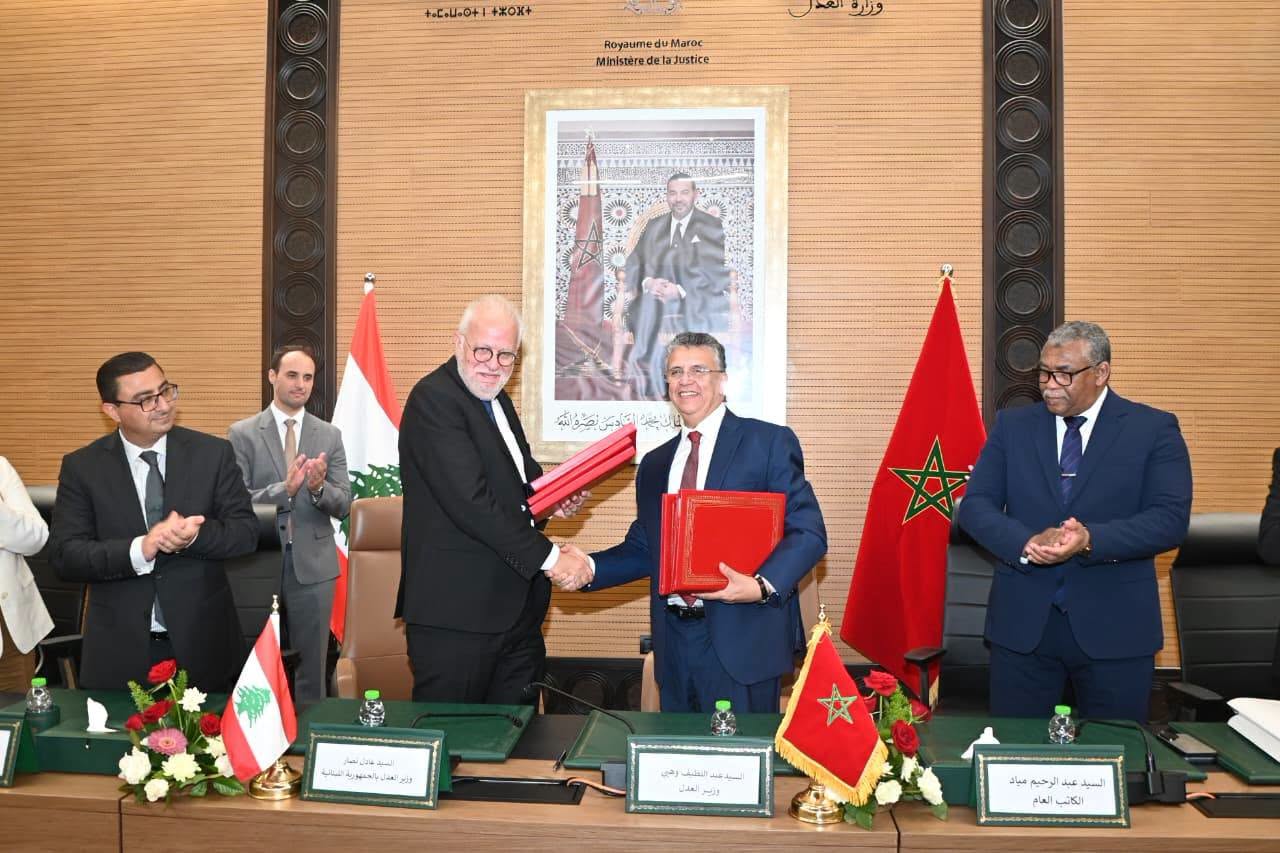
Agadir – Morocco and Lebanon have signed three agreements to strengthen judicial cooperation in criminal matters, including mutual legal assistance, the transfer of sentenced persons, and extradition.
Moroccan Justice Minister Abdellatif Ouahbi and his Lebanese counterpart Adel Nassar, who is on a work visit in Morocco, signed the agreements on October 5.
The agreements cover mutual assistance in criminal matters, the transfer of sentenced persons, and the extradition of wanted individuals between the two countries.
The Moroccan Ministry of Justice said the agreements will help both countries strengthen their ability to respond to different forms of crime and related challenges.
“The signing of these agreements and their entry into force will contribute to achieving the two countries’ shared objectives,” the ministry said in a statement.
The agreements will also help Morocco and Lebanon “address all forms of crime and its challenges in the best possible manner” through judicial cooperation mechanisms in criminal matters, according to the ministry.
The ministry said the agreements are also intended to bring the two countries’ legal and judicial systems closer together through provisions that facilitate cooperation in criminal matters.
They take into account the need to simplify procedures for citizens of both countries, the ministry added.
The signing is part of efforts by Morocco and Lebanon to implement their shared strategic objectives and deepen bilateral cooperation in the judicial field.
According to the ministry, the agreements could also pave the way for further cooperation in other legal and judicial areas.
“The signing of these agreements will provide an opportunity to open discussions on the two countries’ future plans to conclude other agreements covering legal and judicial fields,” it said.
Morocco and Lebanon also agreed to intensify exchanges of visits and expertise.
The two sides agreed to organize meetings to “exchange experiences and share expertise and best practices” in other areas of common interest, according to the ministry.
These exchanges will aim to develop and modernize judicial administration in both countries while strengthening the capabilities of their human resources, the ministry said.
The ministry said these efforts are intended to help both sides achieve their “desired objectives” in judicial cooperation.