
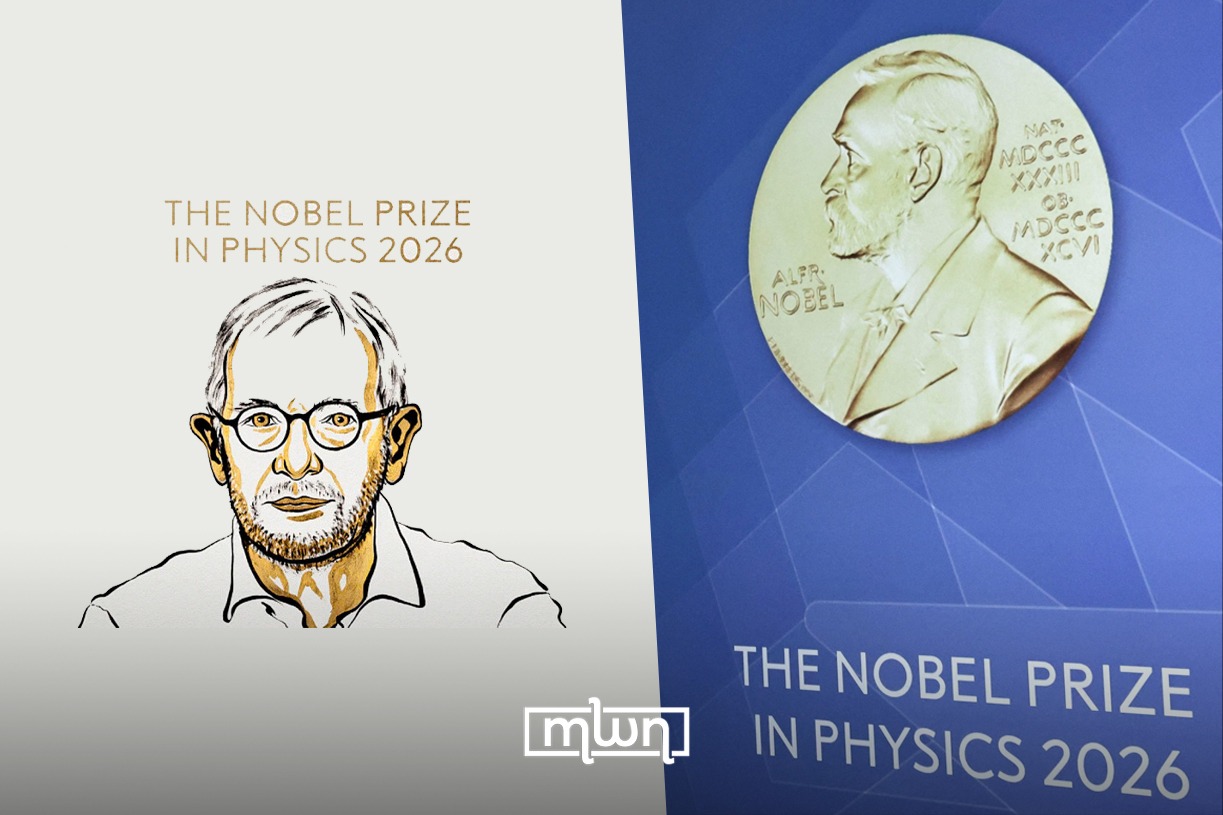
Rabat – Belgian-American physicist Francis Halzen has won the 2026 Nobel Prize in Physics for his pioneering work on high-energy neutrinos and the creation of the IceCube Neutrino Observatory at the South Pole.
Neutrinos are among the universe’s most elusive particles. They have almost no mass, carry no electric charge, and can pass through matter with little interaction. Billions travel through the human body every second without detection.
Halzen proposed in 1988 that Antarctic ice could serve as a giant neutrino detector. The idea eventually became IceCube, a particle observatory that occupies about one cubic kilometer of ice and reaches depths of roughly 2,500 meters.
Thousands of sensors buried beneath the ice detect tiny flashes of light that occur when neutrinos collide with matter. Because neutrinos travel through magnetic fields without changing direction, scientists can use their paths to trace them back toward distant cosmic sources.
IceCube has detected high-energy neutrinos from both inside and beyond the Milky Way, giving scientists a new way to investigate some of the universe’s most extreme phenomena, including exploding stars, black holes and neutron stars.
Eva Olsson of the Royal Swedish Academy of Sciences described neutrinos as “messengers” from the cosmos that can provide information about distant galaxies and violent astrophysical processes.
Halzen acknowledged that the success of IceCube was far from certain when the project began.
“I have to emphasise how lucky I was because, when we started this project, everybody realised this was maybe a good idea, but very few thought it would work, including myself,” he said after the Nobel announcement.
The 82-year-old University of Wisconsin-Madison professor said the most exciting discoveries may still lie ahead.
“The real excitement is that I cannot answer that question yet,” Halzen said. “This is just an introduction to the science, the astronomy is still to come.”
The 2026 Physics Nobel carries a prize of 12 million Swedish kronor, or about $1.2 million. Halzen will receive the award in Stockholm on December 10, the anniversary of Alfred Nobel’s death.