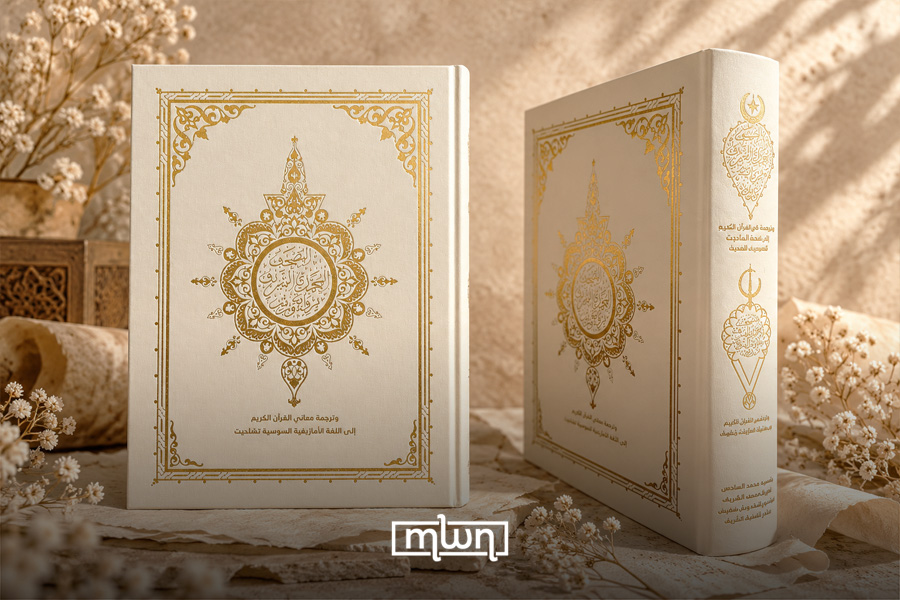
Marrakech – The Mohammed VI Foundation for the Publishing of the Holy Quran has released a new edition of the Mohammedi Mushaf carrying a translation of the Quran’s meanings into Amazigh, specifically the Tachelhit, or Soussi, variety. The edition carries the year 2026.
The release first became public on September 13 through a detailed account by Mouad Essahabi, a Moroccan university professor and researcher in Quranic sciences, readings, and exegesis. It drew renewed attention on Monday, when former head of government Saad Eddine El Othmani shared news of the edition online.
El Othmani opened his message with the words, “Praise be to God, by whose grace good deeds are completed.” He described the work as the first official and scientific translation of the Quran’s meanings into Amazigh in Morocco, produced “under the supervision of a group of distinguished scholars specialized in the sciences of the Holy Quran.”
The committee, he added, worked for years to complete the edition, moving through what he called “a collective path of preparation, review, and arbitration.”
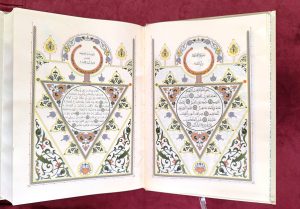
The translation was written in Arabic script rather than Tifinagh. Its words were vocalized according to the rule developed by the scholar Mohamed Mokhtar Soussi, with diacritical marks added to ease reading. The scientific committee kept the text in the Soussi language familiar to ordinary speakers in the regions where it is used, avoiding obscure, unusual, and newly coined terms.
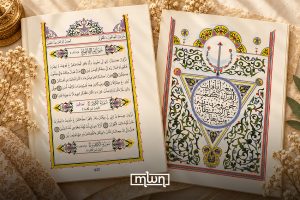
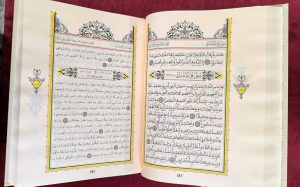
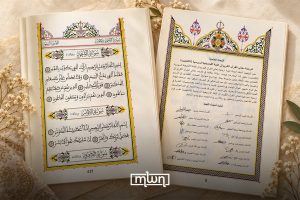
The edition itself runs to 1,278 pages plus appendices, printed in a large mosque format of 25 by 35 centimeters and bound in ivory white with gilded decoration at the center. Each right-hand page presents the Quranic text in the mabsūt style of Maghrebi script – a refined and ceremonial script rooted in the Maghrebi tradition of Arabic calligraphy – arranged in 15 lines, with the Amazigh translation set opposite. The texts are enclosed within a rectangular decorative frame, while Quranic division markers are placed in the page margins within ornamentation inspired by Amazigh culture; the same decorative treatment is used for the surah separators.
A committee of scholars from the Souss region produced the translation. The work proceeded collectively to limit the errors an individual translator might introduce.
Local committees met weekly for review and consultation, with each member assigned a quarter hizb out of every four to translate before presenting it to the group. The text then passed through scientific arbitration and was reviewed three times in its final form after being formatted and typeset by the foundation.
In their work, the scholars confined themselves to the meanings of the verses rather than detailed exegesis. They drew on established commentaries, among them Tafsir al-Jalalayn, al-Baydawi, Ebussuud, al-Nasafi, and Ibn Kathir, while adhering to Moroccan practice in Maliki jurisprudence and Ash’ari creed.
They also consulted classical Soussi Amazigh works and translations, including Al-Hawd and Bahr al-Dumou’ by Sidi M’hamed ben Ali Akbil Aouzal, Sidi Mohamed ben Abdallah ben Daoud At-Tamsmaouti’s translation of Al-Murshid al-Mu‘in, and Sidi El Hassan ben Moubarak ben Mohamed At-Tamoudizti’s commentary on Al-Hawd, alongside numerous other books and poems.
The introduction appended to the Mushaf sets out four reasons behind the project. The first is a Quranic revival the committee tied to the country’s leadership under King Mohammed VI.
The second is that the Quran had already been rendered into several foreign languages, which made it, in the committee’s words, unreasonable that it not be translated into Amazigh, a language spoken in its three dialects by a large share of Morocco’s population.
The third reason concerns the gap itself. The committee pointed to the absence, as far as it knew, of any sound translation of the Quran’s meanings into Amazigh. That void, the introduction notes, risked encouraging those “without qualification” to “intrude upon this sacred preserve,” harming both the Quran and the Amazigh while believing they were doing good.
It therefore fell to those of scholarly, moral, religious, and national competence to close the gap and place before Amazigh speakers a sound translation that brings its meanings closer and helps them “discover some of its treasures and secrets.”
The fourth reason is a recommendation issued by the second scholarly symposium of the local ulema councils of the Souss-Massa-Draa region, held December 21-23, 2012, in Agadir.
The effort builds on a centuries-old Amazigh pedagogical tradition of translating the meanings of the Quran, Prophetic hadith, and foundational religious texts to make them easier to understand and interpret.
In 1933, scholar Mohammed El Hajoui Thaâlibi recorded that Quran teachers working among Amazigh communities would first explain a passage’s meaning in translation before asking students to memorize it, noting that comprehension made memorization considerably easier. He added that this method had been practiced “for generations” and inherited from earlier teachers.
Essahabi concluded that the translation is distinctive and carries considerable scholarly credibility, first because it was issued by an official institution, and second because it was produced by a group of Soussi scholars whose work, he said, combined broad learning with precision, careful verification, and reliability.

The Mohammed VI Foundation for the Publishing of the Holy Quran was established by Dahir No. 1.09.198, issued on February 23, 2010. King Mohammed VI personally inaugurated it in Mohammedia on August 26, 2010.
Its mandate covers the recording, printing, publishing, and distribution of the Quran, along with ensuring the continued accuracy of the text’s orthography, vocalization, and reading. The foundation re-copies the Mushaf in the Warsh ‘an Nafi’ narration, long adopted in Morocco, according to the rules governing rasm, waqf, vocalization, and the readings. It also guards the copies in circulation across the kingdom against error or distortion.
Beyond production, the foundation licenses individuals and entities seeking to print or distribute the Mushaf, and it audits printed and recorded copies to confirm they are free of errors.
Where needed, it can take legal steps to seize such copies and bar them from circulation. Decree No. 2.12.239, issued on March 6, 2013, set the conditions and procedures for licensing the copying, printing, recording, publishing, and distribution of the Mushaf.
The Minister of Endowments and Islamic Affairs chairs the foundation’s administrative council, and the body operates on a non-profit basis. It distributes the Mohammedi Mushaf inside Morocco and across Europe and the West and East African countries that adopted the Warsh ‘an Nafi’ narration for their copies.