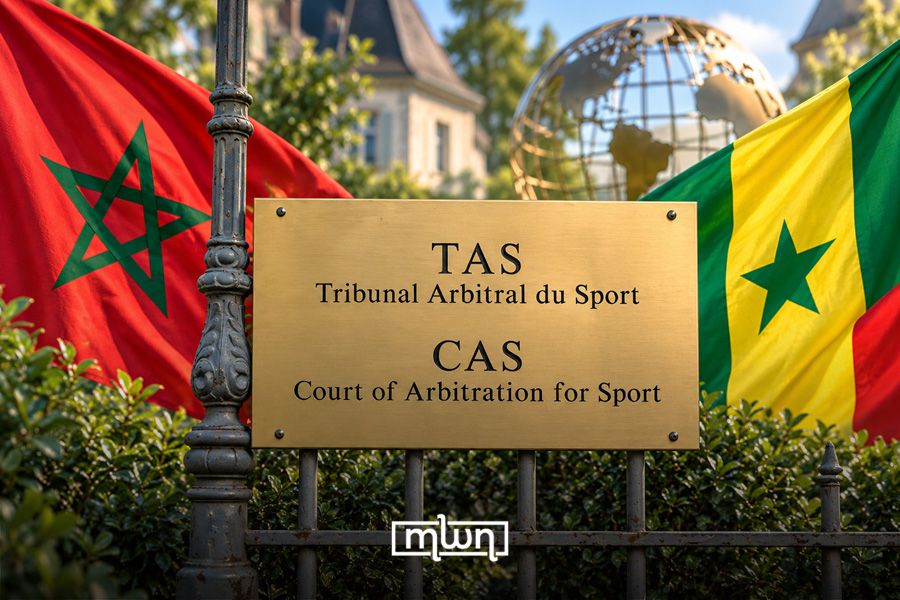
On October 8 this week, the dispute over the 2025 AFCON final between Morocco and Senegal will enter a new phase on the peaceful shores of Lake Geneva in Lausanne. The Court of Arbitration for Sport (CAS) will hear the appeal filed by the Senegalese Football Federation (FSF) against the decision issued by the CAF Appeal Board on March 17, 2026.
First and foremost, this case needs to be put in its proper perspective. The CAS is neither a political platform nor a public-relations body, nor is it an institution tasked with satisfying public opinion in one country or another. It is a specialized arbitral tribunal that settles sports disputes. Its task is to determine, on the basis of the applicable regulations, the established facts, and the arguments put forward by the parties, whether the contested decision should be upheld, amended, or set aside.
The Senegalese case
The starting point is now perfectly clear. Senegal won the 2025 AFCON final on the field, 1-0. But the events that unfolded in the final minutes of the match led to disciplinary proceedings before CAF. The Senegalese team left the pitch for nearly 12 minutes to protest a refereeing decision it considered unfavorable, even unjust. Morocco subsequently filed a complaint with CAF, seeking sanctions over the incident on the grounds that the Senegalese conduct had adversely affected the final outcome. CAF’s Disciplinary Board disagreed and upheld the result recorded on the field.
On March 17, 2026, following an appeal by Morocco, the CAF Appeal Board overturned the earlier disciplinary decision and found that the Senegalese team’s conduct fell within Articles 82 and 84 of the AFCON regulations. It declared Senegal the loser by forfeit and recorded the match as a 3-0 victory for Morocco. This is the decision the FSF is now challenging before the CAS. In its appeal, registered on March 25, the FSF is seeking to have CAF’s decision annulled and to be declared the winner of the AFCON.
The case, therefore, is not simply about challenging the sporting result of a football match. At its core, it concerns the legal characterization of the events surrounding the end of the game and the application of CAF’s regulations.
Understanding how the CAS works
Much of the public commentary surrounding this case rests on a fundamental misunderstanding, whether because of hasty judgment or unfamiliarity with the type of tribunal that will hear the matter.
The CAS is not simply going to ask: “Did CAF get it right?”
Article R57 of the CAS Code gives the panel considerably broader powers. It has full power to review both the facts and the law. It may issue a new decision replacing the one under appeal, or it may set that decision aside and refer the case back to the previous instance, in this case CAF.
In other words, the CAS conducts a genuine rehearing of the case, commonly described as a de novo review. This is essential to understanding the strategy of the Moroccan side, which has filed its own defense and will also be heard in the proceedings.
Morocco’s objective is not merely to prove that “CAF was right.” It will have to persuade the panel that, in light of the facts, the applicable regulations, and their proper interpretation, the decision against Senegal is legally justified. That distinction is fundamental.
October 8 is not ‘Verdict Day’
Another misconception needs to be cleared up. The October 8 hearing is officially listed by the CAS in case TAS 2026/A/12295, Senegalese Football Federation v. CAF & FRMF. But a hearing does not mean that a verdict will be delivered that same day.
The information currently available indicates that the hearing is intended for the adversarial examination of the case and the parties’ oral submissions. The panel will then deliberate and issue its award in accordance with the applicable procedure. There is therefore no reason to manufacture expectations around a “judgment on the evening of October 8.” The CAS operates on a different timetable from social media.
Three main possible outcomes
The case should also be approached soberly, without making predictions, while still considering the possible scenarios.
First scenario: the CAS upholds the CAF decision. In that event, the March 17 decision would remain in force, and the administrative 3-0 result in Morocco’s favor would stand.
Second scenario: the CAS sets aside or amends the CAF decision. Under Article R57, the panel has the power to issue a new decision replacing the one under appeal. This means the CAS would not be forced to choose mechanically between the CAF decision and Senegal’s request. It may conduct its own legal assessment, within the limits of the dispute before it.
Third scenario: the CAS sets aside the decision and refers the case back to the previous instance. This possibility is also expressly provided for in the CAS Code.
It is therefore important to avoid simplistic assertions such as “The CAS will hand the trophy back to Senegal” or “The CAS can only uphold CAF.” Legally, the range of possibilities is broader.
What Morocco needs to do
The strongest Moroccan approach is probably to do precisely what a court expects from a party: argue the law, establish the facts, and leave emotions at the courthouse door.
Morocco has nothing to gain from turning these proceedings into a media battle with Senegal. On the contrary, as in any judicial proceeding, it needs to present an exceptionally rigorous case built around a few straightforward questions:
- What exactly happened?
- Which aspects of the conduct have been legally established?
- Which provisions of the AFCON regulations apply?
- What obligations did the Senegalese Football Federation have?
- Does the sanction imposed by CAF have a sufficient regulatory basis?
- Did the proceedings before CAF’s bodies respect the necessary procedural safeguards?
These are the questions the arbitrators will have to answer. The Moroccan side will presumably devote all its efforts to making that case.
Don’t try to replay the match
There is also a temptation that the Royal Moroccan Football Federation (FRMF) should resist: turning the proceedings into an endless debate over the refereeing of the final. That could be a strategic mistake. The CAS is not being asked to replay the match as a group of supporters might in front of a television screen.
The heart of the dispute is the disciplinary decision and its regulatory basis. The central question is whether the facts established in the case provide a sufficient legal basis for applying the provisions invoked by CAF.
The FRMF, and those representing it, must therefore rely on the regulations, the evidence, the official reports, the chronology of events, and relevant sports jurisprudence.
In other words, fewer slogans, more law.
Let us hope this is indeed the strategy adopted. It is simply common sense.
Morocco’s strength should be its composure
It would also be counterproductive to portray this case as a confrontation between two nations. Senegal is, and will always remain, a brotherly country. The relationship between Moroccans and Senegalese goes far beyond football and a single Africa Cup of Nations final. Firmness in defending a legal position should therefore never be confused with hostility.
Morocco can vigorously defend its interests before the CAS while avoiding any escalation with Senegal. This is where the Moroccan media also have a role to play. Those given the opportunity to comment on the case should be fully aware of this responsibility. The distinction matters: one can challenge a claim without challenging a people.
Morocco, like Senegal on the other side, has every interest in allowing the tribunal to do its job.
The real test is accepting the rules to the very end
There is ultimately a matter of principle behind this case. International football can function only if regulations are applied, if federations agree to submit their disputes to the judicial mechanisms established for that purpose, and if they abide by the decisions that are ultimately rendered.
Senegal has taken its case to the CAS. That is its right. Morocco is a party to the proceedings. Its responsibility is to defend its case. Then the award will come, and whatever the outcome, it should be examined with the same rigor that is expected of the tribunal today.
That, ultimately, is the best posture the Moroccan side can adopt, and it is probably the one it will take. The FRMF’s representatives will not go to the CAS demanding victory. They will present a case that allows the arbitrators to reach their decision with a full understanding of both the law and the facts.
Morocco has nothing to gain from making more noise than necessary. It has everything to gain from being more precise than its opponents. On the shores of Lake Geneva, it will be neither patriotism, nor social media, nor tireless influencers, nor supporters’ commentary that has the final word.
It will be the evidence, the regulations, the facts, and the law. No more, no less.