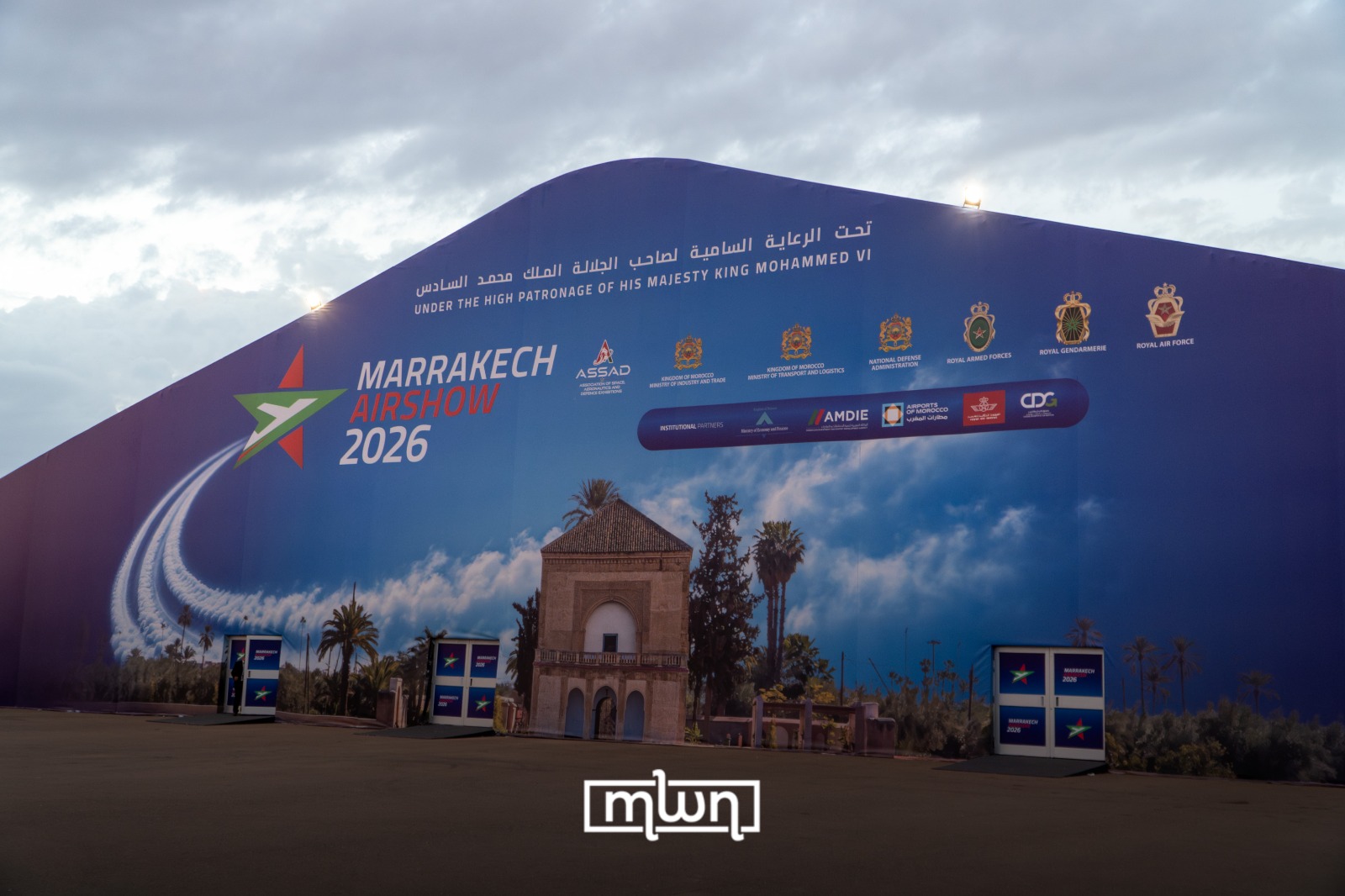
Marrakech – Morocco is seeking to turn its foreign defense partnerships into the foundation of a domestic military industry. At the opening of the Marrakech Airshow on Wednesday, the minister delegate in charge of the National Defense Administration, Abdeltif Loudyi, set out a strategy centered on local production, technological expertise, and greater defense sovereignty.
He described a country preparing to assume more responsibility for building the capabilities it needs, supported by investment incentives, dedicated industrial zones, and cooperation with an increasingly diverse range of international manufacturers.
The objective, he declared, is to move “from a model of importing defense capabilities to building national capacity and defense sovereignty.”
His remarks came as the eighth edition of the Airshow opened at Marrakech’s military air base, bringing together nearly 200 exhibitors from 27 countries. Running through October 10 under King Mohammed VI’s patronage, the gathering places established suppliers alongside companies involved in Morocco’s emerging industrial projects. Lockheed Martin, Boeing, Airbus, Safran, Tata Advanced Systems, IAI, and Elbit Systems are among the participating companies.
View this post on Instagram
Agreements signed at the opening covered advanced manufacturing research, aircraft components, local sourcing, and defense technologies, including a Moroccan drone. They gave practical expression to Loudyi’s central argument: international partnerships should help Morocco acquire the industrial knowledge and production capacity that underpin military autonomy.
Building an industry around sovereignty
Loudyi anchored that ambition in the transformation of Morocco’s aerospace sector, which he credited to King Mohammed VI’s strategic direction. The industry has undergone “a qualitative leap,” he argued, moving from “simple assembly to manufacturing and advanced engineering,” according to MAP’s account of his address.
“Aerospace and space, with all the technologies associated with them, have now become an essential driver of the development of national industrial capabilities,” Loudyi said. Morocco’s ambition, he added, is to establish itself as a global hub for aircraft manufacturing and maintenance, attracting groups such as Boeing, Airbus, and Pratt & Whitney.
He also tied industrial development to a wider modernization agenda, including upgrading airports to support tourism and prepare for major international sporting events. Morocco, he added, aims to contribute as an emerging player to global aerospace production chains.
That progression matters for defense because an industrial base encompasses far more than finished weapons. Engineers, component suppliers, testing facilities, and maintenance expertise help determine whether a country can sustain equipment over its service life and participate in developing its successors.
Loudyi presented the defense industry’s development as a deliberate institutional process. A legal framework created the foundation for investment, followed by dedicated industrial zones with logistics and services adapted to military manufacturing. Incentives and support for investors, he added, have helped attract projects with different international partners.
View this post on Instagram
The framework includes Law 10.20, promulgated in 2020, and its 2021 implementing decree. A separate decree issued in June 2024 established two defense industrial acceleration zones, authorizing activities including the manufacture of defense equipment, weapons systems, and ammunition, alongside related services.
The minister also identified security and economic stability as investment advantages, alongside Morocco’s position connecting Arab and African countries with Europe and its access to the Atlantic. Together, he maintained, these attributes make the kingdom an attractive and competitive destination for defense industries.
He emphasized attracting foreign investment and localizing military technologies while mobilizing Moroccan public and private actors to establish partnerships with overseas investors. The projects already launched, he said, are intended to supply military equipment and services for domestic needs or export.
Loudyi linked this effort to the King’s July 29 Throne Day address. In that speech, the monarch said a defense and cybersecurity industrial and technological base would progressively strengthen defense sovereignty, generate development opportunities, and consolidate Morocco’s standing as a regional power in these sectors.
Partnerships that bring production home
Morocco’s search for autonomy is unfolding alongside substantial arms imports. The Stockholm International Peace Research Institute (SIPRI) ranked it Africa’s largest importer of major arms in 2021-2025. The United States supplied 60% of those imports, Israel 24% and France 10%, measured by SIPRI’s indicator of transfer volume rather than spending.
Those figures show why expanding the range of partners and developing domestic capabilities are complementary tasks. Additional suppliers provide more procurement options; producing and supporting equipment locally can give Morocco greater control over its availability and create opportunities for its own companies.
In other words, diversification is itself a form of sovereignty. A military that depends excessively on a single foreign supplier is exposed not only to commercial risk, but also to political pressure, export restrictions, spare-parts shortages, and shifting alliances. In defense, dependence can quickly become strategic vulnerability.
By spreading procurement across multiple partners while building domestic production, maintenance, and technological capacity, Morocco reduces external leverage over its security choices and preserves greater freedom of action in moments of crisis.
India’s Tata Advanced Systems offers a concrete example. Loudyi and Indian Defense Minister Rajnath Singh inaugurated the company’s Berrechid factory on September 23, 2025. The plant began producing WhAP 8×8 armored vehicles, a platform developed jointly by Tata and India’s Defense Research and Development Organisation.
Morocco’s defense administration put the initial local component share at 35%, with a target of 50% as training and domestic supplier integration advance. On December 24, 2025, Tata announced the handover of its first batch to Morocco’s army, describing the vehicles as made in Morocco.
The project illustrates the model Loudyi outlined in Marrakech: foreign technology combined with Moroccan production, workforce development, and a growing domestic supply chain. The factory is also intended to serve export markets, particularly in Africa, extending its purpose beyond equipping the Royal Armed Forces (FAR).
Türkiye adds another dimension to that diversification. Morocco operates Baykar’s Bayraktar TB2 and Akıncı armed drones, while the company’s Moroccan venture, Atlas Defense, advertises maintenance, repair, and logistics support for unmanned aircraft. Developing these services locally can help Morocco retain technical expertise and sustain its fleet more effectively. The partnership indicates how Loudyi’s strategy extends beyond acquiring equipment to building the domestic capabilities needed to support it.
Israel’s BlueBird Aero Systems has also announced plans for local drone production. In November 2025, the company said it had trained a Moroccan technical team under a technology-transfer program preparing a production line in Morocco for its SpyX loitering munition, an attack drone designed to loiter before striking a selected target. The project would advance the transition Loudyi outlined at the Airshow, combining foreign technology with Moroccan production skills to build national defense capabilities.
Cooperation with the United States increasingly includes aircraft support. Lockheed Martin, which announced the first flight of Morocco’s first F-16 Block 72 on Tuesday, is supporting Maintenance Aero Maroc’s planned facility at Benslimane. It is designed initially for heavy maintenance and modernization of C-130 aircraft, with plans to expand to platforms including the F-16.
Boeing’s cooperation also reaches Moroccan engineering firms. At the 2024 Airshow, the industry ministry announced that NTS Technics had been selected as an engineering partner, with Boeing supporting its progress toward approved supplier status. The ministry linked that initiative to a February 2023 industrial offset agreement with Boeing, connecting defense cooperation to domestic engineering development.
France’s Safran demonstrates the depth of the aerospace capabilities on which Morocco can build. In June, the industry ministry announced an expansion of its Nouaceur Electronics & Defense site, which already assembles avionics computers, actuators and other sophisticated components. The expansion is intended to add 15 production lines and 500 jobs over five years.
Israel provides another strand. The November 2021 defense memorandum signed by Loudyi and then-Israeli Defense Minister Benny Gantz covered technology transfer, training, and defense industrial cooperation. Separately, a 2022 agreement with Israel Aerospace Industries (IAI) identified aerospace manufacturing, research, and engineering opportunities, including developing Moroccan suppliers.
Turning industrial capacity into defense sovereignty
The agreements signed at this year’s Airshow extend that approach into technologies Morocco wants to help develop. According to MAP, a partnership with France’s Harmattan AI covers next-generation counter-drone technologies across research, engineering, production, integration, and testing. A separate agreement concerns developing a Moroccan drone.
A letter of intent signed at the show covers the IRIFI long-range strike program. Harmattan told Le360 that it plans to develop and manufacture the system’s critical technologies in Morocco, primarily with Moroccan personnel. The company describes IRIFI as designed for strikes at ranges of up to 2,000 kilometers.
The initiative builds on Harmattan’s June partnership with the FAR, which envisages Moroccan manufacturing, an artificial intelligence research center and cooperation with universities. Linking research institutions to production programs would give Moroccan engineers a role in developing technology as well as manufacturing equipment.
Other opening-day agreements address the wider industrial foundations. Boeing, Airbus, Lockheed Martin, and Safran joined Moroccan institutions around the Africa Center of Manufacturing Excellence, or ACME, to strengthen industrial and aerospace research. The initiative builds on cooperation launched with Boeing at the 2024 Airshow.
Safran Oil Systems signed an agreement for a Moroccan industrial subsidiary specializing in aircraft-engine lubrication and fluid management. Royal Air Maroc and the industry ministry also agreed to increase the integration of Moroccan products and services into the airline’s supply chain.
These civilian projects support the broader progression Loudyi described by creating demand for local suppliers and strengthening specialist skills. Their contribution to defense will depend on how that expertise is applied to military requirements and how far partnerships transfer meaningful engineering and production responsibilities.
Export potential also features prominently in Loudyi’s account. Producing for overseas customers could help sustain an industry beyond the requirements of the FAR, while giving Moroccan manufacturers an incentive to meet international standards. His emphasis on domestic and export markets connects defense sovereignty to an economic development strategy.
The extent of Morocco’s future autonomy will therefore be measured in the capabilities retained at home: components its companies can supply, systems its engineers can develop, and equipment its technicians can keep operational. Tata’s rising local-content target shows how that progression can be assessed over time.
“Morocco is strongly determined to develop this sector and mobilize the necessary efforts and resources to make it a real means of strengthening its relations with its partners, by moving from a model of importing defense capabilities to building national capacity and defense sovereignty, and consolidating the kingdom’s position in this field,” Loudyi concluded.