
Rabat – Morocco continued rolling out measures to strengthen the use of Amazigh in public administration during the first half of 2026, with sector plans, public signage, translation services and training programs forming part of the effort.
The Ministry of Digital Transition and Administration Reform said the continued implementation efforts are in line with Organic Law 26.16, enacted under Royal Decree 121.19.1 on September 12, 2019. The law sets out the stages for implementing Amazigh as an official language and integrating it into education and priority areas of public life.
According to the ministry, 26 sectoral plans were completed after administrations received technical and methodological support. Eight other administrations submitted support requests, which officials studied before concluding specific agreements to carry out proposed projects and programs.
The measures build on Morocco’s constitutional recognition of Amazigh. Article 5 of the 2011 Constitution recognizes Amazigh as an official language of the state and a common heritage of all Moroccans, while requiring an organic law to define how authorities implement that status in education and priority areas of public life.
In January 2026, the government said it had allocated 1,000 teaching positions for Amazigh language teachers, compared with about 200 in 2020. It has also created a fund to support Amazigh use and a directorate dedicated to developing its use within public administration.
The report details new partnerships. It records framework agreements with the Ministry of Investment, Convergence and Evaluation of Public Policies, the Ministry of Transport and Logistics, and the National Integrity and Anti-Corruption Authority.
It also records agreements with the Ministry of Energy Transition and Sustainable Development’s energy transition sector to strengthen guidance services, and with the General Secretariat of the Government to implement its sectoral action plan.
The ministry has expanded Amazigh signage across public institutions as part of these continued efforts. Speaking at the exhibition marking the Amazigh New Year 2976 at Rabat’s Mohammed V National Theater on January 13, Minister of Digital Transition and Administrative Reform Amal El Fallah Seghrouchni said Morocco was continuing to “strengthen the official use of the Amazigh language by integrating it into public institutions, administration, and daily public services.”
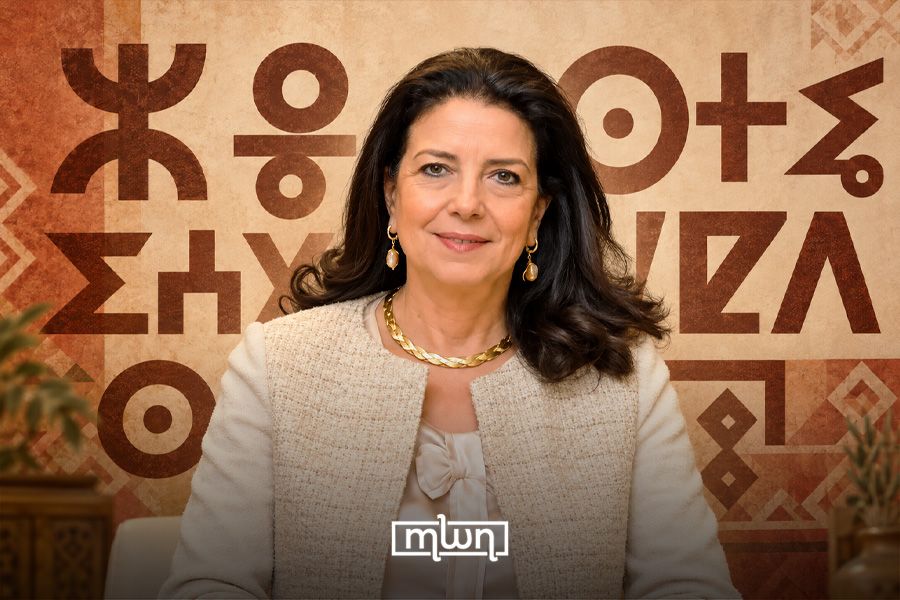
She pointed to measures including expanded Amazigh signage in public spaces and state transport, Arabic-Amazigh translation during parliamentary sessions and mechanisms allowing citizens to communicate in Amazigh with public administrations and through dedicated phone services.
“These initiatives reflect Morocco’s commitment to preserving Amazigh culture and ensuring the practical implementation of its constitutional status,” she added.
Among some of its most notable features, this new implementation program also added the language to signs and panels at the Ministry of Endowments and Islamic Affairs. And it continued coordination with the ministries responsible for transport and logistics, equipment and water, civil protection, and handicrafts and the social and solidarity economy.
On-the-ground rollout, media and cultural initiatives
Local authorities including Temara, Khemisset, El Mers and Tinzert also joined the rollout. Authorities added Amazigh to 403 vehicles and transport units belonging to the General Directorate of National Security and 512 belonging to the Ministry of Health and Social Protection.
A ministry study on adding Amazigh to official government websites produced a roadmap containing 10 structured projects. In cooperation with the Royal Institute of Amazigh Culture, the ministry organized training for 120 employees from public administrations. The course focused on communication in Amazigh, writing in Tifinagh and approved administrative terminology.
Another measure involved the Al-Mouin administrative terminology dictionary. The ministry translated 7,949 Amazigh terms from its original Arabic-French version to help administrative users work in Tifinagh.
The ministry also provided simultaneous Amazigh interpretation during plenary sessions of both chambers of Parliament and continued using Amazigh during the government spokesperson’s weekly press conferences. It began work with the General Secretariat of the Government to classify general legislative and regulatory texts for translation and prepare a legal terminology dictionary.
The program also extends to education and culture. The ministry developed an online platform for students to learn Amazigh remotely with the Ministry of National Education, Preschool and Sports.
It also provided financial support to cultural associations organizing Amazigh festivals and, with the Ministry of Youth, Culture and Communication’s culture sector, organized the 2976 Amazigh New Year celebration. The event ended with new partnership agreements with government sectors to expand the language’s areas of use.