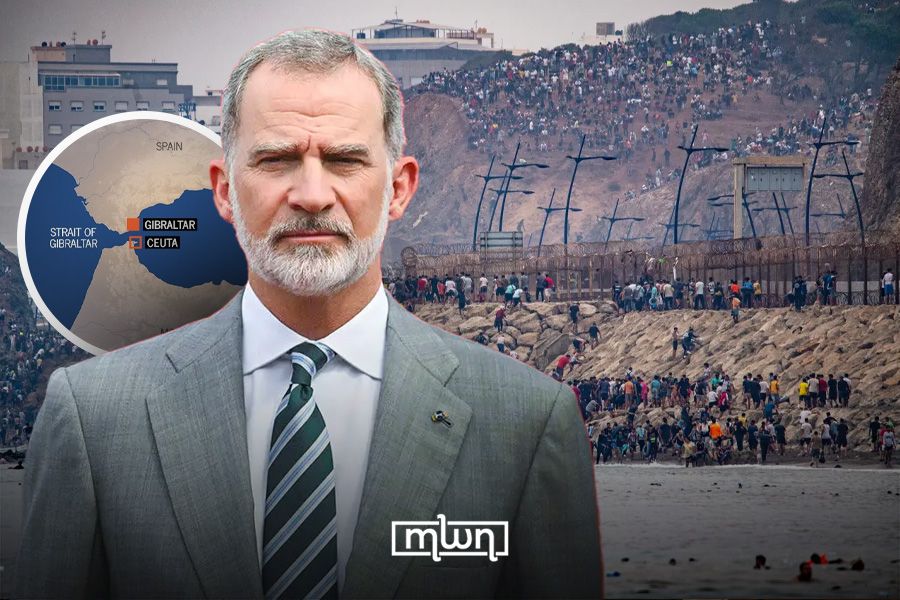
King Felipe VI and Queen Letizia will visit Ceuta on October 13 and 14 before proceeding to Melilla. The program includes an interfaith tribute at the Sidi M’barek Muslim cemetery, named after a Moroccan Sufi saint, in memory of migrants who drowned at sea on July 30 and 31 while attempting to reach Ceuta, a Spanish-administered city on Moroccan soil. Spain’s Royal Household has confirmed the visit in its official agenda.
The gesture deserves unreserved recognition. When a king pays tribute to young migrants who lost their lives at sea, some of whom could never be identified, he reminds us that behind migration statistics and the media and political uproar lie lives cut short, families left waiting for answers, and names that history may never record.
But compassion only has real value when it is not selective. It should not be confined to tragedies that make the headlines, nor should it stop at the boundaries of the present. A state’s commitment to humanism must also be measured by its willingness to confront the most painful chapters of its own history.
Your Majesty, just a few kilometers from Ceuta, Morocco’s Rif region still bears the scars of a colonial war, one of whose darkest episodes involved the use of chemical weapons against civilian populations. There, too, lives were cut short, children were buried without graves, and tombstones preserved the memory of people burned, poisoned, or lost forever beneath chemical bombardments.
The Rif: A testing ground for colonial violence
Between 1921 and 1926, northern Morocco became the scene of a major confrontation between the Spanish colonial army and Rifian resistance forces led by Mohammed ben Abdelkrim El Khattabi. The Spanish army’s crushing defeat at Annual in July 1921 dealt Madrid a major military and political blow and left the country deeply humiliated. What followed was a reconquest marked by extraordinary and inhumane brutality.
Faced with guerrilla fighters who defended their dignity and homeland by making effective use of the mountainous terrain, Spain, Your Majesty, did not limit itself to conventional ground operations. Its military gradually expanded its use of aircraft and chemical weapons, among the most abhorrent instruments of warfare.
In “Deadly Embrace: Morocco and the Road to the Spanish Civil War”, published by Oxford University Press in 2002, British historian Sebastian Balfour documented the extensive use of mustard gas, drawing on Spanish military archives and testimonies collected in Morocco. The evidence is established and recorded, yet it still awaits full recognition by your country, Your Majesty.
Mustard gas, also known as sulfur mustard or yperite, was no ordinary weapon of military neutralization. It causes severe burns to the skin and eyes, respiratory injuries, prolonged suffering, and, in many cases, death. Its effects can emerge after exposure and leave lasting damage. Many people in the Rif still bear its devastating consequences.
Your Majesty, these bombings did not target military positions alone. They struck inhabited areas, villages, and civilian communities, inflicting suffering on people who had no means of protection. Rural populations, then lacking adequate medical facilities and defenses, were particularly vulnerable. Historians continue to investigate the full scale of these attacks, their methods, and their demographic and health consequences. It would therefore be imprudent to cite a precise overall death toll without sufficient evidence. Nevertheless, all indications suggest that the number of victims was considerable.
Your Majesty, this body of research, whether completed or ongoing, is neither an exercise in militant remembrance nor an anti-Spanish legend. Javier Martínez Antonio’s 2025 study of military officer Joaquín Planell and Spain’s chemical warfare program between 1923 and 1927, published in the Revista de Estudios Internacionales Mediterráneos, documents the people involved, the industrial networks, and the technical development behind this military policy.
The evidence needed to acknowledge these crimes is there, Your Majesty.
Al Hoceima: A victory, an unfinished memory
The Al Hoceima landing in September 1925, conducted by Spanish forces with French support, marked a decisive turning point in the Rif War. This major amphibious operation preceded the collapse of the resistance and Abdelkrim’s surrender in 1926.
A century later, the episode remains the subject of research and debate over colonial violence and the consequences of chemical bombardments. On the centenary of the landing, El País noted in September 2025 that the episode remains insufficiently commemorated at the official level, despite the work of historians and memory associations.
What memory demands
Your Majesty, the purpose here is not to ask Spaniards today to inherit personal guilt for the actions of their ancestors. No people should face perpetual condemnation for the deeds of previous generations.
The question lies elsewhere: in the historical responsibility of institutions. A mature nation does not claim an unblemished past, but one that can confront its history, acknowledge the suffering it inflicted on another people, and pass the truth on to future generations without fearing that such honesty will diminish its dignity.
His Majesty Felipe VI’s tribute to migrants who drowned at sea will rightly stand as a gesture of humanity. It would carry even greater meaning if it opened the door to broader recognition: a form of remembrance that makes no distinction between victims of the present, whose suffering receives extensive media coverage and political exploitation, and those whom history has left nameless for decades.
Spain bears responsibility for crimes against humanity committed in northern Morocco. It must acknowledge that responsibility.
The tears the Queen may shed, for I imagine the King, in his dignified posture, will not shed any, will not be enough. On these same lands, Spain continues to occupy territories unjustly acquired by force. The deaths for which official Spain will now mourn are also, in part, a consequence of a double game. On one hand, Spain claims to fight so-called illegal immigration. On the other, it creates incentives for migration through large-scale regularization measures and laws that appear fair and humane but ultimately serve to replenish an aging population with a low birth rate.
Your Majesty, allow me to say that Spain has no right to retain unaccompanied minors who have lost their way and refuse to return them to their families and their country. Those who drowned on July 30 and 31, 2026, also lost their lives because of your country’s policies.