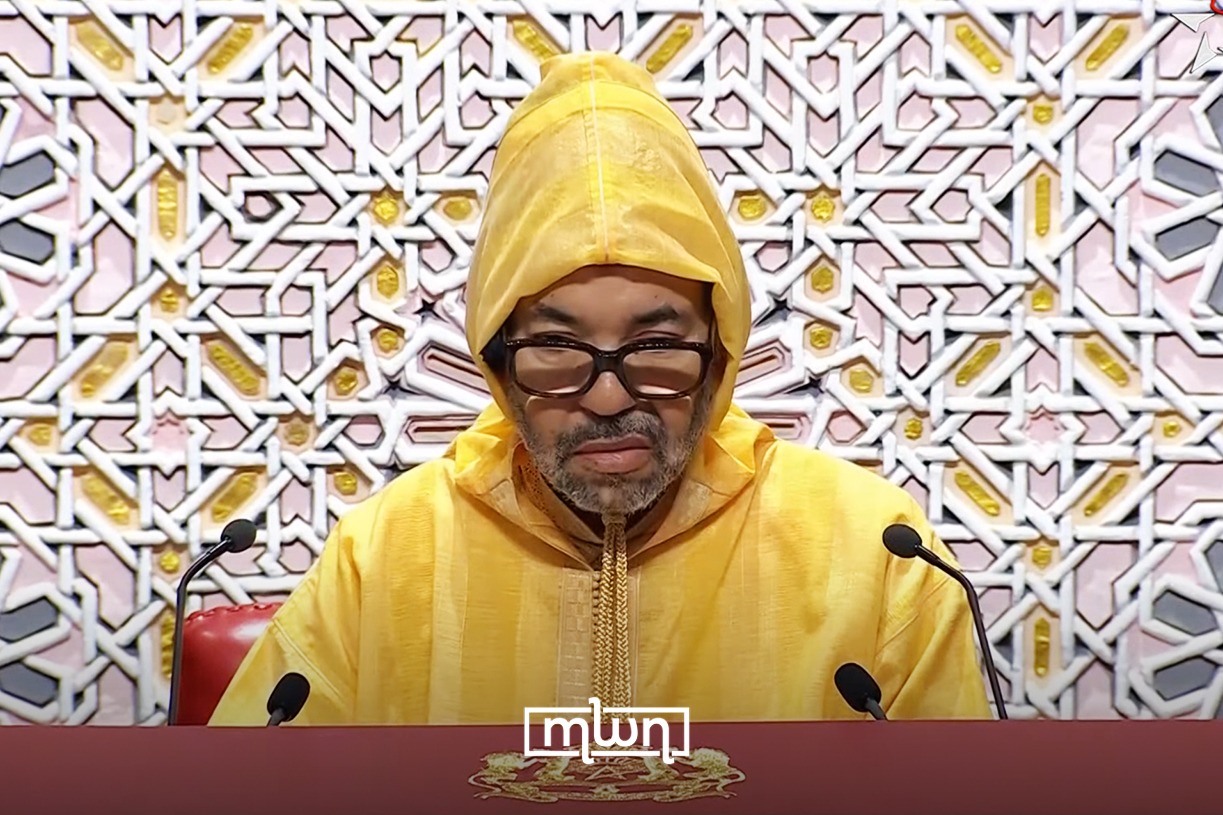
Marrakech – King Mohammed VI used the opening of Parliament on Friday to fix the terms of Morocco’s relationship with Spain, declaring that the partnership rests on a sovereign Moroccan choice that no external actor can force.
Addressing the first session of the first legislative year of the 12th Legislature, convened weeks after the North African country’s September 23 parliamentary vote that made Fatima Ezzahra El Mansouri its first female head of government after her Authenticity and Modernity Party (PAM) won 97 of the 395 seats in the House of Representatives, the King turned to the strain that has built up with Madrid.
“In the face of irresponsible declarations by certain political and media circles, and their flagrant instrumentalization of the situation, We affirm that the partnership is a sovereign choice and a voluntary commitment, one that cannot be subjected to any pressure, threat, or blackmail,” he told lawmakers.
The warning arrives at a charged moment. Spain is heading into a snap general election on November 29, called by Prime Minister Pedro Sánchez, and immigration already dominates the campaign. Polls reported by Reuters place a conservative People’s Party (PP)-Vox coalition as the likeliest outcome, with the Socialists trailing near 28% and the far-right Vox around 18%.
The mass crossing of some 70,000 migrants into occupied Ceuta in July strained local authorities and inflamed disputes over Spain’s border control, even as Morocco, which committed to readmit them, pressed to turn them back and dismantled the criminal networks driving them, often at a cost to its own forces.
The King framed the broader picture first. Morocco, he affirmed, has consolidated its international position as a responsible and reliable partner that honors its commitments, and is therefore entitled to the same treatment from its partners.
The balanced approach Morocco adopted in managing migration, he noted, has produced concrete results. Yet he conceded that the current model of cooperation has reached its limits, as the recurrent crises make clear.
Read also: King Mohammed VI: Morocco-Spain Migration Model Has Become Outdated
He applied the same reading to Spain directly. The partnership, the monarch acknowledged, has advanced across several areas, including the fight against irregular immigration. But that cooperation now runs into major challenges tied to outdated legal provisions and to judicial decisions detached from reality. Such obstacles, he warned, block the repatriation of minors and of people usurping refugee status, and embolden criminal networks.
In response, the sovereign announced that Morocco will present its partners with a document setting out “a clear and practical strategic vision,” one carrying a new orientation aimed at promoting co-development, economic competitiveness, and regional stability.
The royal address builds on a sharper message Rabat delivered weeks earlier. On Thursday, September 10, as Spanish lawmakers pushed through a contested bill granting nationality to Sahrawis, the Moroccan Ministry of Foreign Affairs issued a statement that dropped diplomatic euphemism. Morocco, it declared, “refuses to be a pre-electoral cash cow” and will not accept being “the scapegoat of politicians’ score-settling.”
That statement also laid out the partnership’s ballast. It anchored the relationship in the joint declaration of April 7, 2022, between King Mohammed VI and Sánchez, and listed good neighborliness, political understanding, economic partnership, and security cooperation as its pillars.
Spain stands as Morocco’s leading economic partner, while Morocco ranks as Spain’s second trading partner outside the European Union. On security, the ministry recalled that lives were saved and terror and criminal networks dismantled, “often at the price of human and material losses borne by Moroccan forces.”
The ministry then posed three questions it cast as unanswerable in Madrid. Why sustain the indictment of Morocco when no fact, figure, or report establishes any involvement by its authorities? Why are illegal migrants not turned back, when Morocco has formally committed to readmit them? Why are unaccompanied minors kept far from their families, when Morocco has pressed for their return? The answer, it argued, lies “not in Morocco, but with the Spanish actors concerned.”
Rabat also named the pattern it rejects. The ministry lamented that “historic parties, well-versed in government” had sunk into “this quagmire where unreasonable, populist one-upmanship prevails over common sense,” and that “honorable legislative and judicial institutions” had lent themselves to “unfortunate initiatives” feeding a “strategy of fear.”
The provocations the King alluded to have been accumulating. Spanish officials and media have, in recent weeks, sharpened their rhetoric over the enclaves, stiffened their line on migration, and hurled demands at Rabat, addressing Morocco as a bygone dependency to be lectured and ordered about rather than the sovereign partner it affirms itself to be.
That sequence now culminates in a planned royal visit: King Felipe VI and Queen Letizia will visit Ceuta and Melilla on October 13 and 14, the monarch’s first official trip to the two occupied cities since he ascended to the throne in 2014. The last visit by a Spanish monarch, in 2007, caused a diplomatic crisis with Morocco, and Rabat has traditionally rejected visits by the Spanish monarchy to the enclaves, over which it claims sovereignty.
Writing in the wake of the royal address, Moroccan author and political analyst Samir Bennis read the King’s reference to anti-migration cooperation as a message that admits no misreading. Spain, Bennis argued, cannot demand an effective fight against irregular migration while refusing the legislative changes to its foreigners law that would ease the return of Moroccan minors, “with full respect for the legal guarantees in force.”
The King was just as decisive, he noted, that cooperation “cannot be imposed through the logic of threat” or under the weight of pressure and dictation. It is instead “a strategic and sovereign choice” Morocco makes of its own free will, grounded in mutual respect and shared interests.
Un mensaje rotundo y claro del Rey Mohammed VI a España
La alusión del rey Mohammed VI, durante du discurso de apertura del Parlamento, a la cooperación con España en materia de lucha contra la migración irregular no deja lugar a dudas sobre la posición marroquí al respecto.…
— Samir Bennis (@SamirBennis) October 9, 2026
Bennis read the King’s allusion to the political exploitation of the migration file as no less firm, a clear reference to the right and far-right parties that turned the issue into “a card for political one-upmanship” and a tool for harvesting votes.
Through this message, Bennis wrote, Morocco says plainly: “enough of using the migration question as a weapon” in Spain’s internal struggles, and enough of taking the kingdom as “a scapegoat” made to carry the failures and contradictions of Spanish migration policy.
The message, in his telling, carries particular weight for PP leader Alberto Núñez Feijóo, who made “the demonization of Morocco” one of his sharpest campaign cards and sought to exploit the Ceuta crisis “to the greatest extent possible” for political gain, leveling systematic accusations at Rabat and inflaming confrontation to mobilize his base.
Morocco, Bennis contended, has no need “to issue statements continuously” or to be dragged behind every provocation, preferring to let “its positions and actions speak for themselves.” Yet when it chooses to speak, he wrote, “it speaks in a clear and firm language that leaves no room for interpretation,” drawing candidly the lines it will not allow to be crossed with Spain.
The September statement closed on a warning the King’s address now reinforces. Geographic proximity, the ministry maintained, “is an immutable given.” Whether it becomes an asset rests on politicians and their courage and vision. Strategic blindness, Rabat cautioned, “will transform this capital into a source of chronic mistrust and recurrent tensions.”