
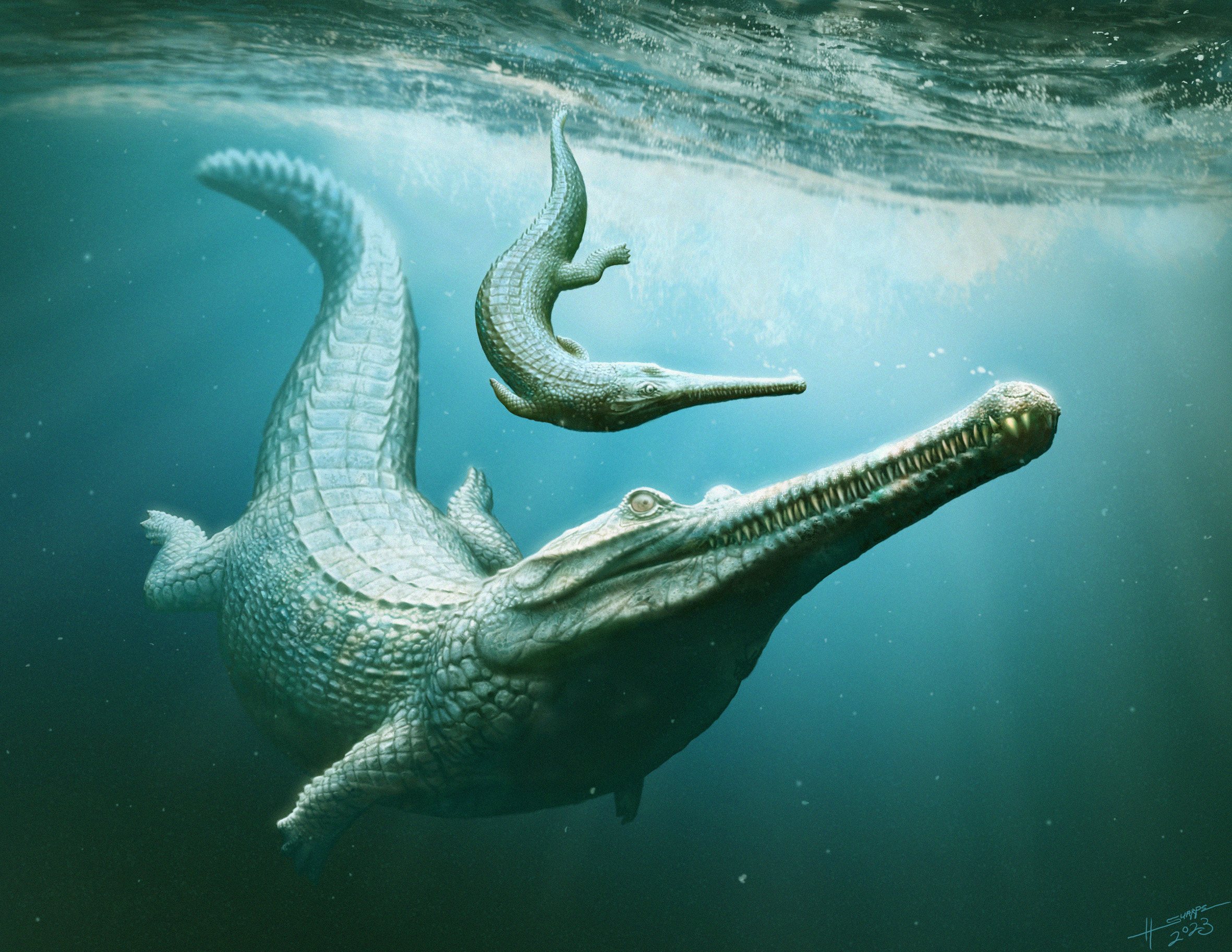
Marrakech – A team of paleontologists has identified a new species of ancient crocodile relative from the Middle Jurassic (roughly 168-165 million years ago) of southeastern Morocco.
The animal, named Ctenosuchus tenuidens, belongs to Thalattosuchia, a group of crocodylomorphs known for their long, slender snouts. The description appears in the Journal of Vertebrate Paleontology, published online on October 8.
The fossils come from the Anoual-Talsint region of Figuig Province, in the eastern High Atlas Mountains. They were recovered from a freshwater, river-and-lake rock sequence dated to the Bathonian stage.
During this interval, Morocco sat in northern Gondwana, at roughly 15°N. The find is significant because thalattosuchians are well documented across Laurasia, especially northwest Europe, but remain poorly known in Africa and on Gondwana.
The research rests on two specimens. The holotype, FSAC-TLSNT-200, preserves part of the skull, including the rostrum, mandible, teeth, and some osteoderms.
The paratype, FSAC-TLSNT-201, preserves the front of the snout along with scattered postcranial bones, among them a vertebra, ribs, a humerus, a femur, and metacarpals.
Both are accessioned at Hassan II University in Casablanca and were loaned to the University of Portsmouth for preparation and study.
The authors purchased the material from commercial fossil collectors in Morocco. Working from locality details supplied by two dealers, four team members visited the area in November 2023, March 2024, and April 2026. They placed the site at coordinates 32°41’06″N, 3°24’34″W, where matrix color, lithology, and copper mineralization matched the described blocks.
What sets the new taxon apart is its dentition. The teeth are thin and needle-like, with a width-to-height ratio of about 1:10.4. The animal carried an estimated count of more than 40 teeth from the premaxilla to the rear of the maxilla, spaced on average 2.3 mm apart.
The genus name reflects this trait: “Cteno,” from the Greek for comb, after the comb-like row of slender teeth, and “suchus,” from the Greek for crocodile. The species name combines the Latin for thin and tooth.
Scanning electron microscopy and thin-sectioning revealed further detail. The tooth crowns show prominent, densely packed vertical ridges on the lingual surface and fainter ones on the labial surface. The enamel is thin, and the teeth are straight or only gently recurved.
A phylogenetic analysis places Ctenosuchus within Teleosauridae, as a sister taxon to Seldsienean megistorhynchus and the group Aeolodontini. The dentition, however, does not match any known thalattosuchian or crocodylomorph.
The feeding ecology points away from the robust, piercing and crushing teeth typical of most teleosaurs. A principal component analysis positioned Ctenosuchus furthest from the generalized teleosaurid dentition.
The authors argue the delicate teeth suit a diet of small, soft prey. They note that the ridges, concentrated on the lingual surface, may have helped the animal grip and puncture fragile prey. With interdental spacing of 2.3 mm and tooth thickness near 1.1 mm, interlocked jaws would leave a gap of only 0.5-0.6 mm, forming a trap for small fish, crustaceans, and soft-bodied organisms.
The team draws comparisons beyond crocodiles. Among living crocodilians, only the Indian gharial carries a needle-like dentition, though its teeth are spaced far wider. The researchers also note parallels with Permian mesosaurs and with suspension-feeding ctenochasmatid pterosaurs.
The authors conclude that Ctenosuchus tenuidens is the only freshwater teleosauroid known from Gondwana, and the second teleosaur taxon recorded from the Jurassic of Morocco.