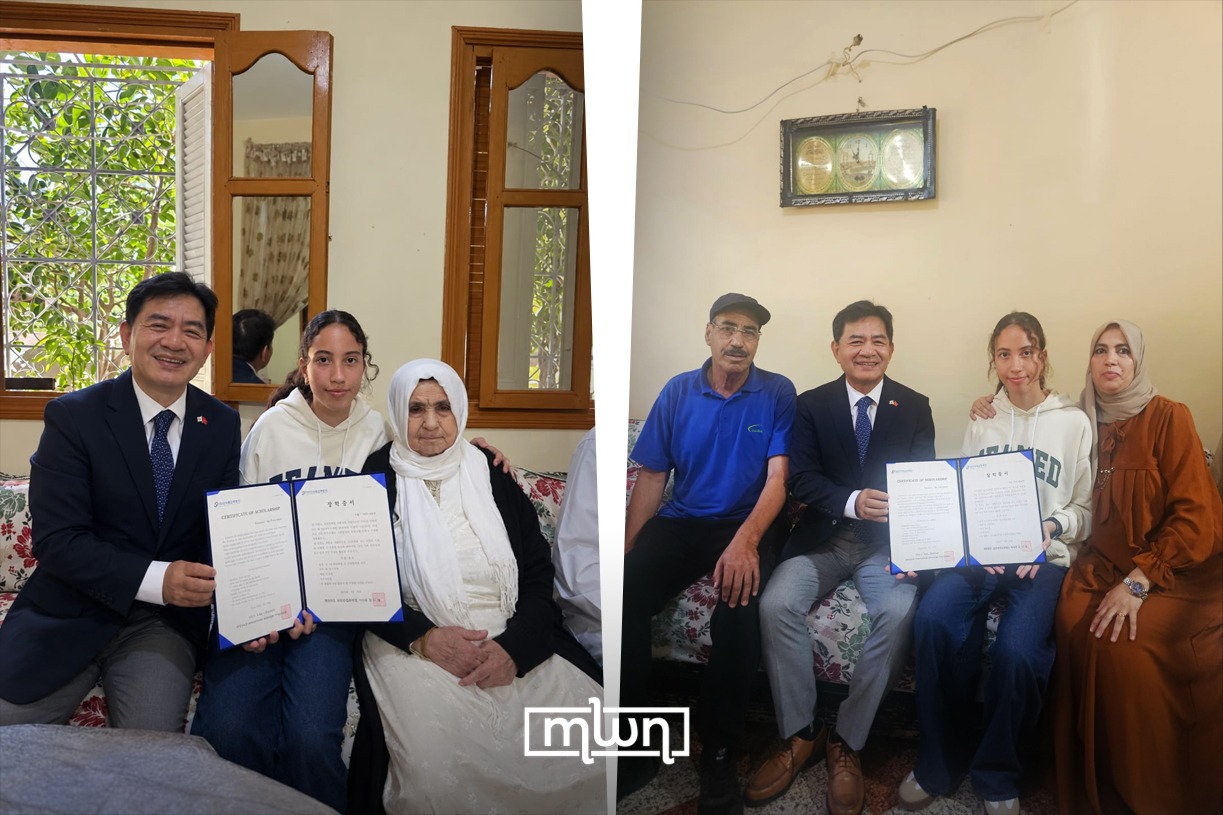
Marrakech – The Ambassador of the Republic of Korea to Morocco, Yoon Yeonjean, traveled to Meknes on Tuesday to meet the family of the late Mohamed Ben Kaddour Lasri, a Moroccan veteran of the Korean War (1950-1953), the embassy announced Wednesday. The visit paid tribute to his commitment and his sacrifice.
During the meeting, the ambassador presented Lasri’s great-granddaughter, Fati Ayach, with a scholarship certificate to pursue her studies in Korea. The award covers one year of Korean language training, followed by a four-year program leading to a bachelor’s degree in the country.
Yoon also inquired about the health of Ftetam Lasri, the veteran’s daughter. He conveyed to her and to the wider family Korea’s gratitude for the courage and devotion of Mohamed Ben Kaddour Lasri during the war.
In his exchanges with the relatives, the ambassador noted that Korea does not forget the sacrifice of the Moroccan veterans who helped defend liberty and peace on the Korean peninsula. He added that the country would continue to honor their memory and pass it on to future generations.
According to the embassy, awarding the scholarship to a veteran’s descendant reflects the friendship and solidarity between Korea and Morocco, while carrying this legacy to younger generations.
Lasri’s story belongs to one of the Cold War’s early conflicts. He was born in Taza, Morocco, in 1915 and served as a corporal-chief. He was killed in action on March 5, 1951, in Tongcheon-gun, Gangwon-do, from an injury suffered in battle at Hill 1037 in the Munchi area, now part of Tongcheon-gun in North Korea, about 200 kilometers north of Wonju.
He was buried at the United Nations Memorial Cemetery in Busan, where cemetery records list his grave as number 571.
His participation belongs to a chapter that long remained outside conventional accounts of the war. When fighting broke out on June 25, 1950, North Korean forces crossed the 38th parallel and invaded the South.
The United States led a multinational intervention under United Nations command, while China entered on the North’s side with Soviet support. An armistice signed at Panmunjom on July 27, 1953, halted the hostilities without a comprehensive peace treaty.
At the time, Morocco remained under the French protectorate, which lasted until 1956. Moroccan soldiers who fought in Korea therefore served within the French contingent operating under UN command, rather than in an independent deployment.
France organized its Korean battalion in 1950, and the unit reached Busan that November before fighting alongside the US Army’s 2nd Infantry Division in engagements that included Wonju, Twin Tunnels, and Chipyong-ni.
About 3,500 French personnel served over the course of the war. Because those troops were recorded as members of France’s UN contingent, Moroccan participation was largely overlooked.
South Korea’s effort to recover their identities gained momentum in recent years. In December 2021, the Korean Embassy in Rabat organized an exhibition honoring Moroccan veterans. On November 15, 2022, it announced that it had officially verified eight Moroccan soldiers through French military records.
A month later, the embassy and Morocco’s Diplomatic Foundation presented “Morocco-Korea: Blood Brothers,” a bilingual publication documenting traces of 21 soldiers. During a ceremony in Seoul in July 2025, researchers announced that 16 more had been identified, raising the known total to 24.
A second soldier, Julien Djian, is also commemorated in Busan. Born in Marrakech in 1928 and of Moroccan-Jewish origin, he died on July 4, 1953, 23 days before the armistice.
Morocco and South Korea established diplomatic relations on July 6, 1962. The wartime service of these soldiers, now partly recovered through archival research, had already linked the two countries years earlier.