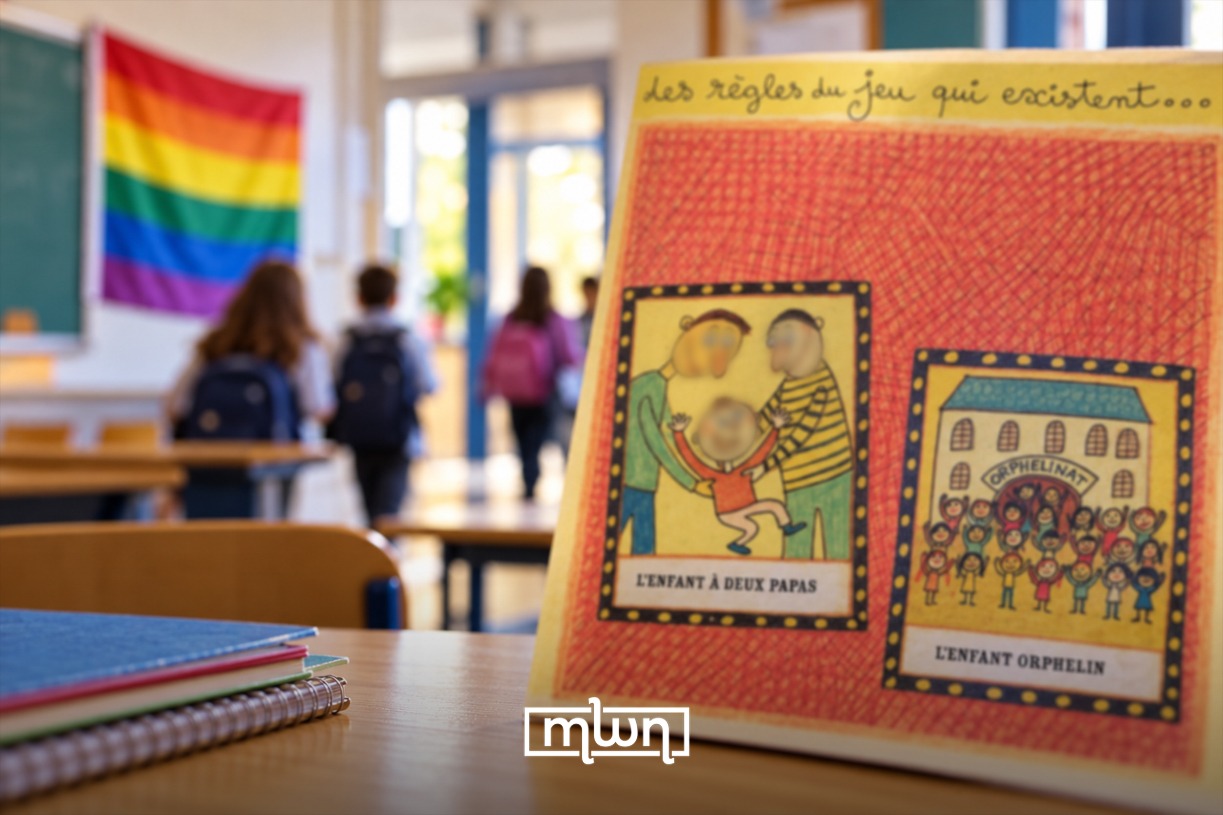
Rabat – A school affiliated with the French educational mission in Morocco’s capital, Rabat, has sparked controversy over a book depicting same-sex parents being used in classes.
The case has renewed uproar and controversy over LGBTQ+-related content in educational settings and the role of teachers in selecting materials for children.
A source familiar with the case confirmed to Morocco World News (MWN) the presence of the book at a school affiliated with the French mission in Morocco. However, the source stressed the book was not part of the school’s official curriculum and had instead been brought in by a teacher as “a personal initiative.”
Some of the book’s pages depict families with two parents of the same gender. One passage reads “L’enfant a deux papas,” which translates into English as “The child has two dads.”
The case has drawn attention in Morocco, a Muslim-majority country where same-sex relations remain criminalized under Article 489 of the Moroccan Penal Code. The provision criminalizes “lewd or unnatural acts with an individual of the same sex,” with convictions carrying prison sentences and fines.
The presence of such material in a school setting has renewed questions about the content presented to children and the responsibility of educational institutions operating in Morocco to respect the country’s laws and cultural context.
Previous controversy at French mission school
The latest case follows an earlier controversy involving LGBTQ+-related educational content at another French mission school in Morocco.
In 2023, parents in Kenitra, a city around 36 kilometers north of Rabat, sued another French mission school over lessons reportedly addressing LGBTQ+ issues.
Reports at the time indicated that Moroccan authorities were investigating the case, which dated back to December 2022.
Moroccan attorney Abderrahim Jamai said parents were shocked to learn that a teacher had presented information about homosexuality and what he described as “abnormal trends,” while also allegedly expressing views that the families considered offensive to Islamic figures and symbols.
According to Jamai, the parents believed the lessons encouraged children to accept or normalize homosexuality and same-sex relationships, arguing that the content conflicted with their religious and cultural values. He also stressed that the children involved were younger than 10.
The controversy also prompted political attention. Hanane Atarguine, a member of the Authenticity and Modernity Party (PAM), previously questioned what the government could do to prevent French mission schools from engaging in practices that she argued ran counter to Morocco’s religious values.
Atarguine said the controversy angered families who did not expect educational institutions to become spaces for what she described as promoting ideas that conflict with their values.
Meanwhile, Moroccan civil society organizations and activists continue to advocate for LGBTQ+ rights, including decriminalization of same-sex relations, despite the legal restrictions that remain in place.