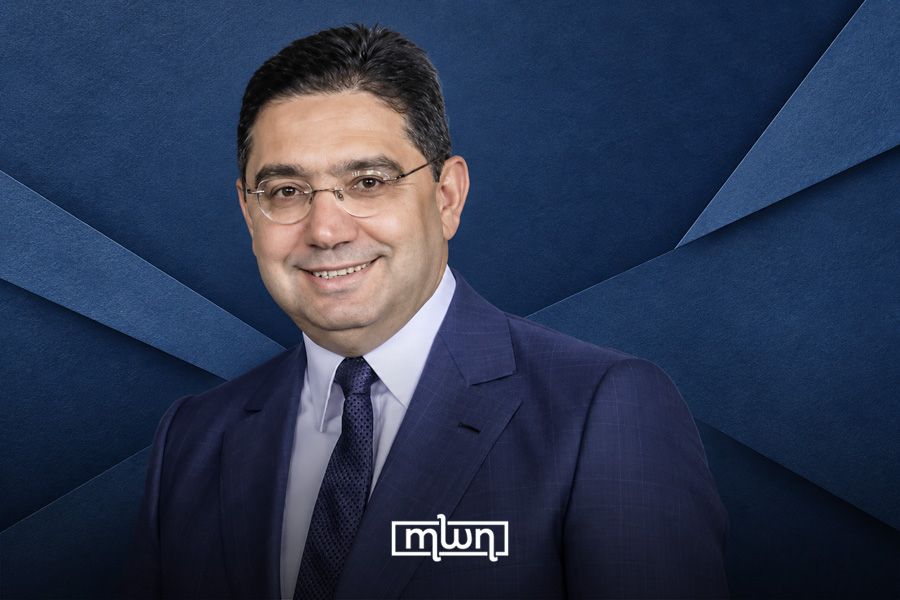
Marrakech – Nasser Bourita has kept his post. King Mohammed VI reappointed him Minister of Foreign Affairs, African Cooperation, and Moroccans Residing Abroad on Friday, as part of the new government led by Fatima Ezzahra El Mansouri.
The appointment extends a tenure that began in April 2017 and has now carried through successive government formations, under Saadeddine El Othmani, then Aziz Akhannouch, and now El Mansouri.
His retention comes after nearly a decade marked by major developments in Morocco’s foreign relations, particularly on Western Sahara, where the kingdom has secured changes in the positions of several influential international partners, expanded its diplomatic presence in Africa, and placed its autonomy proposal at the center of renewed UN negotiations.
The continuity stands out in a cabinet otherwise shaped by change. El Mansouri became Morocco’s first woman to serve as head of government after her Authenticity and Modernity Party (PAM) topped the September 23 legislative elections.
PAM subsequently assembled a coalition with three other parties, including Istiqlal, the Socialist Union of Popular Forces (USFP), and the Party of Progress and Socialism (PPS). Together, they control 207 parliamentary seats, exceeding the 198 required for a majority.
Bourita’s retention reflects Morocco’s constitutional structure as much as the election result. Under the 2011 Constitution, King Mohammed VI exercises central authority over foreign affairs and defense, while the foreign minister conducts diplomacy within that framework. Major diplomatic decisions, particularly those concerning territorial integrity and strategic partnerships, therefore remain tied to the monarchy rather than changes in the governing majority.
A career diplomat, not a party figure
Bourita’s path to the portfolio ran through the diplomatic service. Born in Taounate in 1969, he earned a law degree from Mohammed V University in Rabat in 1991, followed by a certificate of advanced studies in international relations in 1993 and a diploma of advanced studies in public international law in 1995. He is a career diplomat, not a party figure.
He spent years in the Foreign Ministry’s central administration and in diplomatic postings in Vienna and Brussels before specializing in multilateral affairs.
He headed the ministry’s United Nations Division from 2003 to 2006 and directed its United Nations and International Organizations Directorate from 2006 to 2009.
In 2011, he became the ministry’s secretary-general, a position he held until King Mohammed VI appointed him minister delegate in February 2016, under then-Foreign Minister Salaheddine Mezouar.
Bourita was elevated to foreign minister on April 5, 2017, shortly after Morocco formally returned to the African Union on January 31 of that year. He had been minister delegate when the kingdom rejoined the organization following more than three decades outside its institutional structures.
Western Sahara at the center
His subsequent tenure has coincided with a substantial expansion of Morocco’s diplomatic engagement on Western Sahara.
One of the most visible developments began in December 2019, when the Union of the Comoros opened a consulate general in Laayoune, beginning a series of similar openings by African, Arab, and other foreign governments that brought the total to nearly 30 diplomatic missions across Laayoune and Dakhla.
Morocco considers these openings demonstrations of international support for its sovereignty over Western Sahara. They also provide a diplomatic presence in cities the kingdom has sought to develop as centers for trade, investment, and cooperation with sub-Saharan Africa.
The most consequential international shift during Bourita’s tenure came in December 2020, when the United States formally recognized Moroccan sovereignty over Western Sahara.
In a presidential proclamation released on December 10, US President Donald Trump recognized Moroccan sovereignty over the entire territory and endorsed Morocco’s 2007 autonomy proposal as the framework for a negotiated settlement.
The declaration represented a significant change in Washington’s position and strengthened Morocco’s diplomatic argument that autonomy under its sovereignty offered a viable resolution to the dispute. The announcement coincided with Morocco’s decision to resume official relations with Israel under a US-brokered arrangement.
Bourita held the foreign affairs portfolio when the Morocco-United States-Israel Joint Declaration was signed in Rabat on December 22, 2020. The Moroccan signatory, however, was then-Head of Government El Othmani.
Bourita subsequently managed diplomatic contacts following normalization, including discussions concerning bilateral working groups and participation in the March 2022 Negev Summit in Israel alongside the foreign ministers of the United States, Egypt, Bahrain, and the United Arab Emirates.
More recently, on September 16, he joined a US-brokered trilateral meeting in New York, where Morocco and Israel agreed to upgrade diplomatic relations to embassy level, appoint ambassadors, and expand economic and aviation cooperation.
Another significant development followed in March 2022, when Spain, Morocco’s northern neighbor and the former colonial power in Western Sahara, changed its position on the dispute. In a letter to King Mohammed VI, Spanish Prime Minister Pedro Sánchez described Morocco’s 2007 autonomy proposal as the most serious, credible, and realistic basis for resolving the conflict.
The diplomatic momentum continued in July 2024, when French President Emmanuel Macron informed King Mohammed VI that France considered the present and future of Western Sahara to lie within the framework of Moroccan sovereignty. Macron reaffirmed that position during his October 2024 state visit to Morocco, telling Parliament that autonomy under Moroccan sovereignty was the framework within which the dispute should be resolved.
In June 2025, Bourita secured another significant declaration during a visit to Rabat by then-British Foreign Secretary David Lammy. The two ministers announced an enhanced strategic partnership, with the United Kingdom describing Morocco’s autonomy proposal as the most credible, viable, and pragmatic basis for reaching a lasting settlement.
That evolution reached the United Nations Security Council on October 31, 2025, when the Council adopted Resolution 2797. The resolution called for negotiations taking Morocco’s autonomy proposal as their basis and recognized that genuine autonomy could represent one of the most feasible outcomes of the dispute.
The decision marked an important change in the language of the Council’s approach, placing the Moroccan proposal explicitly at the center of negotiations rather than treating it simply as one proposal among several.
The diplomatic process gained further momentum in January 2026, when Bourita co-chaired the 15th EU-Morocco Association Council in Brussels with EU foreign policy chief Kaja Kallas. In their joint communiqué, the European Union welcomed Resolution 2797 and the negotiations envisaged under it, taking Morocco’s autonomy proposal as their basis.
Africa beyond the Sahara
Beyond Western Sahara, Bourita’s tenure has also been associated with Morocco’s efforts to expand economic and political cooperation across Africa.
The kingdom has pursued several regional initiatives under King Mohammed VI, seeking to connect Atlantic African economies, improve access to international markets, and strengthen cooperation with countries facing security and development challenges.
One of these projects is the African Atlantic States Process, launched in Rabat in June 2022. The initiative seeks closer cooperation among African countries bordering the Atlantic Ocean in maritime security, transportation, energy, trade, the blue economy, and environmental protection.
It has subsequently developed a permanent secretariat in Rabat, thematic working groups, and a common action program. Morocco continued coordinating the initiative through successive ministerial meetings, including gatherings in Cotonou and New York in 2026.
A second initiative, announced by King Mohammed VI in November 2023, seeks to provide landlocked Sahel countries with access to the Atlantic Ocean through Morocco’s transportation and port infrastructure. Bourita chaired the initiative’s first ministerial coordination meeting in Marrakech in December 2023, bringing together representatives of Mali, Niger, Burkina Faso, and Chad.
The project became particularly relevant as several Sahel countries sought to diversify their economic partnerships and reduce the transportation constraints associated with their landlocked geography. In April 2025, King Mohammed VI received the foreign ministers of Mali, Niger, and Burkina Faso, whose governments endorsed the initiative.
Another major project is the African Atlantic Gas Pipeline, formerly known as the Nigeria-Morocco Gas Pipeline.
Launched under the leadership of King Mohammed VI and former Nigerian President Muhammadu Buhari, the project is designed to transport Nigerian natural gas through West Africa toward Morocco and potentially onward to European markets. In July 2026, the project reached an important institutional milestone when member states of the Economic Community of West African States (ECOWAS) signed an intergovernmental agreement in Freetown.
The planned pipeline, extending approximately 6,800 kilometers, is intended to support energy security and economic integration across West Africa.
These initiatives illustrate how Morocco’s African diplomacy has increasingly connected political relationships with infrastructure, energy, and trade. Bourita’s ministry has played a coordinating role in translating the King’s regional proposals into diplomatic agreements and institutional arrangements.
A full agenda ahead
The renewed mandate also comes at a sensitive moment in the international handling of Western Sahara.
Following Resolution 2797, the United States facilitated renewed discussions involving Morocco, the separatist Polisario Front, Algeria, and Mauritania during 2026. Morocco entered these talks from a position of diplomatic strength, even as the parties opposing its sovereignty continued to resist a final settlement.
The Security Council is now expected to weigh the future of the UN mission, MINURSO, before its mandate expires on October 31, 2026, with Rabat’s autonomy plan standing as the only credible framework on offer.
For Bourita, the next phase will turn less on whether the autonomy proposal is accepted as the basis for a settlement and more on how to translate that framework into arrangements on the ground. The debate is no longer about autonomy itself; that question is, in effect, already answered. The harder work now lies in converting diplomatic declarations into a negotiated political settlement.
The government also inherits a set of consequential bilateral files, chief among them relations with Spain. Madrid depends heavily on Moroccan cooperation to manage migration and secure its southern frontier, and the renewed tensions of 2026 have underlined how much Spain has to lose when that cooperation is strained.
Rabat has made clear that partnership rests on mutual respect, not on pressure or blackmail, and the burden now falls on Madrid to preserve a relationship that serves Spanish interests as much as Moroccan ones.
At home, El Mansouri’s government faces economic and social challenges, alongside preparations for the 2030 FIFA World Cup, which Morocco will co-host with Spain and Portugal.
Bourita’s reappointment, however, signals continuity in one of the most consequential areas of government policy.