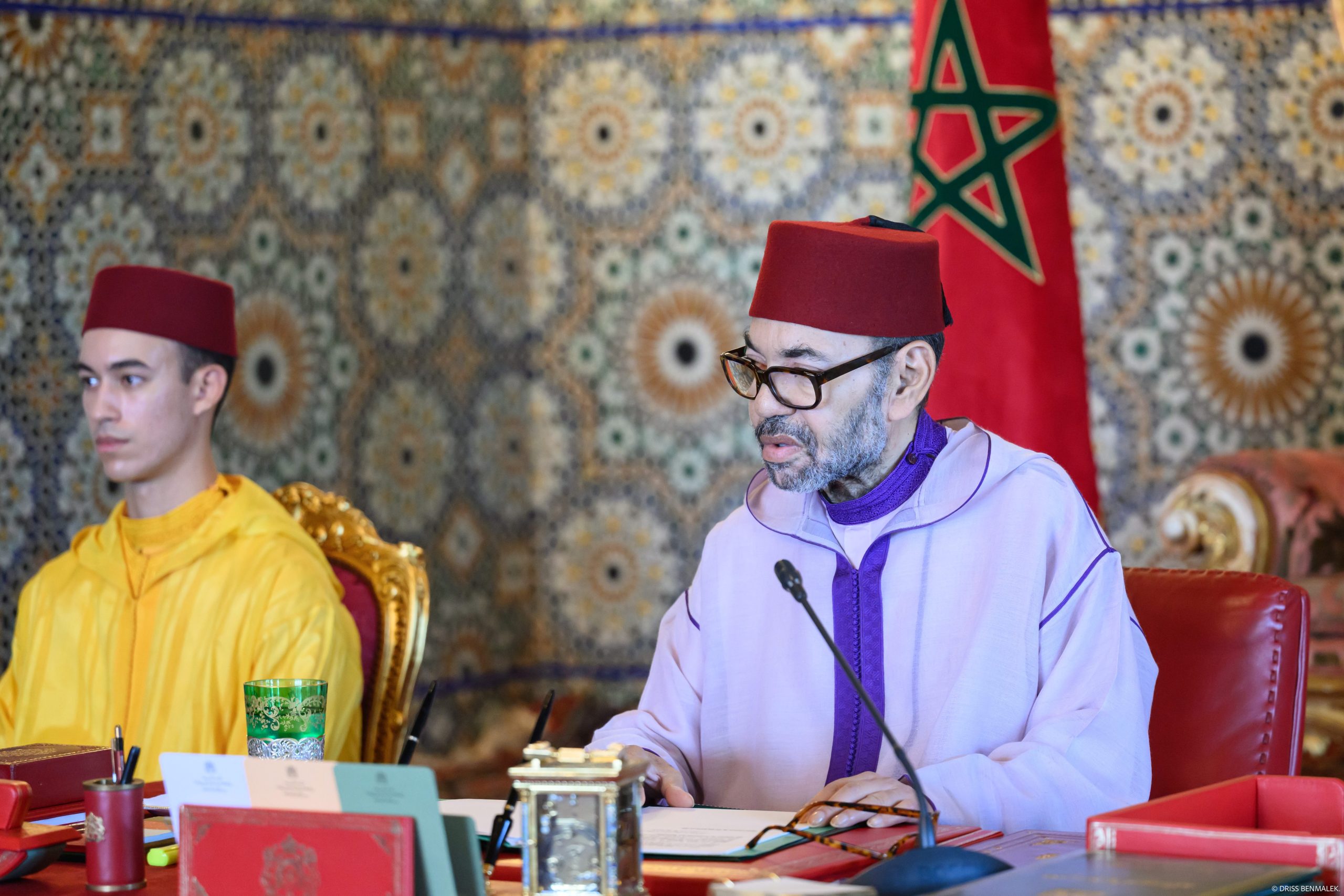
Marrakech – King Mohammed VI chaired a ministerial council at the Royal Palace in Rabat on Saturday to examine and approve the general guidelines and broad orientations of Morocco’s 2027 Finance Bill. Economy and Finance Minister Fouzi Lekjaa presented the proposal under Article 49 of the Constitution.
The government expects the national economy to grow by about 4.7% by the end of this year, with inflation contained near 0.7% and the budget deficit expected to narrow to 3% of GDP.
The 2027 Finance Bill is structured around five major priorities, beginning with restoring purchasing power and strengthening the foundations of a sustainable social state.
From 2027, the government plans structural reforms to markets and pricing, alongside measures to increase direct social assistance, expand healthcare coverage, and ensure its financial sustainability. The proposal also prioritizes improvements in public healthcare and education, as well as access to decent housing through the direct housing assistance program.
The second priority focuses on integrating young people into education, vocational training, and decent employment. A national program covering 2027-2031 will provide professional guidance, training, business support, and access to financing, guarantees, and markets.
The government also intends to replace fragmented sectoral initiatives with an integrated approach accompanying young people from education and training through employment and housing.
Third, the bill seeks to accelerate advanced regionalization and a new generation of integrated territorial development programs. This includes clarifying regional responsibilities, strengthening coordination between the state and regional authorities, and fully implementing the National Charter for Administrative Deconcentration. The government plans to allocate MAD 25 billion ($2.5 billion) to accelerate these territorial development programs.
The fourth priority concerns strengthening Morocco’s strategic sovereignty in water, energy, food, and digital technologies. Measures include improving water security, accelerating renewable energy development, advancing Morocco’s green hydrogen initiative, gradually implementing the national gas infrastructure roadmap, and reinforcing food security and digital sovereignty.
Finally, the government aims to build an economy capable of financing its social and strategic ambitions while preserving macroeconomic and fiscal stability.
This involves accelerating institutional reforms, mobilizing investment for major development projects, developing new strategic industrial ecosystems, and strengthening private investment through the Investment Charter and reforms to Regional Investment Centers, with particular support for micro, small, and medium-sized enterprises.
The 2027 Finance Bill places particular emphasis on youth, proposing an integrated national policy linking education and training to employment and housing, replacing fragmented programs deemed ineffective.
The proposal comes amid global instability, rising costs of geopolitical conflicts, growing protectionism, and intensifying competition over energy, technology, and financing, according to the finance minister.
The council moved the new government into institutional work within a day of its appointment and before its parliamentary presentation. It is expected to be followed by a government council meeting, marking the second of two institutional gatherings scheduled in quick succession.
The sequence, from the appointment of the new government to its first institutional proceedings in less than 24 hours, marks a precedent in the pace of Morocco’s government transitions, shifting attention to the new cabinet’s immediate priorities and forthcoming decisions.
King Mohammed VI formally appointed the government’s members on Friday, led for the first time in the country’s history by a woman, Fatima Ezzahra El Mansouri.
Her Authenticity and Modernity Party (PAM) came out on top in the September 23 elections and formed a coalition with the Istiqlal party and the smaller PPS and USFP. The governing alliance holds 210 of the 395 seats in Parliament’s House of Representatives, comfortably exceeding the 198 required for a majority.
A handover ceremony followed this Saturday morning at the headquarters of the Head of Government in Rabat, between El Mansouri and her predecessor, Aziz Akhannouch. The two reviewed the main strategic files and open projects, with a focus on royal directives on the social state, economic momentum, public administration efficiency, and continuity in government work.
The government inherits pressure over unemployment and demands for better education and health services, which drove last year’s Gen Z youth protests and the migration crisis in occupied Ceuta in July.
It will oversee the final stages of a $20 billion (MAD 200 billion) push to prepare for the 2030 World Cup, co-hosted with Spain and Portugal. Policy is not expected to shift, in a constitutional monarchy where the king retains broad powers over foreign policy and defense.
September’s vote recorded the lowest turnout in nearly two decades, shaped by concerns over the cost of living, employment, and inequality.
After her royal audience on Friday, El Mansouri pointed to an “ambitious government program that can meet citizens’ expectations.” She will present it to a joint plenary session of parliament’s two chambers on Monday at 3 p.m., under Article 88 of the Constitution.