
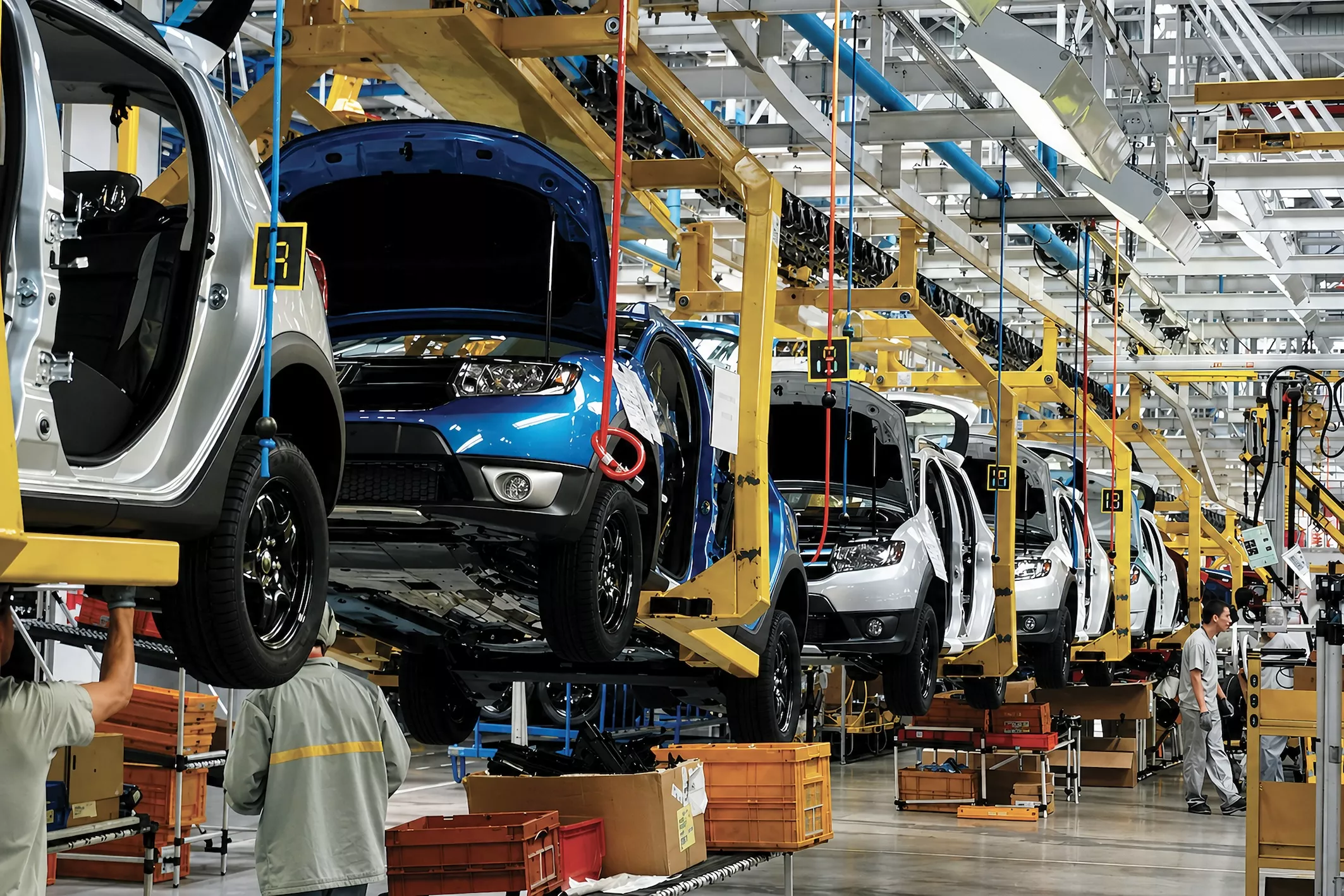
Marrakech – A growing group of European lawmakers is advancing amendments that could shield Morocco’s automotive industry from exclusion under the European Union’s proposed “Made in Europe” rules, pushing back against a more restrictive line favored by France and Germany.
The most recent move came from Spain. According to OKDIARIO, 12 Socialist (PSOE) members of the European Parliament filed an amendment to the Industrial Accelerator Act (IAA) that would extend the regulation’s industrial aid to “third countries” holding an agreement with the bloc, a category that could cover Morocco.
The amendment introduces a new article instructing EU authorities and the Commission to grant “the most favorable treatment and the most flexible application” of the chapter’s provisions to products, services, and investments from third countries already tied to the Union through partnerships or trade agreements.
The lawmakers justify the change by the need to “preserve economic integration and the continuity of strategic value chains” with those partners.
Morocco could fall within that description through its Association Agreement with the EU. The measure still has to be put to a vote, and the regulation is being negotiated between the Parliament and the European Council.
The proposal has drawn resistance. Popular Party (PP) sources in the Parliament warned that the change would let “some industrial components manufactured in Morocco be considered equivalent to European ones” for the purposes of certain public aid, per OKDIARIO.
The PP maintains that the chamber’s majority backs limiting direct favorable treatment to the EU, the United Kingdom, and the European Free Trade Association – Iceland, Liechtenstein, Norway, and Switzerland.
Countries such as Morocco, in the PP’s view, should “first pass an evaluation guaranteeing real reciprocity and clear rules of origin.” The party framed the initiative sharply, arguing that “the Spanish PSOE has once again become the main defender in Brussels of Morocco’s interests.”
That criticism lands amid Spanish-Moroccan tensions. OKDIARIO tied the amendment to the entry of an estimated 70,000 migrants into occupied Ceuta on July 30-31 and to alleged incursions of Moroccan boats into Spanish waters.
Even so, Prime Minister Pedro Sánchez has continued to defend Rabat, telling La Sexta that Moroccan authorities sought to manage the episode “in an intelligent way” and to “produce the least possible harm” to the migrants, adding that “ten hours later, we saw a much more active, more mobilized Morocco.”
Beyond Spain: parliamentary allies and industry weigh in
The Spanish socialists are not acting alone. Agence Europe reported that Dutch MEP Dirk Gotink, a member of the European People’s Party (EPP) and shadow rapporteur on the international trade committee, tabled amendments – backed by Polish, Belgian, German, and Swedish EPP lawmakers – that would widen the regulation’s geographic scope to all third countries holding trade agreements or an EU government procurement agreement.
Those countries would then have one year to demonstrate reciprocity or be automatically dropped from the list of states treated as equivalent to an EU member. The amendment defines reciprocity as a situation in which EU operators gain access, “in law and in practice,” to the third country’s procurement and public support schemes on equivalent terms.
The scale of the debate is considerable. More than 5,000 amendments were tabled to the Parliament’s draft report on the IAA, according to Agence Europe, including one from German and Swedish EPP members calling for the instrument to be scrapped. EPP national delegations are split, with the French delegation leaning toward an EU27 preference and an opt-in approach.
Industry has weighed in as well. In a position paper dated September 28, the European Automobile Manufacturers’ Association (ACEA), whose members include Renault, Stellantis, Volkswagen, and BMW, backed the IAA’s goal while cautioning that the draft “risks rupturing established value chains and undermining a wide range of current investments.”
ACEA accepted that a shift toward “EU27 preference” is legitimate but called for “justified, targeted exemptions,” warning that excluding members’ existing factories – including those in Morocco and Turkiye – “would strand European investments.”
Franco-German deal narrows the field, but a legal path may remain
The amendments arrive against a more restrictive backdrop. On October 16, France and Germany reached a deal that, for the automotive sector, would reserve “Made in EU” status for the 27 member states and European partners that belonged to the EU internal market on January 1, 2020, Reuters reported.
That scope would open the door to the United Kingdom, subject to reciprocity conditions, while leaving Morocco outside.
The distinction matters most for Renault. According to Le Monde, the carmaker had pushed since March for its Moroccan and Turkish production to be covered, as the two countries account for 32% of its global output.
Only electric vehicles built in the 27 member states would qualify for tax breaks and subsidies, with an exception for three non-EU countries, including Britain.
Renault welcomed the compromise but remained less optimistic than Stellantis, which produces 86% of its European-brand vehicles inside the bloc and described the deal as giving the industry “the flexibility and regulatory clarity it needs.”
To soften the geographic limit, the agreement lowered the share of a manufacturer’s vehicles that must meet the criteria to 80%, down from the 85% proposed by the Commission, easing the burden on groups with large operations outside Europe, Le Monde noted. Qualifying electric vehicles would need at least 70% European components, excluding batteries.
Pressure to broaden the scope has come from other quarters too. Renault CEO Francois Provost argued that the UK “should be part of” the scheme because it belongs to Europe’s automotive “ecosystem,” while Toyota’s European division contended that including partners such as Britain, Canada, Japan, South Korea, and Turkiye would give the EU the scale to compete with China, per Reuters. Turkiye’s trade minister likewise argued that trusted partners should not be excluded.
A path for Morocco may still exist in the text itself. The Commission’s March 4 proposal would require vehicles covered by specified public procurement and support schemes to contain a threshold of at least 70% EU-origin components by value, excluding batteries, while allowing components from certain trading partners to count as EU-origin under applicable agreements.
Linked to the EU by a free-trade agreement since 2000, the North African kingdom would have a legal basis to benefit from that equivalence if the mechanism survives.
None of the amendments has been adopted into binding law. France and Germany still need broader support from member states and the Parliament, and a final text is not expected before early next year, after an EU-UK summit scheduled for November 20, according to Reuters. For now, Morocco’s place in the “Made in Europe” framework rests on a debate that remains unsettled inside the EU’s own institutions.