
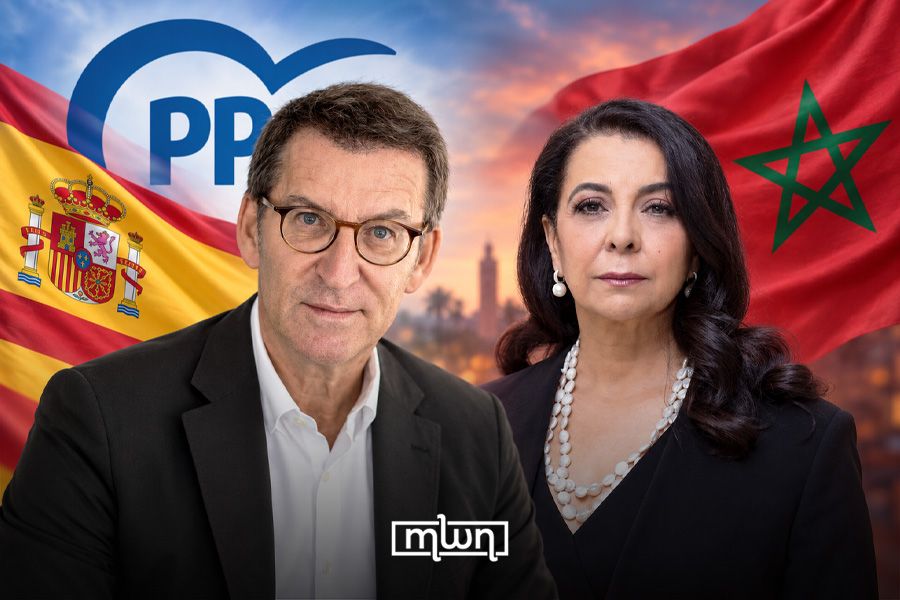
Marrakech – “I will not ask for forgiveness or permission.” With that curt line, flung at Morocco’s ambassador beneath the chandeliers of the Royal Palace’s Salón de Columnas on Monday, Alberto Núñez Feijóo laid bare the whole posture of Spain’s conservative right toward the kingdom.
The leader of the Partido Popular (PP) had, by his own account, simply “done his duty.” His inner circle rushed to rewrite the moment, insisting it was Karima Benyaich who “approached to greet” the man who may soon hold La Moncloa – as if the choreography of a handshake could launder the venom that preceded it.
This was no diplomatic thaw. It was tableau – a brittle courtesy staged for cameras on Spain’s National Day, one day before the Spanish monarchs’ provocative descent this Tuesday on the occupied cities of Ceuta and Melilla, a visit Feijóo spent the summer demanding be held at the earliest hour.
The pleasantries were cosmetic. In parliament, Feijóo had already cast Morocco as an extortionist, intoning that Spain “cannot act under the blackmail or the threat” of its neighbor, and insinuating, with Pegasus-tinged melodrama, “What does Morocco know about you?” of Pedro Sánchez. It was innuendo dressed as patriotism – the conjuring of a compromised premier bowing to a shadowy Rabat.
Morocco did not flinch. As reported by El Independiente, Foreign Minister Nasser Bourita, from New York, dismissed the histrionics as the babble of Spanish political actors who “do not know today’s Morocco” and grasp nothing of migration or its management. He indicted the whole campaign of “escalation, demands, and baseless accusations.” Rabat’s own letter was colder still, judging it worrisome that seasoned parties had “fallen into this quagmire where populist and irrational rhetoric prevails over common sense.”
The quagmire is not new. It is doctrine. As Moroccan author and political analyst Samir Bennis has chronicled at length, the Spanish right practices a double discourse as old as it is cynical: in opposition it flogs Morocco as the author of every ill; in government it suddenly discovers a “loyal and reliable partner.”
The far-right creed, in other words, is simple: borders are sacred only when others cross them, Morocco is guilty before any proof, and patriotism is measured by how loudly one damns the kingdom.
Bennis traces the lineage directly to Mariano Rajoy, who perfected this two-faced liturgy – hurling charges of “acquiescence” and “blackmail” from the opposition benches over the 2005 Melilla crossings, then, once installed in La Moncloa, lauding Morocco’s “exemplary cooperation” and holding it up as a model for Europe. Feijóo merely recites the same catechism.
As Bennis puts it, the PP leader knows “perfectly well, deep down” that should he reach power with Vox, he will abandon this anti-Moroccan rhetoric overnight and embrace the very praise he now scorns – because Spain’s border stability depends overwhelmingly on Rabat’s goodwill. His verdict is unsparing: the cynicism of Feijóo and his officials “knows no bounds.”
Bennis is equally cutting on the method behind the madness. Feijóo, he notes, clings to the “hybrid war” fallacy even after the publication of a CNI report that contained no such accusation – displaying what Bennis calls a “literal disdain for the truth.” The PP leader’s own words give him away: “Even knowing that information is missing, we know that Morocco is behind the hybrid attack,” Feijóo told El Mundo. Knowing is not the issue; proving is. And proof, Bennis argues, is precisely what the Spanish right has never possessed.
Verdict first, evidence never
The method is always identical – verdict first, evidence never. Spain’s own National Intelligence Center (CNI), across forty declassified documents, nowhere accuses Rabat of orchestrating the July assault on occupied Ceuta. Its files record Moroccan forces overwhelmed, not complicit; Moroccan intelligence alerted by the CNI itself on the eve of the crossings; Moroccan interceptions climbing week upon week. The PP read none of it. It reached its conclusion in advance, then rifled the documents for a phrase to prop it up – a political sentence in search of a crime.
Here the deeper truth asserts itself. Morocco is not a diplomatic partner to these factions; it is a whetstone. The kingdom has become the common piñata of Spanish politics – struck by Vox’s xenophobes and the Catalan left’s Polisario romantics alike, each blow a bid for votes, each bruise borne at Rabat’s expense. With Spain’s snap elections set for November 29, the ritual resumes on schedule: Morocco’s image mortgaged to the crude arithmetic of domestic vote-harvesting.
Rabat has named the racket plainly. When the Spanish Parliament pushed through its bill granting nationality to Sahrawis on September 10, the Foreign Ministry answered without euphemism: the kingdom “refuses to be a pre-electoral cash cow” and will not be made “the scapegoat of politicians’ score-settling.” And as recently as last Friday, in his speech before parliament, King Mohammed VI reaffirmed the same red line – that Morocco’s cooperation with Madrid rests on mutual respect and will proceed under no pressure or blackmail whatsoever.
Two empires, one African stage
If any doubt lingered about the character of this crusade, the spectacle in occupied Ceuta on Monday dispelled it. There, Vox chief Santiago Abascal paraded with Jordan Bardella of France’s National Rally, two heirs of fallen empires performing their alliance on African soil.
Abascal branded the July arrivals an “invasion sponsored by Morocco,” rechristened exhausted migrants as “Sánchez’s militias,” and demanded a militarized frontier and mass expulsions. Bardella, discovering Europe from the shores of Africa, pronounced Ceuta “Spanish and European” and warned of an “existential danger” – plucking a figure of 86,800 entries from nowhere to lend his prophecy an apocalyptic sheen.
The irony needs no gloss. Two representatives of former colonial powers, standing in a colonized African city, lamenting that too many Moroccans live in it – and lecturing the kingdom on the meaning of civilization. Their frontiers, it seems, are sacred only when others cross them. Vox’s own doctrine proves the point: when its militants scaled Gibraltar to plant an eighteen-meter flag, Abascal hailed it as “mission accomplished”; when migrants cross into Ceuta, it becomes an act of war.
The Paris-Madrid alignment was on full display on September 29, when the Franco-Spanish chorus reached its crescendo: Felipe VI, addressing Emmanuel Macron at a state dinner in Madrid, denounced the Ceuta crossings as an unacceptable breach of a European frontier. The following day, Macron went further, casting Spain as the victim of an external “attack” and pledging European solidarity. The historical irony is almost too neat: Spain’s reigning Bourbon dynasty originated in France, descending from Louis XIV’s grandson Philip V. Old imperial instincts, it seems, travel remarkably well across generations.
Feijóo’s palace performance belongs to the same choreography. He did not defend Spain in the Salón de Columnas. He auditioned for its highest office, with Morocco cast, once again, as the villain he needs today and the partner he will quietly court tomorrow.