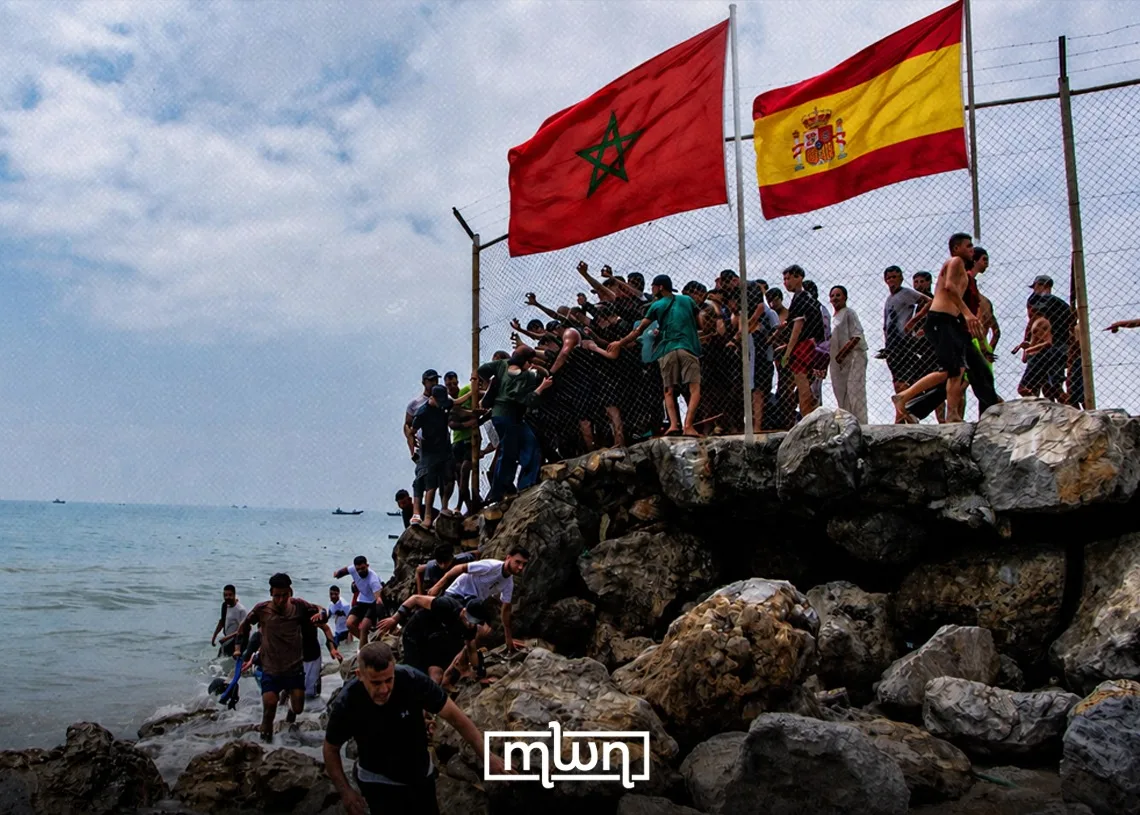
Rabat – Ceuta authorities said the number of migrant minors hosted by the occupied city is estimated at 3,086.
The number is up from the 180 children who were already in the occupied city before the July mass crossings.
On July 30-31, tens of thousands of migrants entered the occupied city, triggering one of the largest irregular migration events on the Moroccan-Spanish border.
The situation sparked uproar and frustration, with a smear campaign from the far right weaponizing the situation to push anti-Moroccan rhetoric and anti-migration policies amid elections.
Reports estimate the number of people who entered the enclave at over 70,000, including minors.
Most of the migrants returned to Morocco either voluntarily or were deported as part of an agreement between Morocco and Spain to mitigate the crisis.
Sources from the Ceuta government told EFE on Saturday that authorities in the occupied city transferred minors to centers on mainland Spain during the first days of July. The decision was made under Royal Decree-Law 2/2025.
“The mass arrival of people at the end of that month changed the situation, with the number of minors rising from 180 to the current 3,086, compared with the city’s ordinary capacity of 29 places,” EFE reported.
The report cited overcrowding in the centers, stating that the difference represents an overcrowding rate of “10,541%, equivalent to 106 times the ordinary capacity of the reception facilities.”
Amid growing concerns, several reports have highlighted the mistreatment and abuse that migrants, including minors, are enduring in the occupied city.
One case involves a disturbing audio recording revealed by elDiario, a Spanish news outlet that said it obtained the recording. It features a group of soldiers describing the violence in chilling detail.
The report, published on Thursday, said the exchange between soldiers on duty in Ceuta took place during one of their surveillance shifts at a fixed post in the city on September 21-22.
Transcripts of the audio recordings capture soldiers describing how they enjoyed beating migrants without gloves, as well as other disturbing events that migrants have endured and continue to endure upon arriving in the enclave.
The Spanish report also revealed that a soldier spoke of a “test” or an “operation” carried out by colleagues belonging to another unit, specifically the Regulares Group.
The soldier said he witnessed the Regulares “enjoying themselves.”
Amid reports of abuse, far-right politicians and politicians from other parties are exerting pressure and engaging in political games targeting Rabat.
One example is the accusations that some politicians continue to use to weaponize the mass crossing.
Earlier this week, People’s Party (PP) leader Alberto Núñez Feijóo also called for Spain’s ambassador in Rabat to be recalled for consultations.
This comes as Spain said there was no evidence of what it described as “new incursions” by Moroccan naval forces into occupied Ceuta.
The PP leader has also called for the deployment of Spain’s military and the summoning of Morocco’s ambassador.
In response to his claims, the Spanish government said there was no evidence of “new incursions” beyond those recorded between July 30 and 31 during the mass crossing into Ceuta, when tens of thousands of people entered the occupied enclave.
The government, however, maintains that Morocco’s naval presence was an “isolated incident,” highlighting coordination between the two countries’ navies.
The Spanish government said that neither the Civil Guard nor the Navy had recorded incidents involving a similar naval presence to that of July 30-31.
This contradicts claims made by Feijóo, who said that “several Moroccan invasions of Spanish waters are not an isolated incident, but repeated aggression that requires a firm response.”