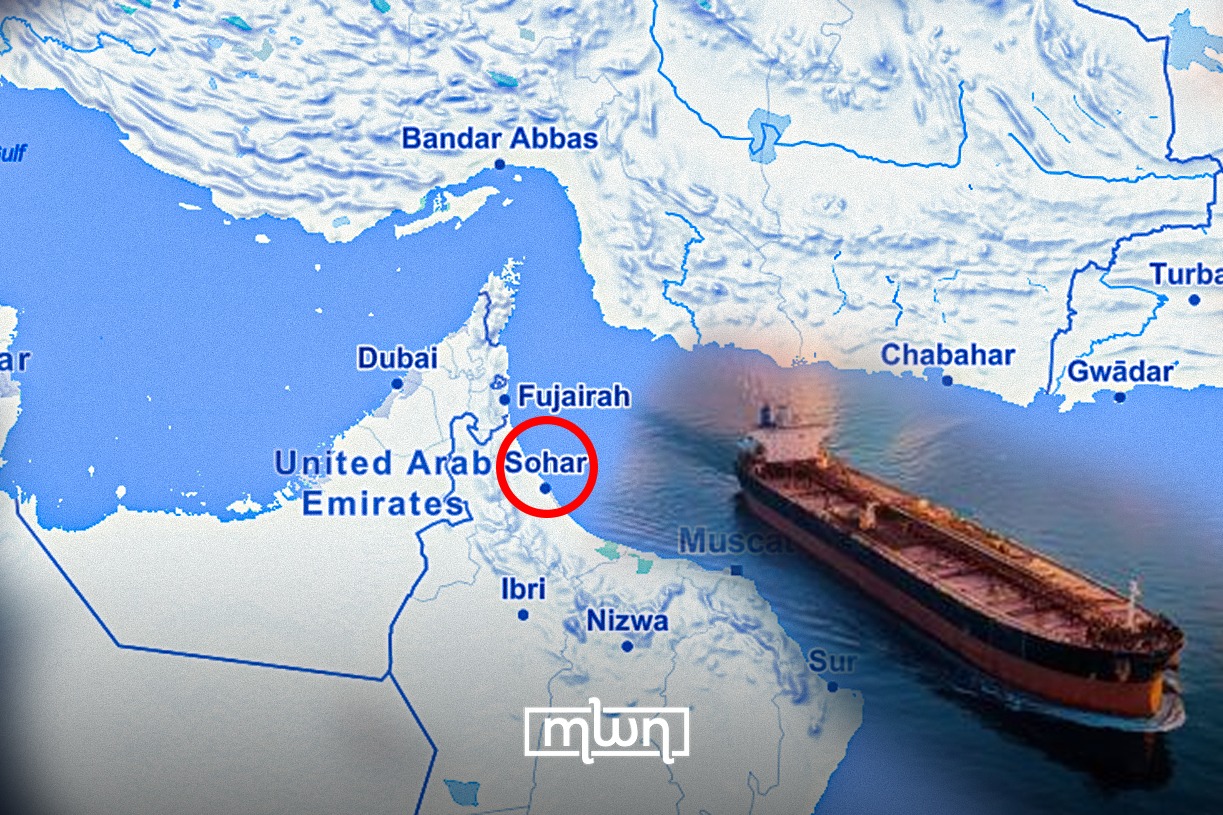
On March 26, satellite imagery of the port of Sohar showed nearly twice as many vessels as in December, before the war on Iran began. Thirteen days earlier, two drones had come down in Sohar province. One struck the al-Awahi industrial area and killed two foreign nationals.
In the same month, the same stretch of coast was filling with ships and coming under attack. That is the position the war has left Oman in.
Oman was not a party to this war. Only days before the US and Israeli strikes on February 28, Muscat had been mediating between Iran and the United States. The following day, two drones targeted the port of Duqm. For decades, Oman has relied on two assets that seemed to reinforce each other.
The first is its neutrality. Muscat maintains ties with both Washington and Tehran, and both use it as a diplomatic channel. The second is its geography. Sohar, Salalah and Duqm are, in the words of the maritime intelligence firm Windward, the only major ports in the region located outside both the Hormuz and Bab al-Mandeb threat zones.
In peacetime, this geography strengthened Oman’s value as a neutral intermediary, while its diplomatic standing helped protect its strategic position. The war has turned these two assets against each other. The more the Gulf’s trade has come to depend on Oman’s coast, the more every side has wanted a say over what Muscat does with it.
The back door
Hormuz has been effectively shut to normal traffic for most of the war. In August, ship transits were running about 90% below the pre-war average of 130 a day, according to a CNBC analysis of Kpler data. Between September 16 and 23, Windward counted 55 transits visible on tracking systems, about 94% below pre-war levels.
Some of that trade found another door. In September, Oman’s transport minister said recent developments had shifted part of the region’s traffic towards Omani ports. Sohar alone handled 52 million tons of cargo in the first half of 2026, up 52% on a year earlier, with ship-to-ship transfers accounting for about 24 million tons. Qatar, according to the Oman Observer, designated Sohar, Salalah and Duqm as key alternatives to its own Hamad Port. In August, Bloomberg reported that Saudi Aramco was offering cargoes for ship-to-ship transfer from locations including Sohar, a possible sign, the agency said, that crude from inside the Gulf was being shuttled out to Omani waters for sale.
Even the Gulf’s long-term escape routes run through Oman. Hafeet Rail, the 238-kilometer line linking Sohar to the UAE’s rail network, is due to begin trial runs in the fourth quarter of 2027, according to Oman’s transport minister. Until then, there is no direct rail link from Oman’s ports outside the strait to UAE markets. So the back door is open, but the corridor behind it is still under construction.
Pressure from every shore
Being useful has not bought Oman protection. Drones hit Duqm on March 1 and again on March 3, struck fuel tanks at Salalah on March 11, and killed two people in Sohar on March 13. Tehran denied involvement in the Salalah strike, but the attacks came as Iran expanded its strikes across the Gulf.
Since then, the pressure has been mostly diplomatic, and it has come from more than one direction.
In July, Oman put forward a plan, reportedly backed by other Gulf states, to manage the strait jointly with Iran and collect voluntary fees from shipping, modelled on the mechanism used in the Strait of Malacca. Tehran rejected it. Iran’s deputy foreign minister Kazem Gharibabadi said a route split between Iranian and Omani waters “would not address our national security concerns.” A senior Iranian official told Reuters that Oman was a “valuable neighbour,” but that a 50-50 arrangement would not serve Iran’s interests.
As of late August, Muscat had not publicly said that it intended to join Iran in controlling the strait. By September, Tehran was describing a corridor it said had been agreed with Muscat, with entry and exit points under Iranian control. On October 7, Iran’s foreign ministry said the two countries had agreed on the coordinates of “safe” transit routes in and out of the strait.
Oman’s Gulf neighbours have wanted a say as well. In September, a planned regional meeting on the Iran–Oman arrangement was postponed. Tehran attributed the delay to Saudi objections, and Axios and CNN reported that Riyadh had sought amendments, concerned that the text would establish a new status quo in the strait.
The waters off Oman have also become the most dangerous route for ships trying to stay clear of Iran’s route. On June 20, the Joint Maritime Information Center said ships could use a southern route along the Omani side. Kpler later found that the route was effectively gone by its fourth week, after attacks on vessels using it.
On October 3, the United Kingdom Maritime Trade Operations said a crude tanker had reported being struck by a projectile about four nautical miles east of Oman. Four days later, a senior adviser to the commander of Iran’s Revolutionary Guards said routes Tehran considers “illegal,” naming the southern pathway along Oman’s coast, would soon be blocked. On October 11, a drone struck a tanker waiting to berth at Sohar’s anchorage, the same day Iran’s security chief Mohsen Rezaei described the US-assisted shuttle moving Gulf crude out near Oman’s coast as a target.
Washington, meanwhile, has treated Oman’s diplomacy as interference. On August 17, as Iran and Oman edged toward an arrangement on shipping lanes, US President Donald Trump told Fox News that if Oman “gets in the way,” the United States would bomb it. It was not the first time he had threatened the sultanate. Days later, Secretary of State Marco Rubio met Oman’s ambassador.
The strongest objection
The strongest case against this reading is that Oman’s neutrality is working. The Arab Gulf States Institute in Washington has argued that the sultanate’s “friend to all” doctrine has long helped safeguard its security and allowed a small state to exert outsized influence, and that Muscat will probably stay committed to it, even as the war has exposed its limits.
The evidence for that view is real. Iran still negotiates with Muscat and calls it a valuable neighbor. America’s top diplomat met Oman’s ambassador days after the president’s threat. Saudi crude has been offered for sale off Sohar. Nobody has cut Oman off. Everyone still needs it.
That is true, and it is also the problem. Being needed is not the same as being left alone.
Each side needs Oman for something different, and each treats Oman’s usefulness to the other as a cost. Iran wants Muscat as a partner in managing the strait, but on Iranian terms. Washington wants Oman’s coast as the safe route around Iran, but not Oman’s diplomacy with Iran. Even Marc Sievers, a former US ambassador to Oman, told The National that Muscat “tipped towards endorsing some of Iran’s positions.” When a country’s ports carry everyone’s trade, every diplomatic move it makes is read as a decision about whose trade comes first.
The cost of being the route
Oman’s neutrality once gave it distance. Muscat could talk to all sides because it posed no obstacle to any of them. The war has eroded that distance. Oman’s coast has become a route, a fallback and a target.
Gulf trade has spread across multiple routes during the war, and many of these alternatives continue to run along Oman’s coast for years to come. The question facing Riyadh, Abu Dhabi and Doha is what they owe the country carrying this burden, and whether Oman can preserve its neutrality when it has become so strategically useful.
On March 26, Sohar hosted nearly twice as many ships as it had in December. Oman chose neutrality. Its ports had no such choice.