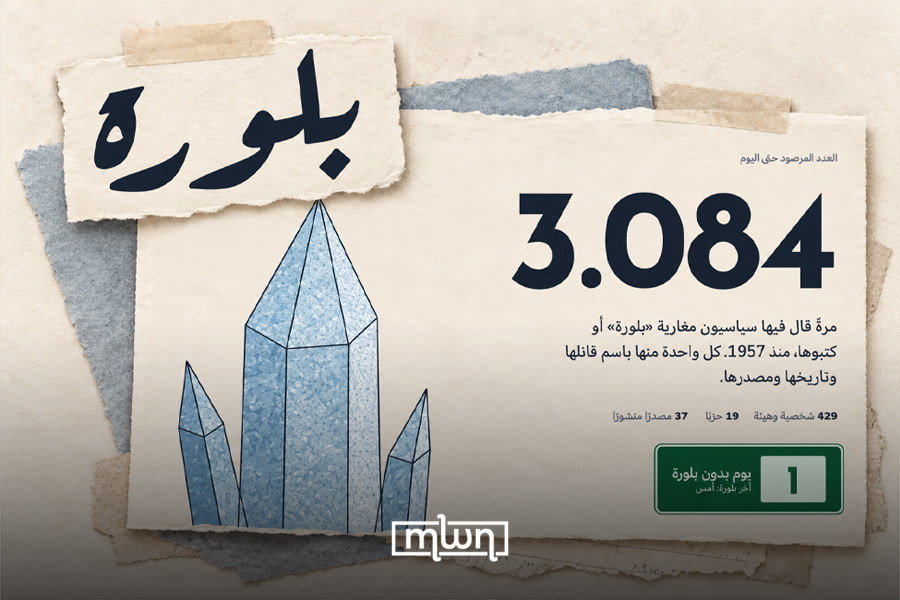
Marrakech – A Moroccan political buzzword now has its own public ledger. An independent platform called “Blwara” documents every recorded instance of a politician using the Arabic word بلورة – “blwara” – and logs each one with the speaker’s name, the date, and the source that published it.
The word carries the sense of crystallizing, formulating, or working out a vision, plan, or strategy. Officials reach for it constantly when they describe programs, reforms, and future orientations, and that repetition is the point. The project treats a single piece of jargon as something to be tracked, measured, and tied back to whoever uttered it.
It reads partly as political satire and partly as a watchdog exercise, a documentation of Morocco’s langue de bois – the formulaic language that fills official speech. The word’s overuse irritates many Moroccans and raises a recurring question about the gap between declarations and results on the ground.
As of Tuesday, October 20, the counter stood at 3,084 occurrences dating back to 1957. These span 429 individuals and institutions and 19 political parties, drawn from 37 published sources. The site also tracks how long it has gone without a new entry; at the latest count, one day.
The register goes beyond a running tally. It stores excerpts of each statement with its source and date, ranks politicians and parties by frequency, and charts how the usage has shifted year to year.
Nabil Benabdellah, secretary general of the Party of Progress and Socialism (PPS), leads all individuals with 175 occurrences. He is followed by Saâdeddine El Othmani with 117 and Aziz Akhannouch with 96. Foreign Minister Nasser Bourita ranks fourth with 80, ahead of Istiqlal leader Nizar Baraka with 75.
Among parties, the Justice and Development Party (PJD) tops the list with 509, trailed by the PPS with 421, the National Rally of Independents (RNI) with 416, and the Authenticity and Modernity Party (PAM) with 402. Each occurrence is credited to the speaker’s party at the time it was spoken.
The timeline stretches across seven decades. The first logged use belongs to Allal El Fassi in 1957. Occurrences stayed scarce for years, then climbed sharply through the 2010s, peaking at 340 in 2019, and have run in the hundreds each year since.
The platform is open about its method and its gaps. An automated agent reads Moroccan newspapers, websites, and parliamentary records each day, extracts every sentence containing the word, and identifies the speaker only when the name appears in the source.
Entries in doubt wait for human review. The first archive was assembled from more than 20,000 articles published since 2007 across outlets including Hespress, Al3omq, Lakome, and Barlamane.com.
The platform counts the word in all its grammatical forms. A single statement relayed by several newspapers counts once, with all its sources listed.
The sentence is reproduced as it appears in the source, and when a politician’s words are paraphrased in the paper’s own phrasing, that is noted above the entry. The date on each entry is the publication date of the source, which may trail the actual remark by a day or more.
The register counts only those who make promises and face voters: government members, both chambers of parliament, party leaderships and their official statements, and elected officials in regions, provinces, and communes.
It excludes journalists, experts, unions, and foreign officials, and it leaves out royal speeches entirely. Appointed officials are logged in a separate register. Where a statement touches the royal institution, that passage is cut and marked.
It sets aside anything published only on parties’ own websites, since some parties offer searchable archives and others do not, and counting those would make the better-archived parties appear to “crystallize” more simply because their records are easier to search. Such statements are held in a separate register and enter the counter only once an independent outlet reports them.
The team concedes the real figure is higher, since parliamentary and televised remarks often go unreported. It invites the public to flag missing instances and request corrections.
Every edit to the register is preserved in its version history. The dataset is available in JSON at /api/mentions.json, with the figures at /api/stats.json, under a CC BY 4.0 open license. The archive before 2007 remains thin and only partly digitized, with the empty years shaded on the timeline.
Words like “blwara” occupy a familiar place in political language. Scholars describe such terms as empty signifiers or weasel words – vocabulary that projects action and intent while committing the speaker to nothing specific or verifiable. To promise to “crystallize” a vision is to announce movement without naming a deliverable, a deadline, or a cost.
The appeal is procedural rather than concrete: the word signals that work is underway without stating what will be produced or when.
Its endurance across parties and decades, as the register shows, suggests it functions less as a description of policy than as a ritual of governance, a verbal placeholder that lets officials speak at length while promising little that can later be checked against results.