
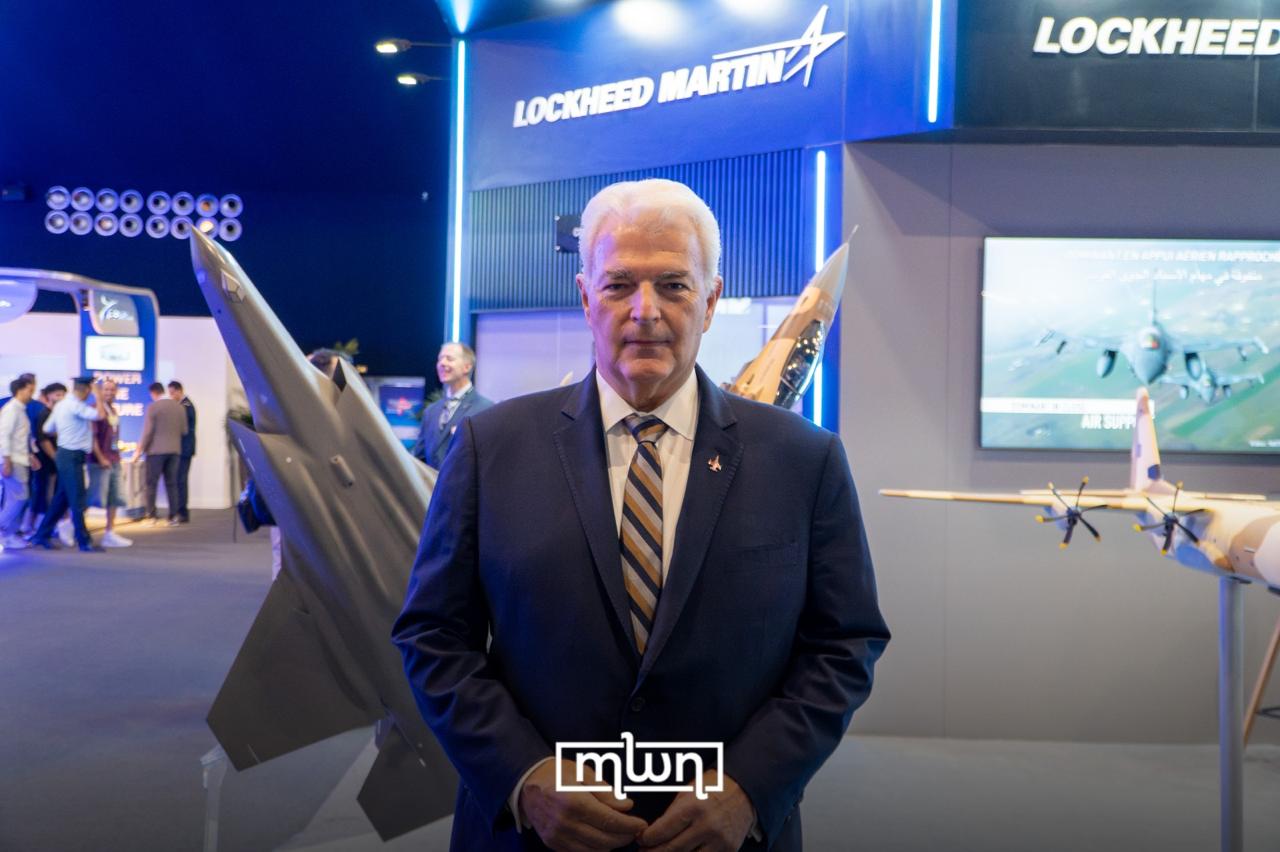
Marrakech – Lockheed Martin closed out the eighth Marrakech International Airshow last week, having placed almost every strand of its Moroccan portfolio on display at once: fighter modernization, military transport, precision weapons, aircraft maintenance, and a growing push into local manufacturing.
The American defense company attended as a platinum sponsor, and its regional director for Egypt and Africa, James Hedges, used an interview with Morocco World News (MWN) to walk through a show that ran from October 7 to 10.
“Lockheed Martin is very pleased to be back in Morocco at this eighth iteration of the Marrakech International Airshow,” Hedges told MWN, framing the visit around what he called more than 50 years of relationship with the country. That relationship dates to 1974, when the first C-130H Hercules landed in Morocco, and expanded substantially with the arrival of F-16 Block 52 fighters in 2011.
A show of fifth-generation capability, not a sale
The fifth-generation F-35 was among the most-watched items on the stand, though not because of any sale. Lockheed Martin brought a cockpit demonstrator and an F-35A scale model, and Moroccan pilots were invited to try the simulator. “Lockheed Martin was pleased to see the F-35 fly by,” Hedges told MWN.
View this post on Instagram
The jets that passed over Marrakech, however, were not Moroccan. Two US Air Force F-35As from the 48th Fighter Wing at RAF Lakenheath in the United Kingdom joined the October 7 opening flyover, according to US Africa Command, which also deployed an HC-130J, a KC-135 and roughly 45 personnel to the event.
The display amounted to a presentation of capability, not a procurement step. As of the show, there was no publicly confirmed US approval for an F-35 sale to Morocco, no signed contract, and no Lockheed Martin announcement naming the kingdom as a customer.
The cockpit demonstrator, Hedges explained, gave Moroccan pilots “an opportunity to see what the aircraft is like and to build some familiarity with the aircraft’s capabilities.” Médias24 reported on October 8 that Moroccan defense authorities were examining the possibility of acquiring fifth-generation capabilities, a media-reported prospect rather than a confirmed agreement.
The concrete milestone of the week belonged to the F-16. One day before the show opened, on October 6, Lockheed Martin announced that Morocco’s first newly built F-16 Block 72 had completed its maiden flight from Greenville, South Carolina. “The F-16 Block 72 is going to build on the excellence and the experience that the Royal Moroccan Air Force has with the F-16 Block 52,” Hedges told MWN.
View this post on Instagram
The new jet carries additional sensors and tools for the pilot and opens a broader set of missions, he explained, and pilots trained on one variant can move to the other, lifting overall performance across the fleet.
Mike Shoemaker, who runs Lockheed Martin’s Integrated Fighter Group, described the flight as a major step for Morocco’s future airpower. The aircraft remains in flight testing, and the company gave no delivery date.
The Block 72 traces to March 2019, when Washington announced two proposed sales to Morocco: 25 new F-16 Block 72 fighters valued at up to $3.787 billion, and an upgrade of 23 existing F-16s to the F-16V standard valued at up to $985.2 million. The combined figure neared $4.77 billion, though both were US government estimates rather than final contracts.
The new-aircraft package listed the AN/APG-83 active electronically scanned array radar, advanced mission computers, Link 16 communications, modern helmet-mounted systems, electronic warfare equipment, and Sniper targeting pods.
From customer to manufacturing partner
Beyond the hardware, Hedges returned repeatedly to industry. Lockheed Martin organized an Industry Day with Morocco’s Ministry of Industry and Trade just before the show. “We will use an industry day to sit down face-to-face with local businesses to see what they offer and then validate their ability to perform on Lockheed Martin programs in conjunction with the government of Morocco,” he told MWN.
The aim, he added, was to give Moroccan industry hands-on participation in national and industrial development. Steve Sheehy, the company’s vice president of international business for aeronautics, had earlier framed the supplier event as a step toward identifying Moroccan firms able to support current and future programs.
The company has named partners before: its December 2024 statement identified Eaton-Souriau’s Tangier plant as a components supplier of nearly two decades’ standing, and described a visit to Ausare, part of the Mecachrome Group, as prospective cooperation rather than a signed contract.
The clearest institutional move came on October 7, when Lockheed Martin signed on to the Africa Center for Manufacturing Excellence (ACME). The consortium brings together nine partners: on the Moroccan side, Mohammed VI Polytechnic University (UM6P), the Ministry of Industry and Trade, the National Defense Administration and OCP Group; on the industrial side, Lockheed Martin, Boeing, Airbus, Safran Nacelles, and CETIM Maroc.
Joseph Rank, the company’s chief executive for Saudi Arabia and Africa, signed for Lockheed Martin. The framework covers research in advanced materials, additive manufacturing, composites, robotics and metrology, and envisions an ACME Academy for engineering skills. The company has not disclosed how much it is investing or how many Moroccan engineers it expects to train.
Hedges singled out maintenance as the most tangible contribution, pointing to Maintenance Aéro Maroc (MAM), which he described as the world’s first F-16 and C-130 major overhaul facility. “When it reaches its full capability, it will be Africa’s primary center for countries to come to for that maintenance,” he told MWN, adding that the site would let Morocco provide defense services to itself and to others in the region.
Work on the hangar began at Benslimane in October 2025, a project exceeding 8,000 square meters built with Belgium’s Sabena Engineering and the Moroccan developer MEDZ, part of the CDG group. It is intended first for heavy C-130 work, with F-16s and helicopters possible in later phases. The original timeline pointed to service in the second half of 2026; by the show, the company was still describing the facility as in development, leaving its operational status open.
The relationship extends well past aircraft. Lockheed Martin confirmed that Moroccan forces operate its F-16s, C-130s, advanced radar, and Black Hawk helicopters, and it stated that Morocco will receive HIMARS rocket systems, though without a date. Washington approved a possible $524.2 million HIMARS package in April 2023, covering 18 launchers along with ATACMS and guided rockets.
A separate March 2024 approval covered up to $260 million in Javelin anti-tank missiles, produced by the Lockheed Martin-RTX joint venture whose system was shown in Marrakech. The C-130J Super Hercules on display carried its own message: Morocco has flown the Hercules since 1974, and the company positioned the newer model as a modernization option for the transport fleet. No firm order emerged from the show.
Taken together, the week pointed to a shift the company itself is trying to manage. Morocco is already a buyer of Lockheed Martin fighters, transports and weapons, and the F-16 maiden flight shows those programs advancing. The Benslimane hangar, the ACME membership, and the supplier search point to a different ambition: building maintenance and manufacturing capacity inside the country.
Whether that ambition becomes more than intent will turn on measurable outcomes – contracts to Moroccan suppliers, completed qualifications, an operating maintenance line and jobs created. For now, much of the industrial story at Marrakech remained a set of commitments without disclosed figures.