
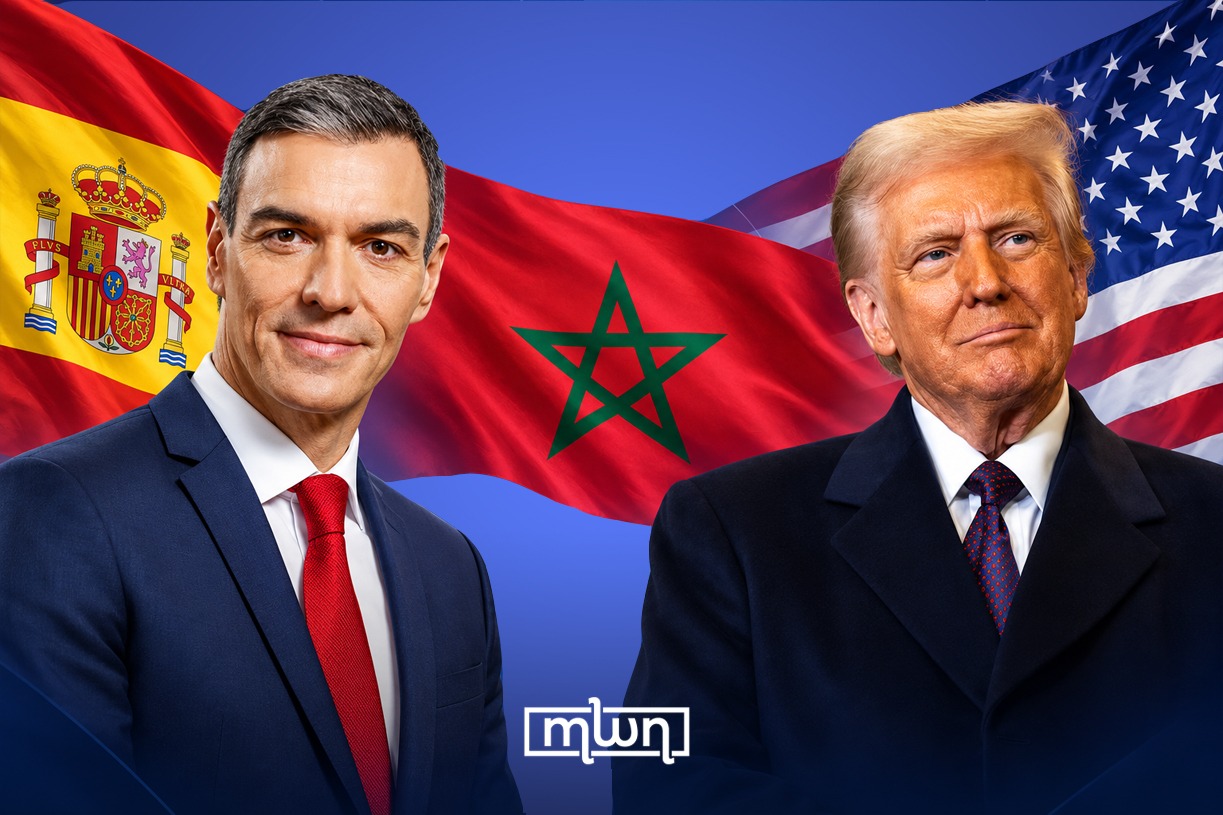
Marrakech – “Wow – Spain is buying more than $7 billion in weapons from the United States? No, no, it can’t be! In Morocco we should be very worried, because if Spain is arming itself, it must want to wage war on us.”
That is Samir Bennis, the Moroccan author and political analyst, and he is not frightened. He is performing. The lines are a deliberate burlesque – a farce, in his own telling – staged to hold a mirror up to the febrile Spanish press. “This is nothing more than a farce,” Bennis writes on X, “with which I mean to illustrate the hysteria and the obsession of certain Spanish media with Morocco.”
An obsession so morbid, he adds, that it reads every Moroccan move – an arms contract here, a routine maneuver there – as a dagger aimed squarely at Spanish hearts. The conceit is sharpened by inversion: “as if in Morocco we were obsessed with Spain, and as if this country were the center of the world around which everything revolves.”
Waww ¿España está comprando armas a Estados Unidos por un importe de más de 7.000 millones de dólares? ¡No, no, no puede ser! En Marruecos deberíamos estar muy preocupados, porque, si España se está armando, es porque quiere hacerle la guerra a Marruecos.
Esto no es más que una… https://t.co/L0MUu3oIwH
— Samir Bennis (@SamirBennis) October 19, 2026
The pretext for the parody was a genuine scoop. US President Donald Trump had green-lit a fresh $75 million sale of mine-detection sonar to the Spanish Navy, the latest tranche in a procurement spree that, since Pedro Sánchez reached La Moncloa in 2018, has pushed Madrid’s authorized purchases of American hardware past $7.1 billion.
Patriot batteries worth $2.8 billion, AEGIS frigate overhauls at $1.7 billion, nearly a billion dollars in Seahawk helicopters, Hellfire missiles bolted onto drones that once flew unarmed – a self-styled pacifist shopping, quietly and voraciously, at the Pentagon’s counter.
And Rabat did not flinch. No emergency sessions, no lachrymose editorials, no columnists conscripting the reader into dread. Because the Moroccan premise is the opposite of the Spanish one. “Every sovereign state has the right to arm itself,” Bennis contends, and to “keep its enemies at bay.”
Morocco, he argues, counts Spain not as an enemy “but rather a strategic ally” – one partner among the many it has deliberately scattered across the map, the hallmark of a foreign policy built on diversification rather than fixation. “However many disagreements we may have with Spain,” he puts it, “we do not consider it an enemy.”
Here the quotation marks close, and the real question opens. Why does the mere spectacle of a modernizing Morocco throw swathes of the Spanish commentariat into paroxysm?
Phantom-limb politics: Mourning an asymmetry that’s gone
Part of the answer is grubby and commercial. Morocco sells. Bashing it moves copy, harvests clicks, and – for the parochial right of PP and Vox – scrapes together votes. So a Moroccan deployment near the Atlantic and Mediterranean approaches becomes, in the Spanish telling, a national alert; a Washington handshake becomes a chapter in some imaginary war plan.
A Politico survey now finds that roughly 60% of Spaniards expect an armed clash with Morocco over the occupied presidios of Ceuta and Melilla – a collective neurosis manufactured in newsrooms, while official Rabat holds its tongue for months and chooses de-escalation over the shouting match its detractors seem to crave.
But the deeper wound is not Ceuta, and it is not sonar. It is a changing paradigm that Madrid’s opinion-makers cannot metabolize. For more than a century and a half, Spain enjoyed an asymmetry it mistook for the natural order of things – a Morocco it could lecture, pressure, and bend; a junior neighbor whose foreign policy Madrid presumed to edit.
That Morocco is gone, and its disappearance is the true source of the hysteria. The old suzerainty has lapsed, and with it the reflex of command.
What remains is a kind of phantom-limb politics. Each datum of Moroccan ascent – the first flight of a Royal Moroccan Air Force F-16 Viper, Abrams tanks and Apache gunships entering service, a US-Morocco military roadmap stretching to 2036, a Senate instruction to make the kingdom America’s foremost military partner on the continent, Washington already supplying some 60% of its arms – is transmuted, in the Spanish thinking, into menace.
Add the economic ledger that unsettles Madrid still more: control of the lion’s share of the world’s phosphate reserves, a looming role in global food security, the ports and high-speed rail turning Morocco into the gateway to Africa, and the American recognition of its sovereignty over the Western Sahara.
Not a threat, but a Morocco that no longer asks
None of this is aimed at Spain. All of it is read as aimed at Spain, because it disturbs a Mediterranean hierarchy Spaniards long assumed immutable. The grievance is not that Morocco threatens them. It is that Morocco no longer needs their permission.
This atavism has a pedigree. It surfaced at Leila/Perejil in 2002, when a nine-hectare rock prompted talk of invasion and casus belli, and it surfaced a century earlier when Madrid planted a lighthouse and a flag on that same islet – a trespass its own historians later conceded was a blunder over territory that was Moroccan all along.
The through-line is a press forever casting Morocco as the perennial blackmailer, the Moor at the gate, the enemy who never keeps his word. The hatred of the Moor, as more honest Spanish voices have admitted, is lodged deep in the collective imagination, and it resurfaces on cue whenever the balance tilts.
This is not mere xenophobia; it is historical memory with a grudge. The Spanish imagination still litigates the Reconquista – those seven centuries when Al-Andalus flourished under Muslim rule, and Córdoba outshone every capital in Christendom – and it remembers, too, the humiliation of being the conquered rather than the conqueror.
The Moor was not simply a neighbor but a former master, and the long campaign to expel him, consummated in 1492, hardened into a founding myth of Christian Spain.
That myth left a residue: a reflex to cast the southern neighbor as the eternal infidel at the threshold, forever plotting a return. So when a modern, Muslim Morocco rises on its own strength, it does not merely unsettle Madrid’s strategists – it stirs an older dread, the half-buried fear that the tide of history, once turned at Granada, might be turning back.
So the farce writes itself, and Bennis merely read it aloud. Spain arms to the teeth and calls it prudence. Morocco buys a sonar set, and it is prophesied as war. The asymmetry Madrid mourns is not military – on tonnage and budget, the Spanish navy still towers over its southern neighbor. The asymmetry it truly cannot abide is one of agency: a sovereign state that calculates its own interests, diversifies its own alliances, and declines to seek absolution from a former metropole.
Morocco is not obsessed with Spain, because Spain is not the axis around which the world turns. The sooner that plain fact penetrates the Spanish press, the sooner the jeremiads quiet down – and the two neighbors can deal, at last, as equals rather than as sovereign and ward.
Read also: Spanish Vertigo: The Strategic Weight of Facing a Confident, Assertive Morocco